 Bellingham Roofing
 Siding Repair in Sudden Valley Is Its Own Kind of Job
Sudden Valley sits on the south shore of Lake Whatcom, wrapped in heavy second-growth forest, with homes spread across hilly terrain at a range of elevations and orientations to the water. That setting makes siding repair here a different task than it is on a typical in-town Bellingham lot. Whatcom County as a whole deals with salt air near the coast, driving rain off Puget Sound, and a long moss season that never really ends. Sudden Valley gets its own version of that same pressure — not salt off the water, but humidity off Lake Whatcom combined with tree canopy so dense that some wall faces barely see direct sun for months at a time. The result is siding that stays damp longer, dries slower, and shows moisture-related problems in different places than a house out in the open.
A repair job that ignores that context tends to fail again within a season or two. A repair job that accounts for it — matching the right approach to the specific way a shaded, lakeside wall actually behaves — holds up. This page covers what siding repair specifically requires in Sudden Valley, how we scope and execute it, and why it matters to hire a crew that already understands this particular stretch of Whatcom County.
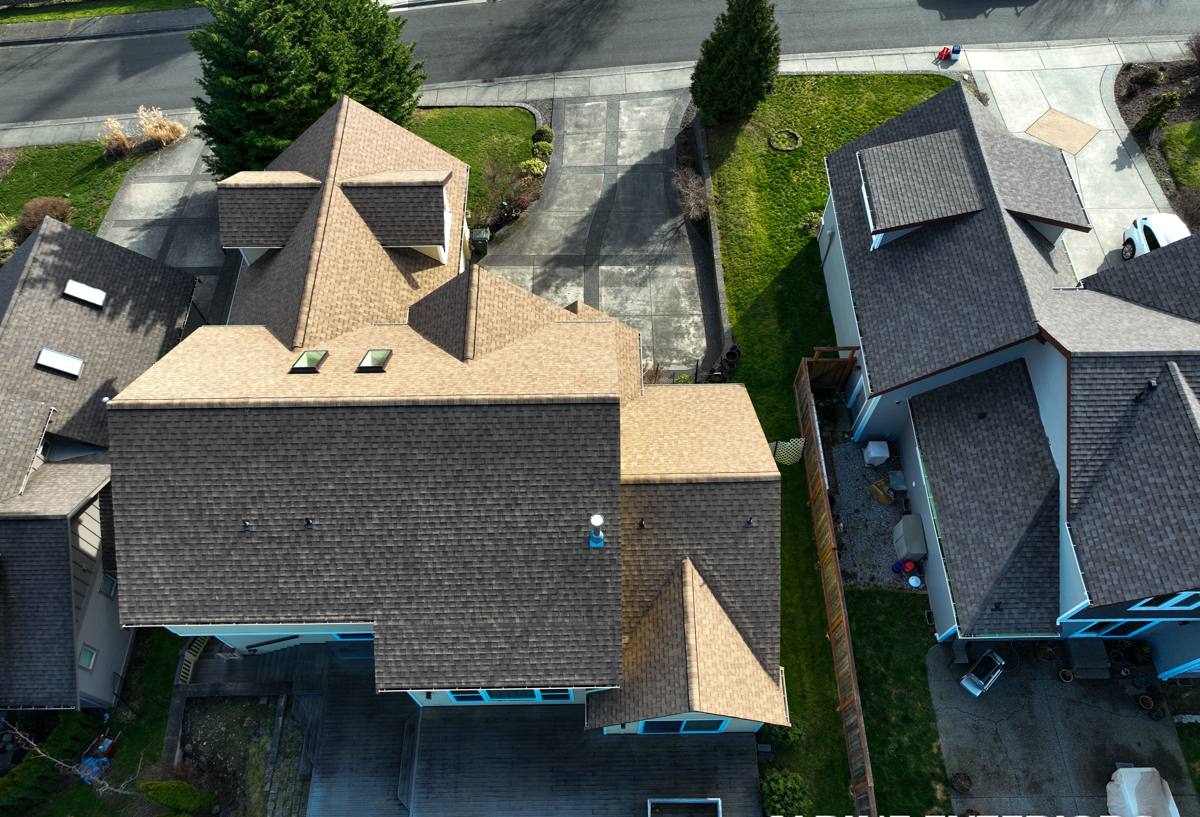
What This Climate Does to Siding That's Already Damaged
Shade Slows Everything Down
Once a panel, joint, or piece of trim is compromised — a crack, a gap, a failed seal — the question becomes how fast moisture gets in and how long it stays before the wall has a chance to dry. On a sunny, open lot, a damaged section might dry out between storms and buy some time. Under Sudden Valley's tree cover, that drying window often doesn't exist. Damage that would sit stable for a season elsewhere can turn into rot, soft substrate, or a mold issue behind the siding much faster here, simply because the wall never gets a full day of direct sun to reset.
Driving Rain Hits Different Walls Differently
Because Sudden Valley's lots vary so much in elevation and orientation relative to the lake and surrounding ridgelines, wind-driven rain doesn't load every wall of a house the same way. One elevation might take the brunt of every storm while another stays relatively sheltered. That means a repair diagnosis has to look at each wall on its own terms — a crack on the exposed side of a house is a very different repair priority than the same-looking crack on a sheltered side, even though they'd look identical from the driveway.
A Moss Season That Runs Most of the Year
Shade, humidity, and mild temperatures are exactly what moss and mildew need, and Sudden Valley's canopy keeps that combination active for a long stretch of the year. On siding, that shows up as dark staining, a slick or fuzzy surface texture, and, on porous or moisture-holding materials, actual softening underneath the growth. Cleaning the surface without addressing why that section stays wet longer than the rest of the wall usually just buys a few months before it comes back.
Repair or Replace? Making the Right Call
Not every damaged section of siding needs to come off the house, and not every damaged section should be patched and left alone. The right call depends on how far the damage goes and whether it's isolated or a sign of a wider problem.
- Localized, surface-level damage — an impact crack, a chipped corner, a single failed piece of trim — is usually a straightforward repair if the substrate behind it is still sound.
- Damage tied to a moisture source — a leaking window flashing, a clogged gutter dumping water against a wall, a grade issue holding water at the base — needs the source fixed first, or the same repair fails again.
- Soft, spongy, or delaminating material found during inspection usually means the damage extends further than what's visible, and cutting it back to sound material matters more than patching over it.
- Widespread damage across multiple elevations, especially on an older or non-fiber-cement product, is often the point where full replacement makes more financial sense than an ongoing string of repairs.
We'll tell you honestly which category your situation falls into. A repair estimate that just quotes patching everything, regardless of cause, isn't doing you any favors long-term.
Signs a Sudden Valley Home May Need Siding Repair
- Cracking, chipping, or visible holes in siding panels, especially on shaded or heavily wooded elevations
- Soft or spongy sections when pressed gently near the base of a wall or below windows
- Moss, algae, or dark staining that returns within weeks of being cleaned off
- Popped nail heads or panels that have pulled slightly away from the wall
- Peeling, bubbling, or chalking finish, particularly at butt joints and corners
- Gaps or cracked caulk at window, door, and trim transitions
- Water staining or discoloration on interior walls near an exterior corner after a heavy rain
What a Correct Repair Job Involves
Diagnosis Before Anything Gets Cut
The first step on any repair call is figuring out why the damage happened, not just what it looks like. That means checking the flashing and water management around the affected area, looking at how that specific wall is exposed to rain and shade, and confirming whether the substrate behind the visible damage is still solid. Skipping this step is how a repair ends up being redone within a year or two — the surface gets fixed, but whatever was letting water in keeps letting water in.
Matching Material and Finish
On a home already sided in James Hardie fiber cement, a proper repair means matching the existing profile, exposure, and ColorPlus finish as closely as possible, since factory-applied color ages differently than field-applied paint and a mismatched patch stands out. On homes with other siding materials, repair options are more limited by what's still available for that product line, and that's often the moment we walk homeowners through what a partial re-side or a move to fiber cement would look like instead of chasing a patch that won't blend in anyway.
Fixing the Cause, Not Just the Symptom
Every repair we do addresses the underlying issue first — resealing or replacing failed flashing, correcting a drainage path, adjusting fastening that wasn't set to spec — before the visible siding damage gets addressed. On a shaded, moisture-holding property like a typical Sudden Valley lot, that order of operations matters more than it would on a drier, sunnier site, because any moisture path left unaddressed has more time to do damage before the wall dries out again.
Repair Scenarios and What They Typically Involve
| Situation | Typical Scope | Key Consideration |
|---|---|---|
| Isolated impact damage or a cracked panel | Remove and replace the affected board(s) | Color and profile matching on older Hardie ColorPlus finishes |
| Moisture staining at a butt joint or corner | Remove siding, inspect and correct flashing/WRB behind it | Underlying moisture source must be fixed, not just the panel |
| Persistent moss or mildew on one elevation | Clean, evaluate finish condition, address shade/drainage cause | Distinguishing cosmetic staining from early substrate softening |
| Loose panels or popped fasteners | Re-fasten to correct spacing and embedment | Damp, shaded walls make correct fastening more important, not less |
| Damage spread across several elevations | Evaluate cost of repeated repairs vs. full re-side | Older or discontinued siding may not be repairable to match |
Our Siding Repair Process
We start with an on-site walk of the affected areas and pay particular attention to how shade, tree cover, and each wall's exposure to wind-driven rain off the lake may have contributed to the damage — that context changes more from one elevation to the next in Sudden Valley than it does on a typical open lot. From there, we give a clear, written scope: what's being repaired, why, what it will take to match the existing siding where possible, and what it would cost to address the underlying cause rather than just the visible symptom. If the honest answer is that a section is beyond a reasonable repair, we'll say so plainly instead of stretching a patch further than it should go. Work itself follows the same standards we hold ourselves to on full installations — correct fastening, proper flashing and drainage detailing, and a finished repair that's built to actually last in this environment, not just look fixed for a season.
Why a Crew That Already Works Sudden Valley Matters
Sudden Valley is a private community with its own internal roads and a homeowners association, and a contractor who already works here knows the practical side of that before the first estimate is scheduled — how access and timing typically work, and how much exposure can change from one lot to the next even within the same stretch of road. More importantly, a crew that's done repair work throughout this specific neighborhood has seen which walls tend to fail first, how far shaded damage typically extends past what's visible, and which repair shortcuts don't hold up under this much moisture and canopy. That experience is the difference between a patch that looks fine at handoff and one that's still doing its job three winters later.
A Few Questions Worth Asking Before Hiring for a Siding Repair
- Will they inspect for an underlying moisture or flashing issue, or just patch what's visible?
- Do they have experience matching James Hardie ColorPlus finishes on partial repairs?
- Will they give you a straight answer if a section is better replaced than repaired?
- Are they familiar with scheduling and access in HOA or private-road communities like Sudden Valley?
- Do they carry current Washington contractor licensing and active liability insurance?
Our Standard on Materials
We install James Hardie fiber cement exclusively, and that shows up in our repair work too. Where a repair on an existing Hardie home is possible, we do it to Hardie's specifications rather than improvising a fix that won't hold up in a shaded, damp environment. Where damage on a home sided in vinyl, LP SmartSide, cedar, or another material has progressed far enough that repair no longer makes sense, we'll say so honestly and talk through what moving to fiber cement would look like for that section or the whole house — not as an upsell, but because it's the material we've found actually holds up to what Sudden Valley's shade and moisture put a wall through year after year.
If you're dealing with damaged, stained, or failing siding on a Sudden Valley home, we're happy to take a look and give you an honest read on what it actually needs — a targeted repair, or something more. Reach out below for a free, no-pressure estimate.