 Bellingham Roofing
 Decks in Sudden Valley Take a Different Kind of Beating
Sudden Valley sits close to Lake Whatcom, tucked into tree cover that keeps the neighborhood shaded and humid for a good chunk of the year. That combination — lake moisture, filtered sun, and heavy tree canopy — is hard on exterior wood in ways that homes out in the open don't experience as badly. Decks here hold onto moisture longer after a storm, dry slower between rain events, and collect a steady drift of needles, leaves, and moss spores that pack into board gaps and around post bases. Add in Whatcom County's long, wet shoulder seasons and you get a moss season that can run from early fall through late spring in shaded yards.
None of that means a deck in Sudden Valley is doomed — it means it needs to be built and repaired with that environment in mind. A repair that would hold up fine on a dry, sun-exposed lot in a different part of Bellingham can fail early on a shaded Sudden Valley lot if the underlying moisture problem isn't addressed at the same time.
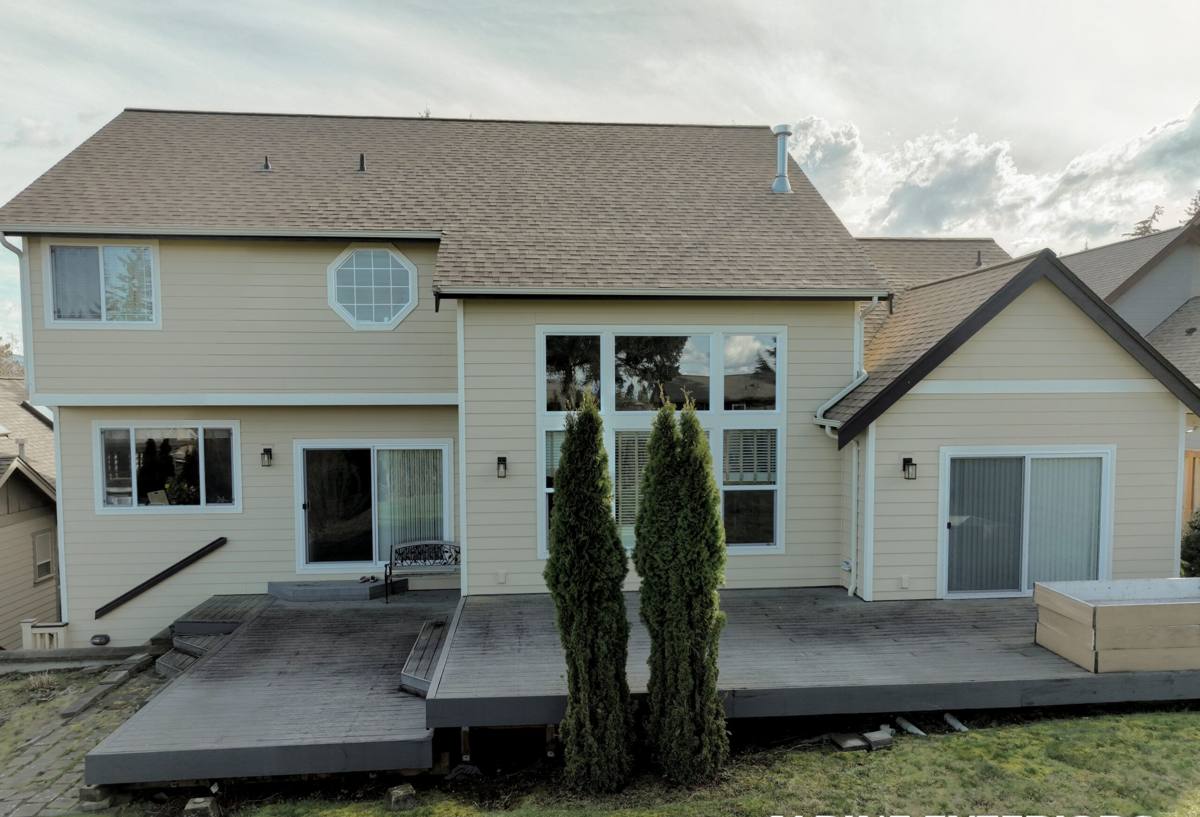
What "Deck Repair" Actually Covers
Deck repair isn't one job — it's a category that ranges from a single board swap to a near-total structural rebuild that keeps the original footprint. Knowing where your deck falls on that spectrum matters, because it changes both the cost and the urgency.
Common repair scenarios we see in this area
- Soft, spongy, or visibly cupped decking boards, usually starting in shaded corners or under planters
- Rot at ledger boards where the deck attaches to the house — often the most serious issue because it's a structural connection
- Loose, wobbly, or rotted railing posts and balusters
- Corroded or failing fasteners — old nails or the wrong-grade screws working loose or rusting through
- Stair stringers that have softened or split, especially on decks stepping down toward a yard or the lake
- Moss and algae buildup making boards slick and accelerating wood breakdown underneath
- Undersized or rotted joists discovered once decking is pulled up
The tricky part is that surface symptoms don't always tell you the full story. A few soft boards can be an isolated fix, or they can be the visible edge of rot that's traveled into the joists below. That's why a proper repair estimate starts with someone actually getting under the deck, not just walking the surface.
Why Moss and Moisture Matter More Here Than the Repair Itself
A lot of deck repair work in Western Washington fails to hold because the crew replaces the damaged wood but doesn't change the conditions that damaged it in the first place. On a shaded, lake-adjacent lot like Sudden Valley, that's a mistake we try hard not to repeat.
What we look at beyond the obvious damage
- Drainage under the deck — is water pooling against posts or footings instead of running off?
- Board spacing — gaps that have tightened over time from swelling wood trap debris and slow drying
- Ledger flashing — the metal flashing where the deck meets the house siding is one of the most common hidden failure points; if it's missing or improperly lapped, water gets behind the siding and into the ledger board
- Post base contact — posts sitting directly in standing water or buried in mulch/soil hold moisture against the wood year-round
- Sun exposure — which sections of the deck are shaded most of the day, since that dictates how often moss and algae will return
Fixing the wood without addressing these is like patching a leak without finding the source — it buys time, not a solution.
Repair vs. Rebuild: How We Make the Call
Homeowners often ask whether it's worth repairing an older deck at all. The honest answer depends on how much of the structure is compromised versus cosmetic.
| Signal | Usually Points to Repair | Usually Points to Rebuild |
|---|---|---|
| Damage location | Isolated boards, one section of railing | Rot at ledger, multiple joists, or main support posts |
| Age of structure | Under 15-20 years, built to a reasonable standard | Older structure with outdated framing or undersized footings |
| Extent of soft wood | Less than roughly 20% of decking/framing | Rot spread across most of the substructure |
| Code compliance | Railing height, baluster spacing already meet current code | Railings, stairs, or guards fall short of current safety code |
| Cost comparison | Repair cost clearly under 40-50% of a rebuild | Repair cost creeps close to rebuild cost |
We'll walk you through where your deck lands on that spectrum honestly. A straightforward repair is often the right call, and we're not in the business of recommending a rebuild when it isn't warranted.
Materials: What We Use and Why
Material choice matters more on a shaded, moisture-prone lot than it does elsewhere. A few principles guide what we recommend for Sudden Valley repairs:
Fasteners and hardware
Corrosion-resistant, code-rated fasteners matched to the decking material are non-negotiable — the wrong fastener in a damp, shaded environment can corrode and fail well before the wood around it does. This is one of the most common shortcuts in low-end deck work, and it's one we don't take.
Decking material trade-offs
Pressure-treated lumber remains a solid, cost-effective option for structural framing and is what most local decks are built on. For the walking surface, homeowners generally choose between treated wood, cedar, or composite boards. Each has trade-offs worth knowing honestly:
- Pressure-treated decking — lowest upfront cost, needs periodic sealing/staining to perform well in a wet, shaded yard, and will show wear faster if maintenance lapses
- Cedar — naturally more rot-resistant and attractive, but still requires regular finishing to hold up to the moss and moisture common here
- Composite decking — higher upfront cost, no staining required, but composite still needs proper structural framing and ventilation underneath — it doesn't rot, but a poorly built substructure under composite boards can still fail
We'll talk through which fits your deck, your budget, and how much upkeep you actually want to do — not push whichever material has the best margin.
Our Repair Process
1. On-site inspection
We get under the deck, check the ledger connection, probe suspect boards and posts with a screwdriver or awl to find soft wood that isn't obvious from the surface, and check drainage and flashing.
2. Written scope and estimate
You get a clear breakdown of what needs to be replaced, what's staying, and why — including anything we find that changes the scope, like hidden joist rot.
3. Removal and inspection of hidden framing
Once damaged boards or railing come off, we confirm the framing underneath before closing anything back up. If we find more than expected, we tell you before proceeding, not after.
4. Repair and replacement
Matching lumber or composite is installed with corrosion-resistant fasteners, proper spacing for drainage, and attention to any flashing or drainage issue we identified.
5. Final walkthrough
We check the repaired area for solid footing, secure railings, and proper board fastening before calling the job done.
What to Check Before You Call Anyone
A quick homeowner-level check can help you describe the problem accurately and get a more useful estimate:
- Press on decking boards in shaded areas and near the house — do any flex or feel spongy?
- Push against the top rail — does it move, or do posts wobble at the base?
- Look at the ledger board where the deck meets the house — any dark staining, gaps, or visible rot?
- Check stair stringers for splitting or soft spots, especially near ground contact
- Note which areas of the deck stay damp or mossy longest after rain
None of this replaces a proper inspection, but it helps us prioritize what to look at first.
Why Local Experience in Sudden Valley Actually Matters
Deck repair advice that works for a dry, open lot doesn't always transfer to a shaded, lake-adjacent property. A crew that regularly works Sudden Valley and the broader Whatcom County area already knows which framing details tend to fail first in this environment, how long moss season really runs here, and what drainage and flashing details hold up against consistent Pacific Northwest rain rather than just looking right on installation day. That local pattern recognition is the difference between a repair that lasts one season and one that lasts fifteen.
If you're dealing with soft boards, a wobbly railing, or you're just not sure whether your deck needs a small fix or something bigger, we're happy to take a look. Reach out for a free, no-pressure estimate using the form below — we'll give you a straight answer about what your deck actually needs.