 Bellingham Roofing
 Siding Replacement in Blaine: Why the Climate Raises the Stakes
Blaine sits at the northern tip of Whatcom County, close enough to Semiahmoo Bay and Drayton Harbor that salt air reaches most homes in town, not just the ones facing the water. Add in driving rain that comes ashore with real force off the Strait, plus a moss season that runs nearly year-round on shaded surfaces, and you get a climate that's genuinely tough on exterior cladding. When siding starts to fail here, it usually fails faster and less forgivingly than it would in a drier, more sheltered part of the state.
That's the backdrop for every siding replacement conversation we have in Blaine. We're a Whatcom County crew that works this town regularly, and we install James Hardie fiber cement siding exclusively — a professional standard we hold to because of what we've seen come off Blaine houses during tear-off, not because of a supplier arrangement.
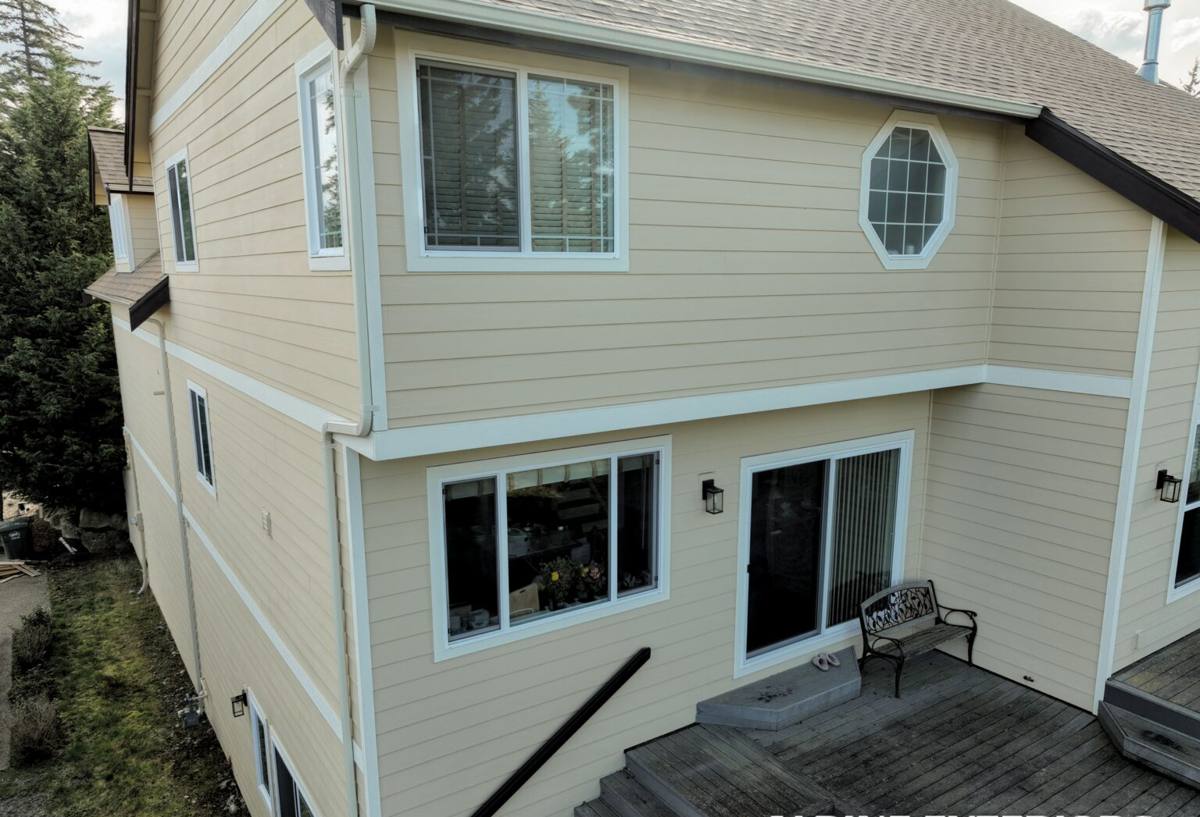
Signs a Blaine Home's Siding Has Reached the End of Its Service Life
Not every siding problem means a full replacement. Localized caulk failure or a cracked board here and there can often be repaired. But there's a point where patching stops being cost-effective and starts masking a bigger moisture problem underneath. In a coastal town like Blaine, that point tends to arrive sooner than homeowners expect.
- Soft or spongy siding when you press on it, especially near the bottom courses or under windows
- Moss or dark staining that returns within a few months of cleaning
- Paint that's peeling, bubbling, or chalking off faster than a normal repaint cycle would explain
- Visible warping, cupping, or separation at seams and trim joints
- Rust streaking around fasteners or trim, more common this close to the water
- A musty smell or noticeable draft near exterior walls, which can point to moisture already behind the siding
- Rising heating bills that track with drafty exterior walls rather than an aging furnace
Repair or Replace? What We Actually Look For
The honest answer depends on what's happening behind the siding, not just what's visible on the surface. When we inspect a Blaine home, we're checking whether moisture problems are isolated to a wall section or a handful of boards, or whether they're systemic — the result of an installation that never had proper flashing, clearance, or a way for water to drain once it got past the surface. Isolated damage can often be repaired. Systemic moisture intrusion almost always means the smarter long-term move is a full replacement, because patching over a wall assembly that's already compromised just buys a few more years before the same problem resurfaces, usually worse.
What Happens During a Correct Siding Replacement
Tear-Off and Inspecting What's Underneath
Old siding comes off entirely before anything new goes up. That's the point where we find out what's actually been happening behind the wall — whether the sheathing is sound, whether previous flashing was doing its job, and whether moisture has already reached the framing. Any water-damaged sheathing or framing gets repaired before the project moves forward. Covering over compromised substrate is one of the more common shortcuts in low-bid siding work, and it's the reason "new" siding sometimes fails within a handful of years regardless of the product installed over it.
Rebuilding the Water Management Layer
A siding system is only as good as what's behind it. We install a properly lapped weather-resistive barrier and a rain screen gap — a small drainage cavity that lets any moisture that does get past the outer surface drain and evaporate instead of sitting against the wall. In a town that takes as much wind-driven rain as Blaine does, that drainage plane is one of the details that determines whether a wall stays dry over the long run or slowly accumulates damage no one notices until it's extensive.
Installing to James Hardie's Spec
Hardie siding is engineered around specific fastener types and spacing, clearances above grade and rooflines, and flashing details at every window, door, and penetration. The product itself is built to handle Pacific Northwest moisture; installation shortcuts are what actually cause the early failures we get called out to fix on other companies' work. We follow the manufacturer's spec because it's the difference between siding that performs for decades and siding that just looks good on install day.
Final Walkthrough
We walk the finished job with the homeowner, checking seams, trim lines, and caulking, and go over basic long-term care — mainly what a normal maintenance rinse looks like and what early moss regrowth on a fiber cement exterior should and shouldn't concern you.
Why Every Replacement Goes On With James Hardie Fiber Cement
We used to install a broader range of siding products. We stopped, and the decision came from tear-offs and service calls, not a sales strategy.
- Non-combustible core: Fiber cement doesn't feed a fire the way wood-based siding products can, which matters for both safety and insurance considerations.
- Factory-applied ColorPlus finish: Color is baked on under controlled conditions rather than brushed on in the field, so it holds up longer against fading, chalking, and constant moisture exposure.
- Climate-engineered HZ5 line: Built for regions with sustained moisture and freeze-thaw cycling, which describes coastal Whatcom County accurately.
- Dimensional stability: Fiber cement doesn't swell, cup, or warp the way engineered wood products can after repeated wet exposure.
- Strong transferable warranty: One of the stronger warranty structures in the industry, provided the installation follows Hardie's spec.
We don't install LP SmartSide, vinyl siding, Cemplank, Allura, primed spruce, or cedar. Each has legitimate uses and homeowners who are satisfied with them, and none of them are junk products. But for a full replacement in a town where salt air and driving rain are near-constant, we'd rather install the one system we fully stand behind than offer a cheaper option that quietly shifts maintenance risk back onto the homeowner a few years down the road.
Tear-Off vs. Overlay: Why We Default to Full Tear-Off in Blaine
Overlaying new siding directly over old siding is sometimes pitched as a faster, cheaper option, and in a dry, low-moisture climate it can occasionally make sense on a sound existing wall. In Blaine, we very rarely recommend it.
| Approach | What It Involves | Why It Matters in Blaine |
|---|---|---|
| Full Tear-Off | Old siding removed, sheathing inspected and repaired, new WRB and rain screen installed before new siding goes on | Only way to confirm and fix hidden moisture damage before it's sealed behind a new wall for another 30 years |
| Overlay | New siding installed directly over existing siding, with minimal access to the wall assembly underneath | Traps any existing moisture problem behind two layers instead of one, and adds bulk that complicates window and trim flashing |
Given how much wind-driven rain and salt exposure Blaine homes take on, installing over an unknown wall condition is a real risk we're not willing to ask homeowners to accept. A full tear-off costs more upfront, but it's the only approach that lets us actually verify what's behind the old siding instead of guessing.
Cost Factors for a Blaine Siding Replacement
| Factor | What Drives It | Blaine-Specific Consideration |
|---|---|---|
| Home size and shape | Square footage, number of stories, dormers and gables | More complex rooflines mean more flashing details to get right against driving rain |
| Substrate condition | Whether sheathing or framing needs repair after tear-off | Homes closer to the water more often have hidden moisture damage from years of salt exposure |
| Trim and detail work | Corner boards, window trim, custom details | More seams and joints that need to be sealed correctly against sideways-driven rain |
| Site access | Driveway space, tree cover, staging room | Waterfront and older in-town lots vary widely in how much room a crew has to work |
| Bundled work | Whether roofing, window, or deck work happens in the same project window | Addressing flashing at rooflines and windows alongside siding avoids re-opening finished work later |
These are general drivers, not a quote. Two houses on the same street in Blaine can need very different scopes once old siding actually comes off, which is why we walk the property and inspect in person before putting a real number on the work.
Timing a Replacement Around Blaine's Weather
Whatcom County's wettest, windiest stretch typically runs from late fall through winter, and Blaine's exposed coastal position makes that stretch harder on both the house and the install crew than it is further inland. Spring and summer generally offer the driest, most stable conditions for a siding replacement, since fiber cement, house wrap, and any substrate repairs all perform better when they can be installed and allowed to set up between storms rather than during one. That said, a home showing active signs of water intrusion shouldn't wait for the ideal season just to hit a calendar preference — ongoing moisture damage tends to get more expensive to fix the longer it sits.
Why Hiring a Crew That Already Works Blaine Matters for a Replacement Job
A siding replacement is a one-time investment that's supposed to last decades, which makes the installer's local experience more relevant than it might seem on paper. A crew that works Blaine regularly has seen how differently a wall facing the harbor ages compared to one set back from the water, which walls stay damp longest through the winter, and which flashing and fastener choices actually hold up here instead of just meeting a generic code minimum. That kind of pattern recognition doesn't come from a spec sheet — it comes from tearing off Blaine siding and seeing what failed and why.
It also means accountability after the trucks leave. A local company with a reputation in the county is easy to find if something needs a second look, which matters a lot more on a job that's supposed to hold up for 30 years than on a smaller repair.
Get a Free, No-Pressure Estimate
If your Blaine home's siding is showing its age, or you'd rather plan ahead than wait for a small problem to become an expensive one, we're glad to take a look and give you a straightforward assessment. Use the form below to schedule a free, no-pressure estimate — no upsell script, just an honest read on what your exterior actually needs.