 Bellingham Roofing
 Building a Deck That Actually Holds Up in Sehome
Sehome sits close enough to Bellingham Bay that salt air is a real factor in how a deck ages, and far enough into the seasonal rain pattern of Whatcom County that moisture management matters just as much. A deck built here doesn't fail because the design was wrong. It fails because the details underneath the decking boards — the flashing, the fasteners, the drainage path, the footings — were built for a drier, calmer climate than the one Sehome actually gets. We build decks for this neighborhood specifically, not a generic deck plan pulled from a catalog, and the difference shows up in year eight and year fifteen, not in the first summer.
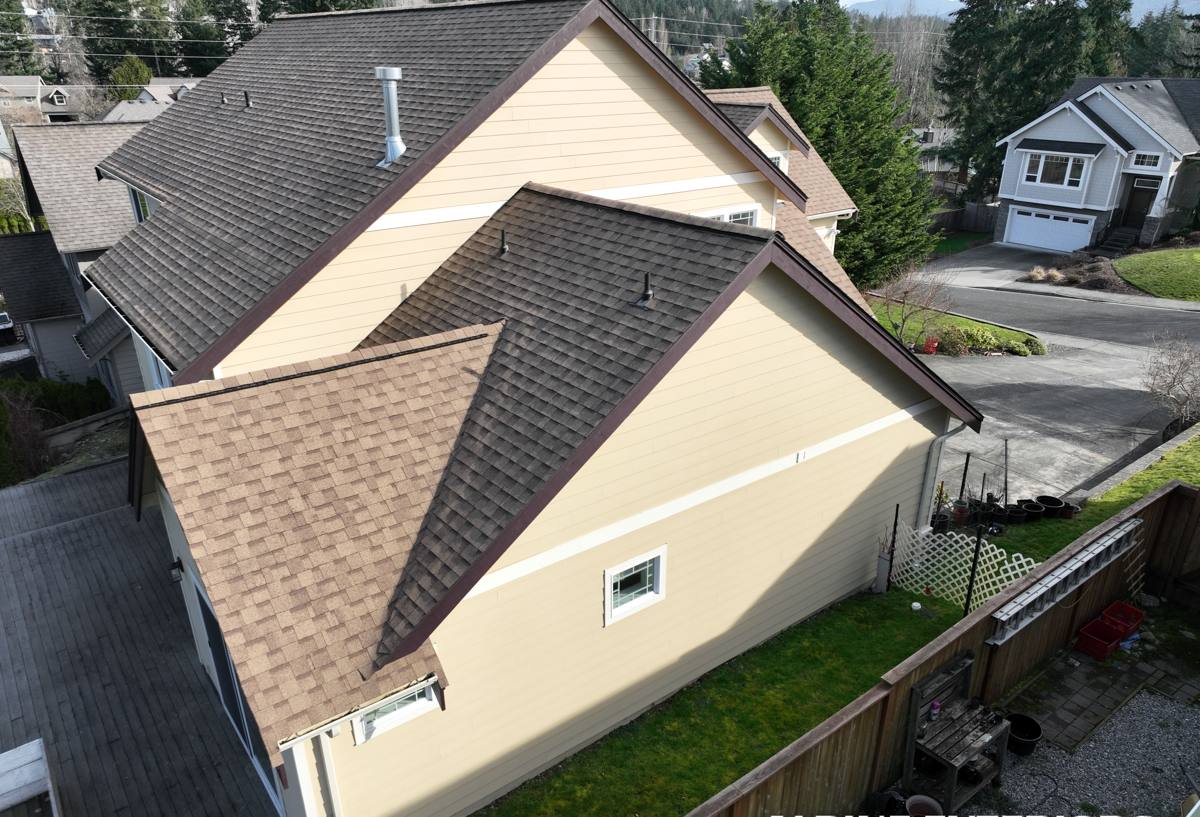
What Bellingham's Climate Actually Does to a Deck
Three things wear on a deck here more than in most parts of the country, and they compound each other over a Whatcom County winter and spring.
Salt Air and Corrosion
Proximity to the bay means airborne salt settles on metal hardware, fastener heads, and structural connectors. Standard zinc-coated fasteners that would last decades inland can start corroding at the surface within a few years this close to the water. Corrosion doesn't always show — it often starts at the fastener head or inside a joist hanger where you can't see it until the connection is already weaker than it should be.
Driving Rain
Rain here doesn't just fall straight down. Wind-driven rain gets pushed sideways into ledger boards, under railings, and into any gap where flashing was skipped or done poorly. A deck attached to the house needs a ledger connection that's actively shedding water away from the wall, not just a board bolted on and caulked.
Moss Season
Whatcom County's long wet season, roughly fall through spring, gives moss and algae months of shaded, damp conditions to establish themselves on horizontal wood and composite surfaces. Moss holds moisture against the decking material, and on wood it accelerates rot; on any material it turns a walking surface into a slip hazard, especially on stairs.
What a Correctly Built Deck Requires Here
A deck that's going to hold up in Sehome's conditions needs a handful of details done right, none of which are visible once the project is finished:
- A ledger board flashed with a proper water-diverting flashing detail, not just caulk and lag bolts
- Joist tape or an equivalent moisture barrier on top of every joist, so standing water can't sit against the wood grain
- Stainless steel or coated fasteners rated for the corrosion exposure this close to the bay, not generic exterior-grade screws
- Footings set to the correct frost and bearing depth for the soil on the lot, with drainage so water doesn't pool against the post base
- A consistent drainage slope across the decking surface, away from the house
- Board spacing that allows airflow and drying between rain events, especially on lower decks with less sun exposure
Skip any one of these and the deck will probably still look fine for the first few seasons. The problems show up underneath, where nobody's looking, until a board feels soft or a railing post has more give than it should.
Choosing a Decking Material for This Climate
There's no single right answer for every Sehome property — it depends on budget, how much upkeep the homeowner wants to take on, and how exposed the deck is to sun and rain. Here's how the common options actually perform in this specific climate, not in general.
| Material | Moss/Algae Resistance | Maintenance Needed | Typical Lifespan Here |
|---|---|---|---|
| Pressure-treated wood | Low — needs regular cleaning and sealing | Annual cleaning, re-staining every 2-3 years | 15-20 years with upkeep |
| Cedar | Moderate — natural oils help but fade over time | Cleaning and oil/sealer every 1-2 years | 15-25 years with upkeep |
| Capped composite | Higher — cap layer resists staining and moss growth | Periodic washing, no sealing or staining | 25-30+ years |
| PVC decking | Highest — fully synthetic, sheds moisture at the surface | Occasional washing only | 25-30+ years |
Composite and PVC cost more up front, but in a moss-prone, wet climate they cut down dramatically on the recurring cleaning and re-sealing that wood decking demands. Wood is still a legitimate choice for homeowners who want that look and don't mind the maintenance schedule — it just needs to be honestly priced into the decision, not glossed over.
Why We're Selective About Certain Products
Some lower-grade composite boards on the market use a cap layer that's thinner or less consistent, and in a climate with this much sustained moisture exposure, that shows up as swelling at cut edges or fastener points years before it should. Our standard is to use decking products with a full wrap cap and a manufacturer warranty structure that actually accounts for moisture exposure, not just UV fading. That's a professional judgment call on our part, not a claim about any specific brand failing — it's about matching the product to what this climate actually demands.
The Substructure: Where Decks Actually Fail
Almost every deck problem we get called out to look at in this area traces back to the framing, not the decking boards on top. Joist hangers without corrosion-resistant coatings. Ledger boards without flashing. Posts set on footings that were too shallow for the soil, or without a way for water to drain away from the base. None of it is visible from a walk-through, and none of it shows up on a listing photo. It's also the part that's genuinely difficult to retrofit once the decking is installed, which is why getting it right the first time matters more here than in a drier climate where a builder can get away with shortcuts for longer.
Permits and Code Considerations
Most deck projects attached to a house, or built above a certain height, require a permit through the local jurisdiction, along with guardrail height and spacing requirements once the deck surface is a certain distance above grade. Setback requirements can also come into play depending on the lot and its proximity to property lines. We handle the permit process as part of the build rather than leaving it to the homeowner to sort out, and we design to the guardrail and stair code requirements from the start rather than treating them as an afterthought.
How We Approach a Sehome Deck Project
1. Site Visit and Assessment
We look at sun exposure, drainage patterns on the lot, existing structure if it's a rebuild, and how the deck will attach to the house. This is where we catch site-specific issues before they become design problems.
2. Design and Material Selection
We walk through the material tradeoffs honestly — what a wood deck will cost to maintain over ten years versus what composite costs up front — so the decision is based on real numbers, not a sales pitch.
3. Permitting
We handle the permit submission and inspection scheduling so the project meets code without the homeowner having to manage that process.
4. Framing and Structural Work
This is where the flashing, fastener grade, joist protection, and footing depth all get done to the standard this climate requires, before a single decking board goes down.
5. Decking, Railing, and Finish Work
Board spacing, fastening pattern, and railing installation are finished to spec, with attention to drainage slope and airflow underneath.
6. Final Walkthrough
We go over the finished deck with the homeowner, including what maintenance (if any) the chosen material will need going forward.
Why It Matters That We Work Sehome Regularly
A crew that builds decks across a wide, generic service area treats every job like it's starting from zero on climate exposure. A crew that regularly works this neighborhood already knows how close a given lot sits to the bay, how much shade a typical yard gets during moss season, and which older Sehome homes have ledger connections or framing quirks worth double-checking before a new deck ties into them. That local familiarity doesn't replace good building practice, but it does mean fewer surprises during the site visit and a design that's already accounting for conditions specific to this part of Bellingham rather than Whatcom County in general.
Questions Worth Asking Before You Hire
- Does the quote specify fastener and hardware grade, or just say "exterior-grade" without detail?
- Is ledger flashing called out explicitly, or assumed to be included?
- What footing depth is being used, and is it based on the actual soil on your lot?
- Is joist protection tape included on top of the framing, or only on the ledger?
- Does the contractor handle the permit application, or is that left to you?
- What does the material warranty actually cover — structural issues, or just surface fading?
If you're planning a new deck or replacing an aging one in Sehome, we're happy to walk the site, talk through material options honestly, and put together a straightforward estimate — no pressure, no upsell. Use the form below to get started.