 Bellingham Roofing
 Siding Replacement for Lynden Homes
There's a real difference between patching a few damaged boards and taking a Lynden home down to the sheathing for a full siding replacement. A lot of homeowners land on this page after a repair estimate turned into a longer conversation — the contractor pulled a section of siding, found soft sheathing or trapped moisture behind it, and the small job stopped being small. That's a common enough pattern in this part of Whatcom County that it's worth planning for rather than being surprised by.
Lynden's setting is a little different from the coastal towns closer to Bellingham Bay — more open farmland, more sun exposure on some lots, more tree cover and shade on others — but it still sits inside the same weather system that defines exterior work across the county: salt-laden marine air moving in off the water, rain that comes in sideways more often than straight down, and a moss season that can run most of the year on shaded or north-facing walls. A full siding replacement is the point where all of that gets addressed properly, instead of managed around, because the wall is open and everything behind the old siding is finally visible.
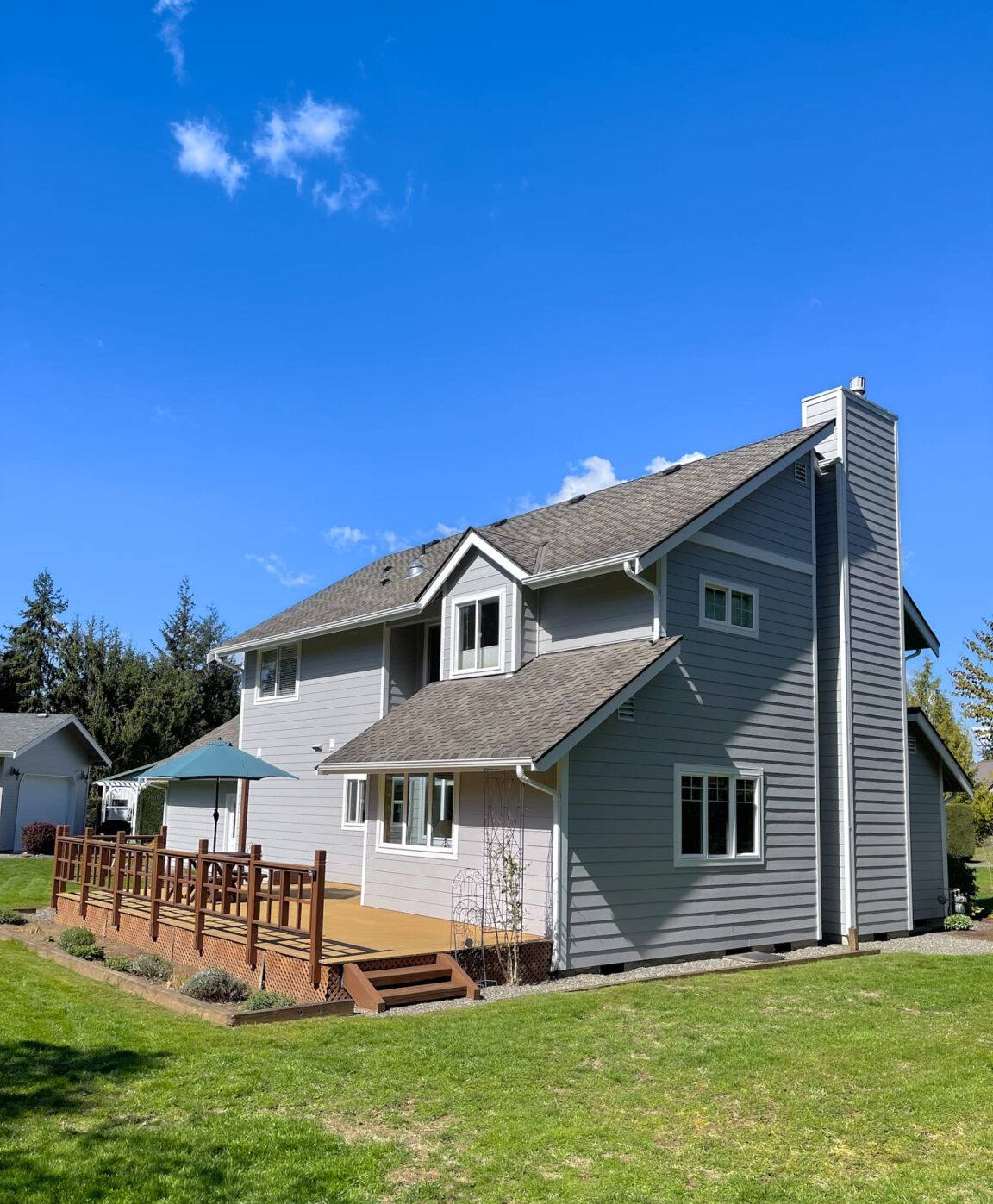
What Pushes a Lynden Home From Repair to Full Replacement
Siding doesn't usually fail all at once. It fails in a pattern — one wall exposed to weather worse than the others, one area around a window or roofline where water has been getting behind the cladding for years. The question a homeowner has to answer isn't just "does this look bad," it's "how much of the wall behind this siding has already been affected."
Localized Damage
If the damage is contained to one or two areas, isolated cracking, a section that took storm damage, and the sheathing underneath tests solid, a repair or partial recover can make sense. That's a smaller, faster project.
Widespread or Structural Damage
If moisture has been getting behind the siding broadly, or the siding is old enough that its useful life is genuinely over rather than cosmetically tired, patching individual spots just delays a bigger problem and adds labor cost that doesn't carry forward into the new job. At that point, full replacement is the more honest recommendation, even though it's the larger number.
Repair, Recover, or Full Tear-Off: Making the Right Call
| Approach | When it fits | What it doesn't fix |
|---|---|---|
| Spot repair | Isolated damage, sound sheathing, siding otherwise in good shape | Doesn't address moisture already behind other walls, if present |
| Recover over existing siding | Old siding is flat and structurally attached but cosmetically dated, sheathing confirmed dry | Locks in whatever condition the wall assembly is already in — a bad bet if there's any uncertainty about hidden moisture |
| Full tear-off and replacement | Siding is at or past its useful life, moisture damage is present or suspected, or a homeowner wants certainty about what's behind the wall | Larger project, but nothing left unverified |
We won't recommend a recover over a wall we haven't confirmed is dry. Covering a moisture problem instead of finding it is how a manageable repair turns into a rot problem discovered five years later, at a much higher cost to fix.
What a Correct Full Replacement Actually Involves
Tear-Off
Old siding, trim, and any failed house wrap come off down to the sheathing. This is also the point where a lot of hidden problems get found — soft plywood or OSB, rusted fasteners, gaps in the original flashing work. It's better to find these now than to cover them again.
Sheathing Repair
Any damaged sheathing gets cut out and replaced before anything new goes up. This step gets skipped by contractors trying to hold a low bid, and it's the single most common reason a "new" siding job fails early — the siding itself was fine, but it was fastened to compromised wood underneath.
Weather-Resistive Barrier
A new house wrap goes on as the primary drainage plane behind the siding. Given how much wind-driven rain this region gets, the lap sequencing and taping on this layer matters as much as the visible siding above it — it's the layer doing the real work of keeping water out of the wall assembly.
Flashing at Every Penetration
Windows, doors, roof-to-wall transitions, and any vents or fixtures through the wall get flashed correctly before siding covers them. Most siding failures traced back to a specific point trace back to a flashing detail that was rushed or skipped, not to the siding material itself.
Installation to Manufacturer Spec
James Hardie's warranty is conditioned on installation following their published specifications — fastener type, spacing, clearance above grade and roofline, joint treatment, and correct field cutting. We install to that standard as the baseline on every job, not as an upgrade.
Trim, Caulking, and Paint
Trim boards, corner details, and caulking get finished to match the home's design, and factory-primed cut edges get sealed per spec before the final coat, where the product line calls for it.
Final Walkthrough
We walk the completed job with the homeowner, confirm it matches what was scoped and estimated, and go over basic care so the new siding holds up as long as it's built to.
Why We Rebuild With James Hardie Fiber Cement
When a wall is already open for a full replacement, it's worth using the project to upgrade the material, not just replace it in kind. We install James Hardie fiber cement exclusively — not LP SmartSide, not vinyl, not Cemplank, not Allura, not primed spruce or cedar. That's a standard we've settled on for this climate specifically, not a general sales position.
- Non-combustible core: A meaningful safety and insurance factor that wood-based and vinyl products can't match.
- Factory-applied ColorPlus finish: Baked on under controlled conditions, holding color and adhesion far longer than a field-applied coat under sustained moisture and UV.
- HZ5 formulation: Engineered for regions with significant moisture exposure and freeze-thaw cycling, which fits Lynden's weather pattern closely.
- Dimensional stability: Doesn't swell, cup, or warp through repeated wet-season cycles the way engineered wood can.
- A strong transferable warranty: Backed by Hardie when the installation follows their spec — which is exactly why the installation details above aren't optional steps.
Each of the products we don't install has a place in the market and plenty of satisfied owners elsewhere. Our decision is a professional one: on a full replacement, we'd rather put on a system we can stand behind completely than offer a cheaper option that quietly shifts maintenance risk back onto the homeowner a few years out.
Planning the Project: Timeline, Debris, and Permitting
A full siding replacement on an average single-family home typically runs from under a week to a couple of weeks depending on square footage, trim complexity, and how much sheathing repair turns up once the old siding comes off. A few practical points worth planning around:
- A dumpster or debris trailer is on site for the duration of tear-off — worth planning driveway and yard access around it ahead of time.
- Walls are open to the weather during tear-off and sheathing work, so timing matters. We plan around Whatcom County's wetter stretches where possible and move quickly once a wall section is open.
- Most jurisdictions in the county require a permit for full siding replacement. We pull it as part of the project so it isn't left to the homeowner to navigate.
- Landscaping and anything close to the foundation may need temporary clearance for tear-off and material staging.
Signs a Lynden Home Is Due for Full Replacement, Not a Patch
- Soft or spongy siding in more than one area of the house, not just one isolated spot
- Moss or staining that returns quickly after cleaning across multiple walls
- Visible warping, cupping, or delamination on older wood-based or engineered wood siding
- Musty odors or interior staining on walls that back up to exterior siding, suggesting moisture has already reached the sheathing
- Siding original to a home built more than 20-25 years ago with no documented replacement
- Multiple past repairs that haven't held, a sign the underlying wall assembly needs attention, not another patch
What Drives Cost on a Full Replacement
| Factor | Why it matters |
|---|---|
| Total square footage and number of stories | Larger, taller homes need more material, labor, and equipment for access |
| Sheathing condition once old siding is off | Rot or soft spots found during tear-off require repair before new siding goes up |
| Amount of trim and detail work | Windows, corners, and rooflines with heavier trim take more time than plain wall runs |
| Product line and profile selected | James Hardie offers multiple lines and plank widths at different price points |
| Site access | Tight lots, landscaping, or limited driveway access can add setup time |
We walk through these specifically during the estimate, based on what we actually see at the house, rather than handing over a flat per-square-foot number with no explanation behind it.
Why Hire a Crew That Already Works in Lynden
Full replacement is exactly the kind of project where local experience shows up in the details — knowing which wall orientations on a Lynden property tend to hold moisture longest, how open farmland exposure changes wind-driven rain loading compared to a tree-sheltered lot, and which flashing details are worth extra time given what this specific climate does to a wall over years. We're based nearby in Custer, working Whatcom County job sites through every season, not flying in for a single bid. That also means if a warranty question or maintenance issue comes up years down the line, it's a call to a crew that's still working in the same area.
If your Lynden home's siding has reached the point where a patch isn't enough, we're glad to take a real look and walk you through what full replacement would involve — no pressure, no obligation. Reach out using the form below to get started.