 Bellingham Roofing
 Siding Repair in Lynden: Small Damage, Big Consequences in This Climate
A cracked panel, a soft spot near a window sill, a section of trim that's pulled away from the wall — none of that looks urgent from the driveway. In Lynden's climate, it rarely stays small for long. Whatcom County's marine air, wind-driven rain, and a moss season that can run most of the year all go to work on exposed wood, fasteners, and open seams the moment a siding system's outer defense is broken. We're based in Bellingham and work this end of the county regularly, and most of our repair calls in Lynden start the same way: a homeowner noticed something minor months ago, and it's grown into something that needs more than a caulk gun and a Saturday afternoon.
This page is specifically about siding repair, not a full re-side and not a general overview of exterior work, because repair is its own job with its own decisions: what actually failed, whether the damage is cosmetic or structural, and whether a patch will hold or just delay the real fix. We install and repair James Hardie fiber cement exclusively, and that standard shapes how we approach a repair call as much as it shapes a new installation.
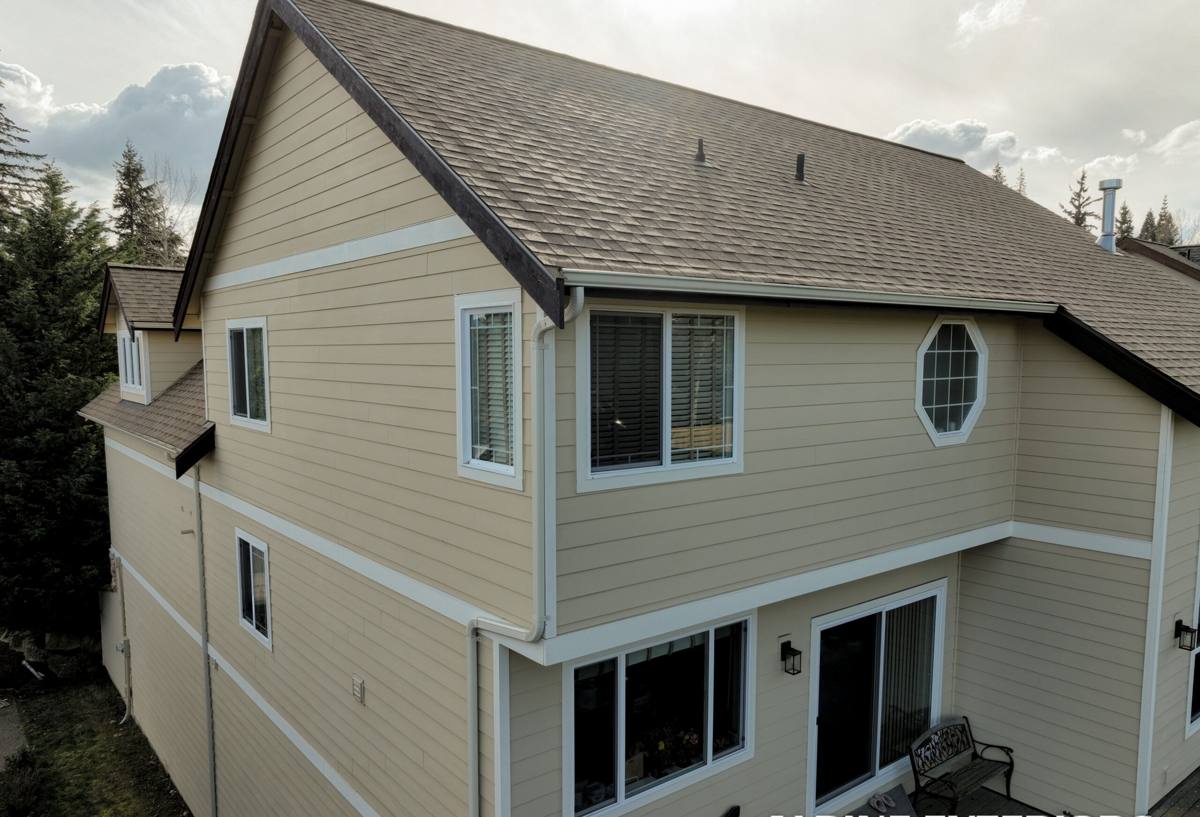
What Whatcom County's Climate Does to Siding Over Time
Salt Air and Corrosion
Lynden sits inland from the immediate coastline, but marine air off the Salish Sea still reaches this far into the county. Over years, that salt-tinged air works on fasteners, flashing, and trim hardware, especially anything already compromised by a nick, a missed spot of finish, or a gap where water sits instead of draining away. A repair that reuses corroded fasteners or unprotected metal trim tends to fail again within a few seasons, even if the visible siding damage got fixed correctly.
Wind-Driven, Sideways Rain
Rain through the fall and winter rarely falls straight down here — wind pushes it sideways into lap joints, trim seams, and any gap in the siding's outer surface. That's why a small crack or a popped nail doesn't just sit there looking bad; it becomes an entry point that lets water track behind the cladding every time it storms, long before the damage is visible from the street.
A Moss Season That Barely Breaks
Mild temperatures and consistent moisture keep moss and mildew active across most of the calendar year on shaded and north-facing walls. Once a section of siding is damaged or a seam has opened up, that's exactly where moss and organic growth tend to take hold first, holding moisture against the substrate and accelerating whatever damage already started.
Common Repair Calls — and the Warning Signs Before Them
Most of the siding repair work we do in Lynden falls into a handful of recurring categories:
- Impact damage — cracked or dislodged panels from storms, falling branches, or equipment contact
- Trim and corner rot — deterioration where trim boards meet siding, usually where caulking has failed
- Failed sealant joints — cracked or shrunken caulking at seams, window edges, and penetrations that's let water start tracking behind the wall
- Fastener and hardware corrosion — rust streaking below nails or trim hardware, a sign fasteners are breaking down
- Moisture-compromised sections — soft, spongy, or discolored siding where water has been getting behind the panel for a while
- Pest and woodpecker damage — most common on wood-based or engineered wood siding, less so on fiber cement
The visible symptom and the actual cause aren't always the same thing. A cracked panel might be purely cosmetic, or it might be the one visible sign of a wall assembly that's been taking on water for a year. Catching that difference early is most of what a proper repair diagnosis is for — waiting until the damage is obvious from the driveway usually just means the fix has gotten bigger while nobody was looking closely.
Repair or Replace? How We Make That Call
Not every siding problem calls for a full re-side, and not every repair is actually worth doing instead of replacement. We walk through a few consistent factors before recommending either path:
| Factor | Often Points to Repair | Often Points to Replacement |
|---|---|---|
| Extent of damage | Isolated to one or two sections or wall areas | Spread across multiple walls or elevations |
| Underlying moisture | Surface-level, sheathing tests dry | Sheathing or framing shows sustained water damage |
| Age of existing siding | Under 15-20 years, otherwise sound | Near or past its expected service life |
| Material match | Existing product can be reasonably matched | Discontinued product with no close match available |
| Root cause | Isolated event, like an impact or one failed seam | Systemic issue, like failed house wrap or chronic flashing gaps |
We'll tell you plainly which category a given repair call falls into. A patch that's only going to buy a year or two before the same section fails again isn't a favor to a homeowner, even if it's the cheaper option today.
What a Correct Siding Repair Actually Involves
Diagnosing the Real Cause, Not Just the Symptom
Before anything gets cut or replaced, we check what's behind the visible damage — whether the sheathing underneath is dry and sound, whether the house wrap and flashing at that section are still doing their job, and whether the damage is isolated or a sign of a wider problem. Replacing a cracked board without checking what's behind it just hides the same question for another season.
Matching Board Profile, Texture, and Color
James Hardie siding comes in specific plank widths, textures, and ColorPlus finishes, and matching a repair into existing siding means getting all three right, not just the general product line. Boards that have weathered on a wall for several years will have faded slightly from UV and salt exposure, so even a correctly matched new board can look subtly different until it weathers in. We're upfront with homeowners about that reality rather than promising an invisible patch that isn't always possible, especially on a highly visible wall.
Flashing, House Wrap, and Sealant Detail
Most repair failures we see trace back to this step being skipped, not to the siding material itself. Any repair that involves removing and replacing a section needs the house wrap and flashing underneath restored correctly, and any sealant used needs to be a product and application method actually rated for the joint it's protecting. This is the part of a repair that's invisible once the job is done, and it's the part most likely to determine whether the fix lasts five years or fifteen.
Fastening and Finish Work
James Hardie's warranty and long-term performance depend on installation specs that apply just as much to a repair as to a full install — correct fastener type and spacing, proper clearance from grade, rooflines, and other transitions, and joints lapped and sealed the way the manufacturer specifies. A repair that skips these details to save time on a small job tends to become the next repair call in a few years, on the same section of wall.
Why We Only Repair (and Install) James Hardie Fiber Cement
We install James Hardie fiber cement exclusively, and that standard carries into repair work too. We don't stock or install LP SmartSide, vinyl siding, Cemplank, Allura, primed spruce, or cedar, which means a repair on a Hardie wall benefits from the same product depth we bring to a full installation — consistent profiles, a factory-matched ColorPlus finish system, and fastening and clearance specs we already work to every day on jobs across the county.
If your home has one of those other products and needs a repair, we'll still take a look and give you an honest read on the situation. But our depth of product knowledge, and our ability to source a close match quickly, is strongest on Hardie. On a non-Hardie wall with damage significant enough to need real repair work, we'll tell you plainly if the scope has grown to a point where a broader conversation about replacement, and what to replace it with, makes more sense than another patch on a product we don't otherwise install.
Our Siding Repair Process for Lynden Homes
- Inspection and diagnosis: We look at the damaged area and check the substrate, house wrap, and flashing behind it, not just the surface.
- Honest scope and estimate: We explain what actually needs to happen, including whether we think replacement makes more sense than repair, before any work starts.
- Material sourcing and match: We order the correct Hardie profile, texture, and closest available ColorPlus match for the repair.
- Repair execution: Damaged material comes out, the substrate and moisture barrier get restored properly, and the new section goes in to Hardie's fastening and clearance specs.
- Final walkthrough: We check the finished repair with you and cover what to expect as the new section weathers in against the existing siding.
What Drives Siding Repair Cost in Lynden
| Factor | What It Affects |
|---|---|
| Extent of damage | Material and labor for the repair itself |
| Substrate condition | Whether sheathing or framing repair is needed before new siding goes back on |
| Accessibility | Ladder work, staging, or lift needs on multi-story or steep-lot homes |
| Material availability | Whether the existing color and profile are still in current production |
| Root cause work | Flashing, house wrap, or sealant repair beyond the visible siding damage |
We walk the specific area before quoting, since two repairs that look similar from the ground can involve very different amounts of hidden damage once the old siding comes off.
Signs a Lynden Home Needs a Repair Call Now
- A cracked, chipped, or dislodged panel after a storm or wind event
- Soft or spongy siding, particularly low on the wall or around window and door trim
- Caulking or sealant that's visibly cracked, shrunken, or missing at seams and edges
- Rust staining running down from a fastener or piece of trim hardware
- Moss or dark staining that returns quickly after cleaning on a shaded wall
- A musty smell or staining on an interior wall that backs up to exterior siding
None of these automatically mean extensive damage, but each is worth a professional look before the next wet season adds to whatever is already happening behind the wall.
Why a Bellingham Crew That Already Works Lynden Matters
We're based in Bellingham and work across this part of Whatcom County regularly, which means Lynden repair calls aren't a special trip for us — they're part of the normal week. That matters for a few practical reasons: we're not learning this climate's failure patterns on your house, we already carry the Hardie profiles and fastening knowledge a repair needs, and if a question comes up after the repair is done, it's a call to a crew still working in the area, not one that's moved on to the next region. Lynden's mix of open farmland and tree-sheltered residential lots also means exposure varies more from property to property than in a uniformly built-up town, and a crew that's seen that variation firsthand makes better calls about what a given repair actually needs.
If something on your Lynden home's siding needs a look, whether it's an obvious crack or a soft spot you're not sure about, we're glad to come out and give you a straightforward, no-pressure assessment. Reach out using the form below to schedule a free estimate.