 Bellingham Roofing
 Cordata's Climate and What It Actually Does to a Deck
Cordata sits in north Bellingham, close enough to the Salish Sea that salt-laden air reaches even inland lots, and squarely inside Whatcom County's marine climate pattern of long wet winters and short dry summers. That combination is rough on outdoor structures in ways that aren't always obvious until a deck is a few years old. Salt air accelerates corrosion on fasteners, brackets, and any exposed metal hardware. Driving rain off the water pushes moisture sideways into joints, seams, and end grain that a straight-down rain would never reach. And Whatcom County's moss season — realistically October through April here — means a deck surface can stay damp, shaded, and organically fed for more than half the year.
None of that is unique to any one property in Cordata, but it's the baseline every deck in this neighborhood has to survive. A deck built without that baseline in mind — using materials or details that work fine in a drier climate — tends to show problems early: soft spots, mildew staining, loose fasteners, and boards that cup or crown. A deck built for it holds its look and its structure for decades instead of years.
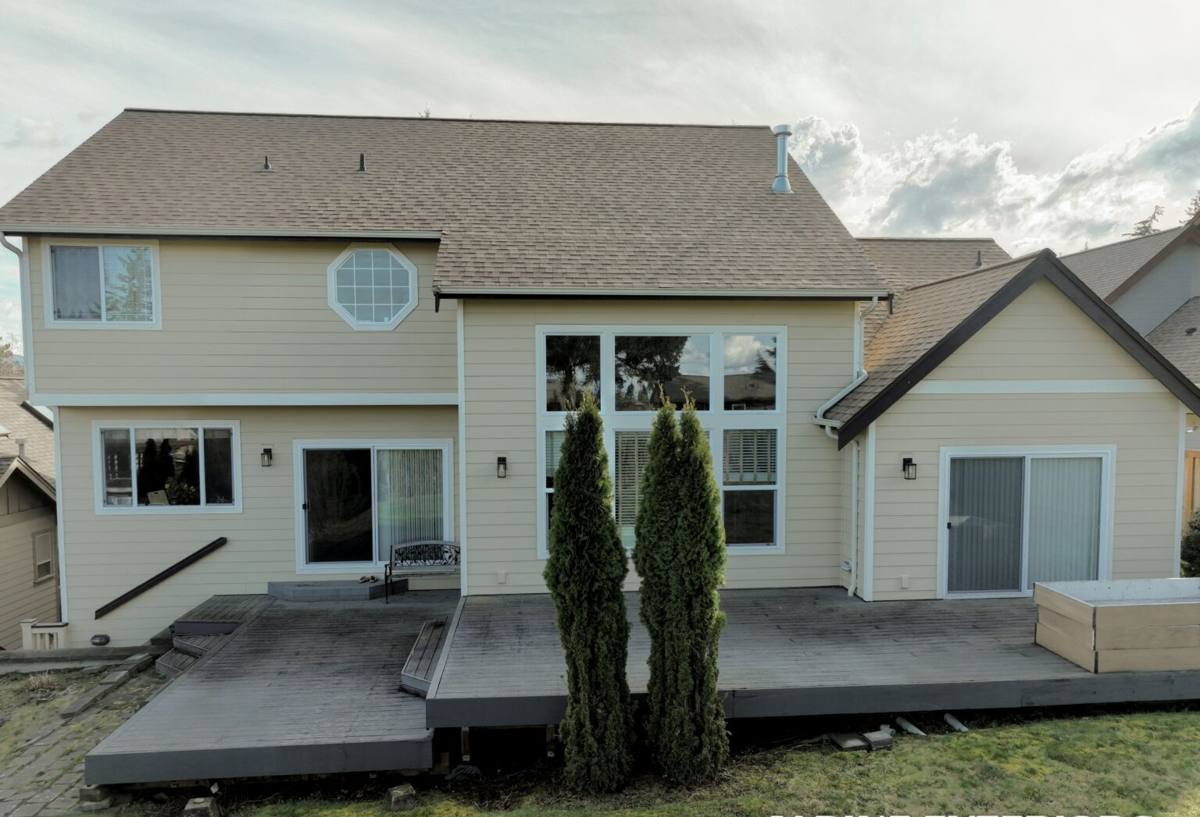
Why Composite Decking Makes Sense for This Neighborhood
Wood decking isn't a bad product, but it asks a lot of a homeowner in a climate like ours — annual or biannual staining, regular moisture sealing, and constant vigilance for soft spots where water has gotten into the grain. Skip a year of maintenance in Cordata's wet season and wood decking starts losing ground fast. Composite decking, especially capped composite, doesn't rely on a surface coating to keep water out. The board itself is largely inert to moisture, so it doesn't swell, split, or splinter the way wood does after repeated wet-dry cycles.
That matters most in exactly the conditions Cordata deals with: long stretches of damp weather followed by short dry spells that pull wood grain apart at the surface. Composite doesn't need that annual coat of stain or sealer to keep performing, which is a real difference for anyone who doesn't want deck maintenance as a standing item on their spring and fall to-do list.
Where Composite Still Needs Attention
Composite isn't maintenance-free — it's maintenance-reduced. It still needs to be kept clear of standing organic debris, and it still needs a design that lets water actually drain instead of pooling on the surface or trapped underneath. A composite deck installed without attention to drainage and airflow can develop mildew staining just like a poorly maintained wood deck would, because the moss and algae that thrive in our climate don't care what the surface is made of — they care whether it stays damp and shaded.
Not All Composite Decking Is Built the Same
"Composite decking" covers a wide range of products, and the differences matter more in a wet climate than in a dry one. The biggest distinction is capped versus uncapped composite. Capped composite has a polymer shell wrapped around a wood-plastic core, which is what actually blocks moisture absorption at the board surface. Uncapped composite, or older-generation composite, is more porous and can absorb water at cut ends and exposed surfaces over time — which in a climate with this much rain is a real long-term liability, not a minor spec difference.
PVC decking (no wood fiber in the core at all) takes moisture resistance a step further and is worth considering for spots with heavy shade or minimal airflow, though it comes at a higher price point and a different look and feel underfoot than wood-composite blends.
| Material | Moisture Behavior | Maintenance | Typical Lifespan Here |
|---|---|---|---|
| Pressure-treated wood | Absorbs water; prone to splitting and rot without upkeep | Annual staining/sealing | 10–15 years |
| Uncapped composite | Some absorption at edges/cuts | Periodic cleaning | 15–20 years |
| Capped composite | Minimal absorption; shell blocks moisture at the surface | Occasional cleaning | 25+ years |
| PVC decking | Essentially non-absorptive | Occasional cleaning | 25+ years |
We install capped composite as our standard for Cordata projects specifically because of the salt air and rain exposure this neighborhood sees. It's not that other materials can't work — it's that capped composite's moisture behavior lines up with what this climate actually demands, and we'd rather set that expectation honestly up front than sell a cheaper board and have a homeowner deal with the consequences in year six.
What a Correct Composite Deck Installation Involves
The decking boards themselves get most of the attention, but the substructure underneath is what determines whether the deck lasts. Composite boards are heavier than wood and behave differently under load and temperature swings, so a few details matter more than they would on a wood deck:
Framing and Support
Composite typically needs tighter joist spacing than wood — usually 16 inches on center, sometimes closer depending on the board and whether it's run straight or on a diagonal. Undersized or improperly spaced framing is one of the most common shortcuts we see on decks that were "fine" for a few years and then started to feel bouncy or spongy.
Ledger Attachment and Flashing
Where the deck attaches to the house is the single most water-vulnerable connection on the whole structure. Proper flashing at the ledger board keeps driving rain from working its way behind the siding and into the house framing — a slow, hidden failure mode that's expensive to fix once it's gone unnoticed for a few wet seasons.
Footings and Post Depth
Footings need to be set below the local frost line and sized for the actual load of the deck, including composite's added weight versus wood. This is also where a lot of older decks in wet climates fall short — footings that were adequate decades ago, or that were never inspected against current code, don't always hold up.
Ventilation Underneath
Airflow under the deck matters as much as drainage on top. A low-clearance deck with poor underside ventilation traps moisture against the framing year-round, which is exactly the setup that leads to hidden rot in joists and posts even when the visible decking above looks fine.
Fasteners and Hardware
Given the salt air in this area, we use corrosion-resistant, code-rated fasteners and hardware throughout — not just at the visible surface. Hidden fastener systems also keep the deck surface free of screw heads that would otherwise become entry points for water over time.
Living With a Deck Through Cordata's Moss Season
From roughly October through April, shaded and low-airflow surfaces around Bellingham stay damp enough to grow moss and algae, and a deck is no exception. Composite resists staining better than bare wood, but it isn't immune, especially on boards positioned under trees or against a shaded side of the house.
- Sweep off leaves, needles, and organic debris regularly rather than letting them sit through a wet stretch
- Rinse the deck surface periodically with a garden hose or low-pressure setting — high-pressure washing can damage the cap layer on composite boards
- Use a mild soap-and-water solution for general cleaning; avoid solvents or abrasive cleaners not rated for composite
- Keep gutters and downspouts near the deck clear so runoff isn't dumping directly onto the surface
- Trim back overhanging branches where possible to cut down on shade and debris load
None of this is heavy maintenance compared to a wood deck's staining schedule, but skipping it entirely in a climate with this much moss pressure will still shorten the life of the finish, even on a good board.
How Our Process Works for a Cordata Deck Project
We start with an on-site assessment rather than a phone quote, because so much of what determines cost and scope is underneath the existing structure or hidden in the framing.
- Inspect the existing ledger board and house connection for hidden water damage
- Check footing depth and condition against current load and frost-depth requirements
- Evaluate joist spacing and framing condition for composite's weight and span requirements
- Assess drainage, grading, and underside ventilation
- Walk through board tier, color, and railing options based on sun exposure and shading on your specific lot
From there we handle permitting through the appropriate local jurisdiction, schedule the build, and walk the finished deck with you before calling the job done. We don't treat the permit step as optional or as paperwork to skip — a deck built to code is a deck that's actually insured, inspected, and safe to stand on, and it protects you if you ever sell the house.
Problems We Commonly Find on Older Cordata Decks
When we're called out to replace or repair an existing deck in this neighborhood, a handful of issues show up repeatedly:
- Rotted or under-flashed ledger boards where water has been getting behind the siding unnoticed
- Footings that are undersized, too shallow, or were never properly inspected
- Wood decking with surface staining that masks soft, water-damaged boards underneath
- Poor underside airflow leading to hidden joist rot despite a fine-looking surface
- Corroded fasteners and hardware from years of salt-air exposure
Most of these aren't visible from a casual look at the deck surface, which is exactly why a proper structural assessment before any composite install matters — building a nice new deck surface on top of a compromised substructure just hides the problem for a few more years.
What Affects the Cost of a Composite Deck Here
We don't quote a flat per-square-foot number without seeing the site, because too many variables change the actual cost. In general terms, here's what moves the price up or down:
| Factor | Effect on Cost |
|---|---|
| Board tier (entry-level vs. premium capped composite) | Material cost varies significantly by brand and line |
| Existing substructure condition | Rotted framing or inadequate footings add repair cost before decking even starts |
| Deck height and stairs | Elevated decks and multi-level stairs add framing and railing complexity |
| Railing style | Composite, cable, or metal railing systems price differently than basic wood rail |
| Size and layout | Diagonal board patterns, curves, or picture-frame borders add labor and waste |
| Permit and inspection requirements | Varies by jurisdiction and project scope |
We'd rather walk your property and give you real numbers than a rough estimate that changes once we open up the old deck.
Why Hiring a Crew That Already Works Cordata Matters
A lot of what makes a deck last in this climate isn't visible on a spec sheet — it's knowing how driving rain actually hits a given lot's orientation, how much shade a typical Cordata yard gets through moss season, and which local permitting requirements apply to a deck attached to the house versus a freestanding structure. A crew that already builds in this neighborhood has seen how these decks age here specifically, not just in general Pacific Northwest conditions, and builds accordingly from the first framing decision instead of learning the hard way after a callback.
If you're planning a new deck or replacing one that's showing its age, we're happy to come take a look and talk through what your specific lot and layout actually need. There's no pressure and no cost for the estimate — just a straight assessment and honest numbers.