 Bellingham Roofing
 Windows Built for Silver Beach's Particular Kind of Weather
Silver Beach sits among mature trees near the water, and that setting is part of what makes the neighborhood desirable — and part of what's hard on windows. Homes here deal with the same marine air that moves through all of Bellingham off Bellingham Bay, long stretches of driving winter rain, and a moss season that can run from fall clear through spring under all that tree canopy. None of that is unique to one street or one house. It's a Whatcom County reality, and it shows up first at the weak points of a house: rooflines, siding transitions, and windows.
Windows take a specific kind of abuse. They flex with temperature swings, they're sealed with materials that degrade over time, and every seam around them is a potential path for water. In a climate where it rains sideways more often than most window manufacturers assume, a window that's slightly wrong for the exposure — the wrong glass package, a weak seal, a frame that wasn't flashed correctly at install — will tell on itself within a few winters. That's why we treat window work in Silver Beach as climate-specific work, not a catalog order.
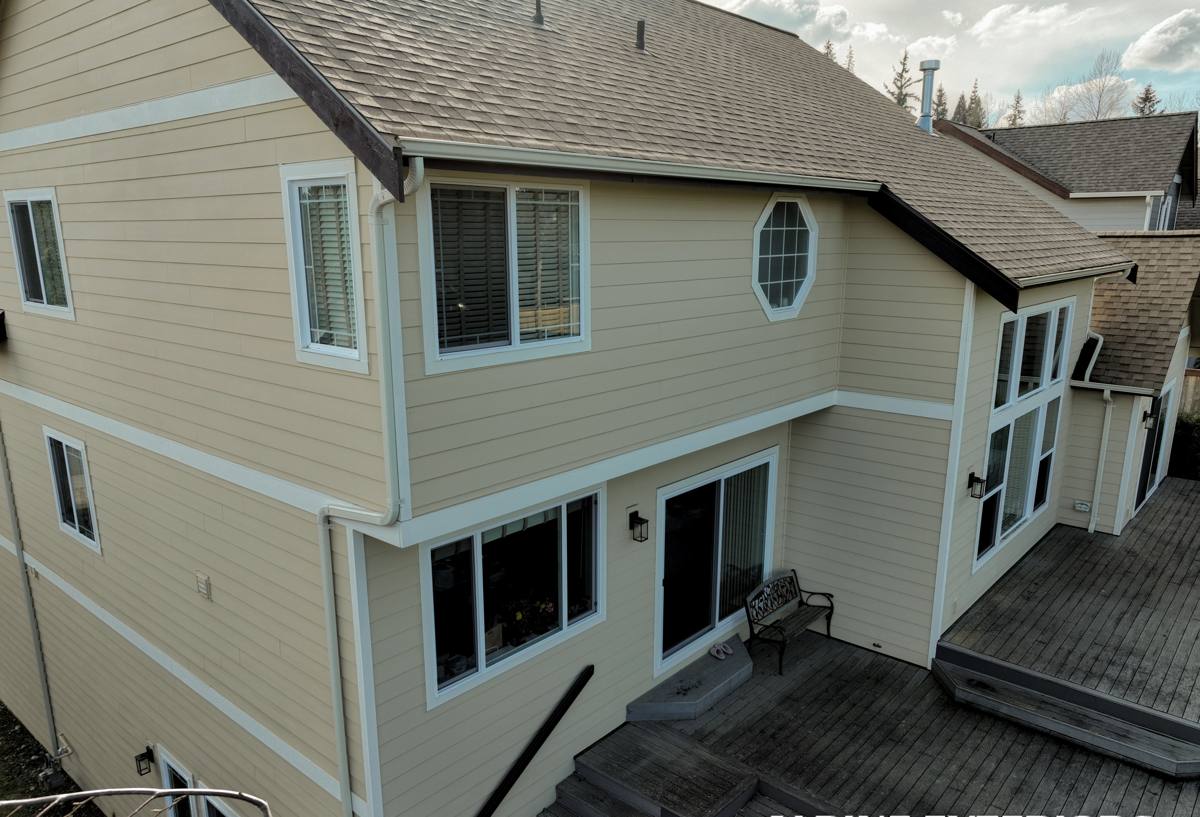
Signs Your Windows Are Overdue for Replacement
Most homeowners don't wake up one day and decide they need new windows. It's usually a slow accumulation of small annoyances that finally adds up. Some of the most common signs we see on service calls in this neighborhood:
- Fogging or a hazy film between the panes of double-pane glass — the seal has failed and the gas fill is gone
- Sashes that stick, drag, or won't stay open, often from swollen wood or worn-out balances
- A draft you can feel standing near the window on a windy day, even with it fully closed
- Paint or caulk cracking and pulling away from the frame year after year
- Soft or discolored wood at the sill or lower corners — an early sign of rot
- Condensation forming on the inside of the glass through the winter months
- Noticeably higher heating bills without any other change in usage
Any one of these on its own might just need a repair. Several at once, especially on a home with its original windows, usually means it's time to talk about replacement before the moisture damage spreads into the framing around the opening.
What "Custom" Actually Means Here
"Custom" isn't a marketing word for us — it describes the actual process. Off-the-shelf window sizes are built around a handful of standard rough openings. A lot of homes in older Bellingham neighborhoods, Silver Beach included, weren't built to those standards, especially if they've had additions, settling, or previous window work over the decades. A custom window is manufactured to the exact dimensions of your opening rather than forcing your opening to fit a stock size.
That distinction drives a real decision early in the process: full-frame replacement versus an insert (also called a "pocket" replacement). An insert fits inside your existing, sound frame — faster and less invasive, but only appropriate if that old frame is dry and structurally solid. A full-frame replacement removes everything down to the rough opening, which is the right call anytime we find water damage, rot, or a frame that's out of square. We'll tell you honestly which situation you're in — this is not a decision we make to sell a bigger job.
Choosing the Right Frame Material for a Wet, Wooded Lot
Frame material matters more here than in a drier climate, because it determines how the window handles years of damp air and shaded, slow-drying conditions. There's no single "best" material — it depends on your home's style, your budget, and how much upkeep you want to take on.
| Material | Moisture Resistance | Maintenance | Typical Lifespan | Best Fit |
|---|---|---|---|---|
| Vinyl | Very good — won't rot, doesn't need painting | Low — occasional cleaning | 20–30 years | Budget-conscious replacements, rental or resale-focused projects |
| Fiberglass | Excellent — very stable in wet/dry cycling | Low — factory finish holds up well | 30-plus years | Homes with heavy sun/shade contrast or large window openings |
| Wood-clad (wood interior, clad exterior) | Good on the exterior; interior wood needs protection from indoor humidity | Moderate — interior finish maintenance | 20–30 years with upkeep | Older or character homes where interior wood trim matters |
| Aluminum | Fair — prone to condensation without thermal breaks | Low | 20-plus years | Specific architectural styles; less common for standard home replacement in this climate |
For most Silver Beach homes we lean toward vinyl or fiberglass because they shrug off the wet-dry cycling and don't need repainting under a tree canopy that keeps everything damp longer than an open lot would. Wood-clad still has a place where the look of real wood trim matters more than minimizing maintenance — we'll be straight with you about that trade-off rather than talk you out of a style you want.
How We Approach a Custom Window Job
Assessment and Measuring
We start by inspecting the existing opening, not just the window itself — checking the sill, the framing, and how water has historically been shedding away from that spot. Every opening gets measured individually; we don't assume two windows on the same wall are identical, and on older homes they often aren't.
Flashing and Moisture Management
This is the step that actually determines whether a window lasts. A window can be top quality and still fail early if it isn't flashed correctly to shed water down and out, not into the wall cavity. We integrate the window's flashing with the surrounding siding or trim so water has one continuous path off the house — the same water-management logic we apply to roofing and siding work, because a window is just another penetration in the building envelope that has to be sealed to the same standard as everything above it.
Installation and Sealing
The window gets set plumb, level, and square, shimmed correctly so it isn't relying on the fasteners to hold its shape, then insulated and sealed with materials rated for exterior exposure — not just whatever caulk is on the truck.
Cleanup and Walkthrough
We walk every completed window with you, operate it, and confirm it seals and locks the way it should before we consider the job finished.
Energy Performance and Condensation in a Marine Climate
Glass Packages
Double-pane, low-E glass is the standard baseline for this climate and performs well for most homes. Triple-pane adds a further step of insulation and sound dampening, which is worth discussing if a window faces a busy road or a particularly exposed, weather-beaten side of the house — but it isn't a must-have for every opening. We'll help you decide where triple-pane earns its keep and where standard double-pane low-E is the smarter spend.
Condensation, Explained Honestly
New, well-sealed windows sometimes show more interior condensation in winter than old, leaky ones did — not because anything is wrong, but because the old windows were letting humid indoor air leak out along with your heat. A tighter home holds moisture indoors unless it's ventilated. Running bath fans, kitchen exhaust, and cracking a window periodically in winter usually resolves it. If condensation is heavy and persistent after a new install, that's worth a follow-up call, not something to just live with.
Moss, Trees, and Long-Term Window Care
Under a mature tree canopy, moss and organic debris build up faster than most people expect — not just on the roof, but in window tracks, on sills, and around weep holes at the bottom of the frame. Weep holes exist to let any water that gets into the frame drain back out; when they're clogged with moss or debris, water sits against the frame instead of leaving it, which is exactly the slow damage that shortens a window's life in a shaded, damp lot.
- Clear debris from window tracks and weep holes each fall before the heavy rains set in
- Keep nearby gutters clean — overflow running down the siding is a common source of water intrusion at windows below
- Rinse moss and algae off sills and lower sashes rather than letting it sit and hold moisture
- Check exterior caulking annually where the frame meets siding or trim; PNW wet-dry cycling breaks it down faster than in drier climates
None of this is difficult, but it does need to happen regularly on a shaded, tree-heavy lot in a way it might not on a more exposed property.
Why Local Experience in Silver Beach Matters
A contractor who mostly works drier, more open parts of Washington will size up moisture risk differently than one who works wooded, water-adjacent neighborhoods in Bellingham every week. We see the same patterns repeatedly here: older frame stock reaching the end of its service life at similar times, shaded north- and west-facing walls that stay damp longer, and trim details that need to be matched carefully so a replacement doesn't look bolted on to a home with real architectural character.
Because we also handle roofing and siding, we look at your windows as part of the whole exterior envelope rather than an isolated product swap. Flashing at a window head has to work with the siding above it and the trim around it — treating that connection as one continuous water-management system, instead of separate trades that don't talk to each other, is what actually keeps a Whatcom County home dry through the wet months.
If your windows in Silver Beach are showing their age or you're planning a broader exterior update, we're happy to take a look and give you a straightforward, no-pressure estimate. Use the form below to get started.