 Bellingham Roofing
 Replacing Siding on a Fairhaven Home Is a Different Job Than Replacing It Inland
Fairhaven sits close enough to Bellingham Bay that its homes take on exterior wear at a different pace than houses a few miles inland. Salt-tinged marine air, rain that gets driven sideways by wind off the water, and a moss season that can stretch across most of the year all put steady pressure on whatever material is covering the wall. When it's time to actually replace that siding, not just patch it, those same conditions shape almost every decision: what gets torn off, what gets inspected underneath, what product goes back up, and how the job gets sequenced around Bellingham's weather.
This page is specifically about full siding replacement in Fairhaven, the process of removing failing or worn-out siding down to the sheathing and installing a new system correctly, not general upkeep or spot repairs. If your existing siding still has useful life left, a repair may be the right call. If it's past that point, here's what a correct replacement actually involves and why doing it right matters more here than it does in a milder climate.
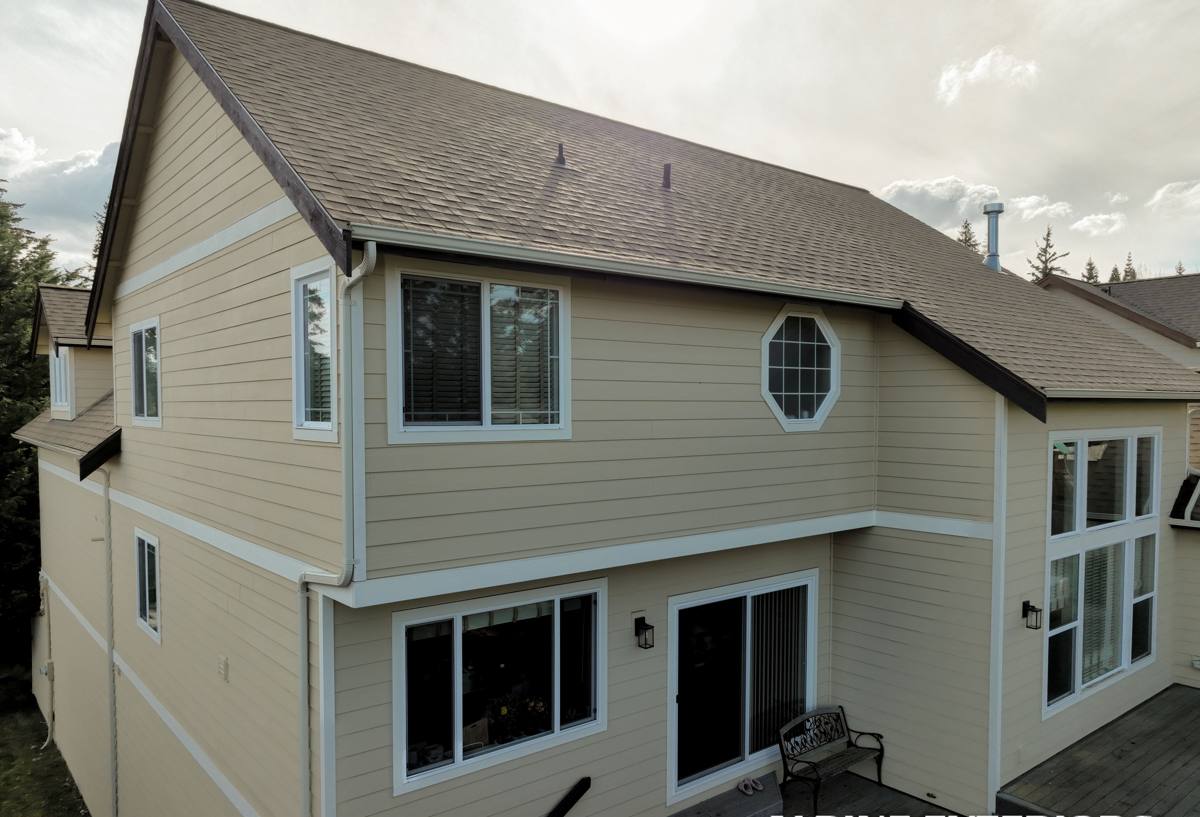
Why Fairhaven's Climate Pushes Siding Toward Replacement Sooner
Salt Air Works on Fasteners and Finishes
Homes near the bay sit in a steady drift of mildly corrosive, moisture-laden air, not just during storms but as a background condition most of the year. Over time it corrodes fasteners, breaks down lower-grade paint finishes, and degrades caulking at seams and trim joints. None of that shows up overnight. It builds quietly until a homeowner notices rust streaking, chalky faded siding, or gaps at joints that used to be sealed tight.
Wind-Driven Rain Finds the Weak Points
Rain near open water rarely falls straight down. Wind pushes it sideways into lap joints, trim seams, and anywhere a wall has been penetrated for a vent, fixture, or fastener. A siding system that would hold up fine forty miles inland can still take on water here purely because of how wind interacts with the coastline. Once water gets behind the siding repeatedly over years, it's usually the sheathing and framing underneath, not just the visible siding, that end up needing attention during replacement.
A Long Moss and Mildew Season
Mild temperatures, consistent dampness, and mature tree cover common on older Fairhaven lots add up to extended moss and mildew growth, especially on shaded or north-facing walls. Porous or moisture-retentive materials become a growth surface over time. By the time a homeowner is scraping moss off siding every year just to keep it presentable, that's often a sign the material itself, not just the cleaning schedule, has become the problem.
Sloped Lots Complicate Water Management
A good share of Fairhaven's housing sits on terrain that slopes up from the waterfront, which affects how water drains around a foundation and moves up a wall during heavy rain. On these lots, correct grading, flashing, and clearance from grade at the base of the siding matter as much as the siding material itself, and they're details a replacement project has to get right the first time.
Signs a Fairhaven Home Needs Full Replacement, Not a Repair
- Soft, spongy, or delaminating siding across multiple sections rather than one isolated spot
- Moss or dark staining that returns within weeks of cleaning, especially on shaded walls
- Visible warping, cupping, or buckling across whole panels or courses
- Paint that's peeling or bubbling over a large percentage of the wall surface, not just one board
- Rot discovered at trim, corners, or window returns during even a minor repair
- Rising heating bills that suggest the wall assembly is no longer sealing the way it should
- Siding that's simply reached the end of its rated service life, regardless of visible damage
One or two of these on their own might point to a targeted repair. Several at once, especially if they show up on more than one side of the house, usually means the material has reached the point where patching just delays a bigger project by a year or two.
What a Correct Siding Replacement Actually Involves
Tearing off old siding and nailing up new boards is the visible part of the job, but it's not the part that determines whether the new siding lasts. A replacement done right treats the wall as one water-management system, not a series of separate steps.
Full Tear-Off, Not Overlay
Installing new siding over old material is faster and cheaper, but it also seals in whatever moisture damage is already hiding behind the existing wall. In a marine climate like this one, we don't recommend overlaying. A full tear-off is the only way to actually see the sheathing, framing, and old flashing details underneath before covering them back up.
Sheathing and Framing Inspection
Once the old siding is off, we inspect the sheathing and framing for rot, soft spots, or past water intrusion, which is common on Fairhaven homes that have taken on wind-driven rain for years through failed seams or aging caulk. Any damaged material gets repaired or replaced before anything new goes back on the wall. Skipping this step is one of the most common reasons a brand-new siding job fails early.
House Wrap and Flashing as One System
New house wrap, properly lapped and taped, along with correctly integrated window, door, and penetration flashing, is what actually keeps water out of the wall assembly. The siding itself is the least important layer for keeping water out; it's the water-resistive barrier and flashing behind it doing most of that work. We treat these as one continuous system rather than separate trades working in isolation.
Fastening and Clearance to Spec
James Hardie siding has specific fastening patterns, nail penetration depths, and clearance requirements from grade, roofline, and decking that have to be followed for the product to perform and for the warranty to stay valid. Getting this wrong doesn't usually show up as a problem in year one. It shows up in year eight or ten, which is exactly the kind of corner-cutting that gives a good product an undeserved bad reputation.
Why We Replace Siding with James Hardie Fiber Cement Only
We don't offer a menu of siding brands and let price make the decision for the homeowner. We install James Hardie fiber cement, and only James Hardie, because of what we consistently see when we tear off other materials on homes exposed to this much salt air and sustained moisture.
- Non-combustible core: Fiber cement doesn't feed a fire the way wood-based siding products can.
- Factory-cured ColorPlus finish: The color coat is applied and cured under controlled factory conditions, giving it far more resistance to fading, chalking, and moisture intrusion than field-applied paint.
- HZ5 formulation for wet, coastal climates: Hardie's HZ product lines are engineered for regions with heavy sustained moisture and freeze-thaw cycling, a closer match to coastal Whatcom County than a generic national product spec.
- Dimensional stability: Fiber cement doesn't swell, cup, or warp the way engineered wood can after repeated wet-season moisture cycles.
- A strong transferable warranty when the installation follows spec, which matters more when you're replacing siding once and want it to actually last.
We don't install LP SmartSide, vinyl, Cemplank, Allura, primed spruce, or cedar. Those are legitimate products, and other contractors install them competently. On a replacement project, where the whole point is not having to do this again in ten years, we made the professional call that standing behind one system we understand completely serves Fairhaven homeowners better than offering a cheaper alternative that quietly shifts maintenance risk back onto them.
What Should Happen Before Your Tear-Off Begins
- A written scope of work that specifies tear-off, sheathing inspection, house wrap, and flashing details, not just "new siding installed"
- A plan for protecting landscaping, walkways, and outdoor living space during demolition
- Confirmation of how old siding and debris will be hauled and disposed of
- A weather window that accounts for Bellingham's rain pattern, since bare sheathing shouldn't sit exposed longer than necessary
- Clear communication about what happens if hidden rot or damage is found once the old siding comes off
Our Siding Replacement Process
- On-site walkthrough: We assess the existing siding, wall condition, trim detail, and any problem areas specific to your home before quoting anything.
- Written scope and estimate: You get a clear breakdown of what's being torn off, inspected, repaired, and installed, with the Hardie product line and color specified.
- Tear-off: Old siding comes off down to the sheathing, with landscaping and outdoor spaces protected throughout.
- Inspection and repair: Sheathing and framing are checked for hidden moisture damage and repaired before anything new is installed.
- House wrap and flashing: A new water-resistive barrier and properly integrated flashing go on as one system, not an afterthought.
- Hardie installation: Siding is installed to manufacturer fastening and clearance specifications, not shortcuts.
- Trim, caulking, and final detail: Joints, corners, and penetrations are sealed correctly to keep water out for the long term.
- Final walkthrough and cleanup: We review the finished work with you and clear the site of debris and old material.
Siding Replacement Cost Factors in Fairhaven
| Factor | What It Affects | Why It Matters in Fairhaven |
|---|---|---|
| Extent of hidden sheathing damage | Repair costs uncovered during tear-off | Years of wind-driven rain and salt exposure can rot sheathing long before it's visible from outside |
| Wall complexity and trim detail | Labor and material time | Older Fairhaven homes often have more trim and roofline intersections where water can work its way in |
| Site access and slope | Staging, scaffolding, and setup time | Hillside lots common near the waterfront can add equipment and access time |
| Siding profile and color | Material cost | HZ5 lap, shingle, and panel profiles vary in price; ColorPlus finishes cost more upfront but outlast field paint |
| Disposal and debris removal | Total project cost | Full tear-off generates more debris than an overlay, which some contractors quote separately |
These factors interact differently on every house, which is why we price a replacement after walking the property in person rather than off square footage alone.
Timeline: What to Expect on a Fairhaven Replacement
Most full siding replacements on a single-family Fairhaven home take anywhere from several days to a couple of weeks, depending on the size of the house, how much trim detail is involved, and what's found once the old siding comes off. Weather plays a real role in scheduling here. Because Bellingham gets sustained wet stretches, we plan tear-off sections around forecast windows so bare sheathing isn't left exposed longer than necessary, and we sequence larger homes wall by wall rather than opening the whole exterior at once when conditions call for it.
Why Hiring a Crew That Already Works Fairhaven Matters
A crew that regularly works this stretch of Whatcom County has already seen how salt air, wind-driven rain, and moss actually behave on real houses over a full year, not just how a product performs on a spec sheet. That experience shows up in practical decisions made on tear-off day: which wall orientations tend to hide the worst sheathing damage, where extra flashing attention pays off, and how to sequence a job around this area's weather instead of a generic regional timeline. Fairhaven's older housing stock, hillside terrain, and closeness to the bay aren't identical to conditions elsewhere in Bellingham, and a crew with real local experience accounts for that instead of treating every job the same.
If your Fairhaven home's siding is showing its age, or you just want an honest assessment of whether repair or full replacement makes more sense, we're happy to take a look. Reach out using the form below to schedule a free, no-pressure estimate.