 Bellingham Roofing
 Board & Batten in Cordata: A Look That Demands the Right Material Underneath
Board and batten has become one of the most requested siding looks in Cordata over the past several years — wide flat panels with narrow strips covering the seams, giving a home clean vertical lines and a look that reads as both modern farmhouse and traditional Pacific Northwest at the same time. It shows up as a full-elevation treatment, a gable accent, or a wrap around an entry or bay window. The look is simple. What holds up behind it in a Whatcom County winter is not.
Board and batten siding has more seams, more fastener penetrations, and more edge exposure per square foot than standard horizontal lap siding. That's fine when it's built correctly with the right material and the right detailing behind it. It's a problem when it isn't. In a neighborhood like Cordata, where homes take on salt-laden air, sustained driving rain, and months of shaded, damp conditions that feed moss and algae growth, the margin for error on a vertical siding system is smaller than most homeowners realize.
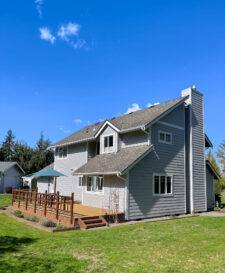
What Bellingham's Climate Does to Vertical Siding
Cordata sits within the broader Bellingham climate zone — close enough to Bellingham Bay and the Salish Sea to pick up salt-bearing air, and squarely inside a Whatcom County weather pattern that delivers heavy, sustained, wind-driven rain rather than the short, hard downpours you'd see elsewhere. Add a long, cool, low-sun moss season, and you have three distinct stresses working on a home's exterior nearly year-round.
Salt Air
Marine air carries fine salt that settles on siding, trim, and fasteners. Over years, it accelerates corrosion on lower-grade fasteners and metal flashing, and it can degrade paint films and substrates that weren't engineered to shed it. Board and batten's exposed batten strips and fastener lines give salt more surface area to work on than a flat lap profile.
Driving Rain
Wind-driven rain doesn't just fall on siding — it's pushed sideways and upward into seams, laps, and fastener holes. Vertical board and batten has more vertical seams than horizontal lap siding, and every one of those seams is a potential entry point if it isn't flashed, gapped, and fastened correctly.
Moss Season
Bellingham's damp, shaded stretch of the year runs long, and north- and west-facing walls in particular hold moisture for extended periods. Moss and algae don't just look bad — they hold water against the siding surface and, on materials that aren't dimensionally stable or properly finished, that sustained moisture exposure is what eventually causes swelling, delamination, or paint failure.
Board & Batten Is a Look, Not a Material
This is the part homeowners often don't realize until they're comparing quotes: "board and batten" describes a siding profile, not a product. It can be built in vinyl, cedar, primed spruce, engineered wood, or fiber cement. Two board and batten estimates can look nearly identical on paper — same reveal, same batten spacing, same color — and still be built from materials with completely different track records in a coastal Whatcom County climate.
That distinction matters more with board and batten than with almost any other siding style, because the profile itself puts extra demand on the material. More seams mean more places for a lesser product's weaknesses to show up first.
Why We Only Build Board & Batten in James Hardie Fiber Cement
We install exclusively James Hardie fiber cement siding — no vinyl, no LP SmartSide, no Cemplank or Allura, no primed spruce or cedar. For a vertical profile with heavy seam count in this climate, that's not a marketing preference, it's the reason the look holds up.
- Non-combustible core — fiber cement doesn't feed a fire, which matters for insurance conversations and long-term peace of mind, not just wildfire-zone properties.
- Dimensionally stable in moisture swings — fiber cement doesn't expand, contract, and warp the way engineered wood products can when they take on repeated wetting from driving rain.
- ColorPlus factory finish — a baked-on finish applied under controlled conditions, formulated to resist fading and hold up against UV and moisture far longer than field-applied paint, which is what most wood and engineered-wood board and batten ultimately depends on.
- HZ5 product engineering — Hardie's HZ product lines are formulated for specific climate zones; the Pacific Northwest's wet-side engineering accounts for exactly the rain exposure Cordata sees.
- Strong transferable warranty — backed by the manufacturer, not just the installer, and it follows the house if it sells.
We've made a professional call not to install board and batten in vinyl or engineered wood, even when it's requested, because we don't want to hand a homeowner a look that needs repainting, re-caulking, or partial replacement within a decade. Fiber cement isn't the cheapest board and batten option on the market — it's the one we're willing to warranty our workmanship on.
What a Correct Board & Batten Installation Involves
The material is half the equation. The other half is installation detail, and this is where a lot of board and batten jobs — regardless of brand — go wrong.
Behind the Panel
A weather-resistive barrier goes on first, followed by a rainscreen gap — a small drainage space between the WRB and the siding panel. That gap lets any moisture that does get past the siding drain and dry out instead of sitting against the wall sheathing. It's not optional in a climate that delivers this much sustained rain.
Seams, Corners, and Penetrations
Every horizontal joint, corner, window head, and door head needs proper flashing — not just caulk. Caulk is a supplement to good flashing detail, not a substitute for it. Cut panel edges need to be sealed per manufacturer spec, since a raw cut edge is more absorbent than the factory-finished face.
Battens and Fasteners
Batten spacing and fastening pattern affect both the finished look and the panel's ability to move slightly with temperature changes without stressing the fasteners. In a marine-air environment, fastener selection matters — corrosion-resistant fasteners rated for the exposure, placed at the manufacturer's specified pattern and edge distance.
Kickout Flashing and Water Management
Anywhere a roofline meets a wall, kickout flashing directs roof runoff away from the siding instead of letting it sheet down behind it. It's a small detail that's frequently skipped, and it's one of the more common causes of hidden water damage on vertical siding.
Material Comparison for Board & Batten Siding
| Material | Driving Rain Performance | Salt Air Durability | Moss/Algae Resistance | Maintenance | Typical Lifespan |
|---|---|---|---|---|---|
| Vinyl | Seams can flex and gap over time | Can become brittle with UV and salt exposure | Traps moisture at laps | Low, but cracks/warps and can't be repainted easily | 15-25 years |
| Primed Wood / Cedar | Absorbs moisture at cut edges and seams | Prone to accelerated weathering | Susceptible without diligent upkeep | High — repainting, caulking, spot repairs | 10-20 years with upkeep |
| Engineered Wood (LP-type) | Vulnerable at unsealed edges and seams | Moderate, coating-dependent | Moderate, coating-dependent | Moderate — edge sealing, repainting cycles | 20-30 years with upkeep |
| James Hardie Fiber Cement | Engineered for wet climate zones (HZ5) | Strong, factory-finished | Resistant with correct install and gap detail | Low — no repainting for many years | 30+ years, backed by warranty |
Our Process for Cordata Board & Batten Projects
- On-site assessment — we look at wall orientation, existing moisture damage, roofline intersections, and which elevations take the most driving rain and shade.
- Removal and substrate check — old siding comes off and we inspect sheathing for hidden rot before anything new goes on. Problems get addressed before they get covered up.
- WRB and rainscreen installation — the drainage layer goes in per manufacturer and code requirements for the wall assembly.
- Panel and batten installation — James Hardie panels and battens installed to spec, with proper flashing at every joint, corner, and penetration.
- Trim, caulking, and detail work — window and door surrounds, corner boards, and transition points finished and sealed.
- Final walkthrough — we go over the finished work with the homeowner before calling the job done.
Maintenance Checklist for Board & Batten Homes in This Climate
- Rinse pollen, salt film, and debris off siding once or twice a year, especially on ocean-facing walls
- Check north- and west-facing elevations each fall for early moss or algae growth before it spreads
- Inspect caulk lines around windows, doors, and trim annually and re-caulk hairline gaps promptly
- Keep gutters clear so overflow doesn't run down the siding face during heavy rain events
- Trim back landscaping that keeps siding shaded and damp for extended periods
- Watch for soft spots, staining, or bubbling near the base of walls and around roof-to-wall intersections
Why Hiring a Crew That Already Works Cordata Matters
Board and batten forgives almost nothing when the details are wrong, and the details that matter shift depending on where a home sits relative to prevailing wind, rain direction, and shade. A crew that's done this work across Cordata and the surrounding Bellingham area already knows which elevations typically need the most flashing attention, how local wind-driven rain behaves against a vertical seam pattern, and how Whatcom County's permitting and inspection process runs — so there are no surprises mid-project. That local track record is worth more on a board and batten job than on almost any other siding style, simply because there's less room for guesswork.
If you're considering board and batten siding for a home in Cordata, we're happy to walk the property, talk through what your specific elevations need, and put together a free, no-pressure estimate — no obligation, just a straight assessment of what correct board and batten siding looks like on your house.