 Bellingham Roofing
 Edgemoor's Waterfront Exposure and What It Does to Siding
Edgemoor sits on the bluff above Bellingham Bay, and that position is exactly what makes it beautiful and exactly what makes it hard on exterior materials. Homes here take on a combination most inland Whatcom County neighborhoods don't see in the same intensity: salt-laden air drifting off the bay, wind-driven rain that hits siding at an angle instead of falling straight down, and a wet season that runs long enough for moss and algae to get a real foothold on north- and west-facing walls before summer ever dries things out.
None of that is unusual for the Pacific Northwest coast. But it does mean siding choices that work fine in a drier, more sheltered part of the county can underperform on an exposed Edgemoor lot. Salt residue accelerates corrosion on fasteners and trim. Driving rain finds gaps and seams that would stay dry elsewhere. And a siding material that holds moisture, rather than shedding it, stays damp longer in a neighborhood where "dry season" is a relative term.
Why James Hardie Fiber Cement Fits This Environment
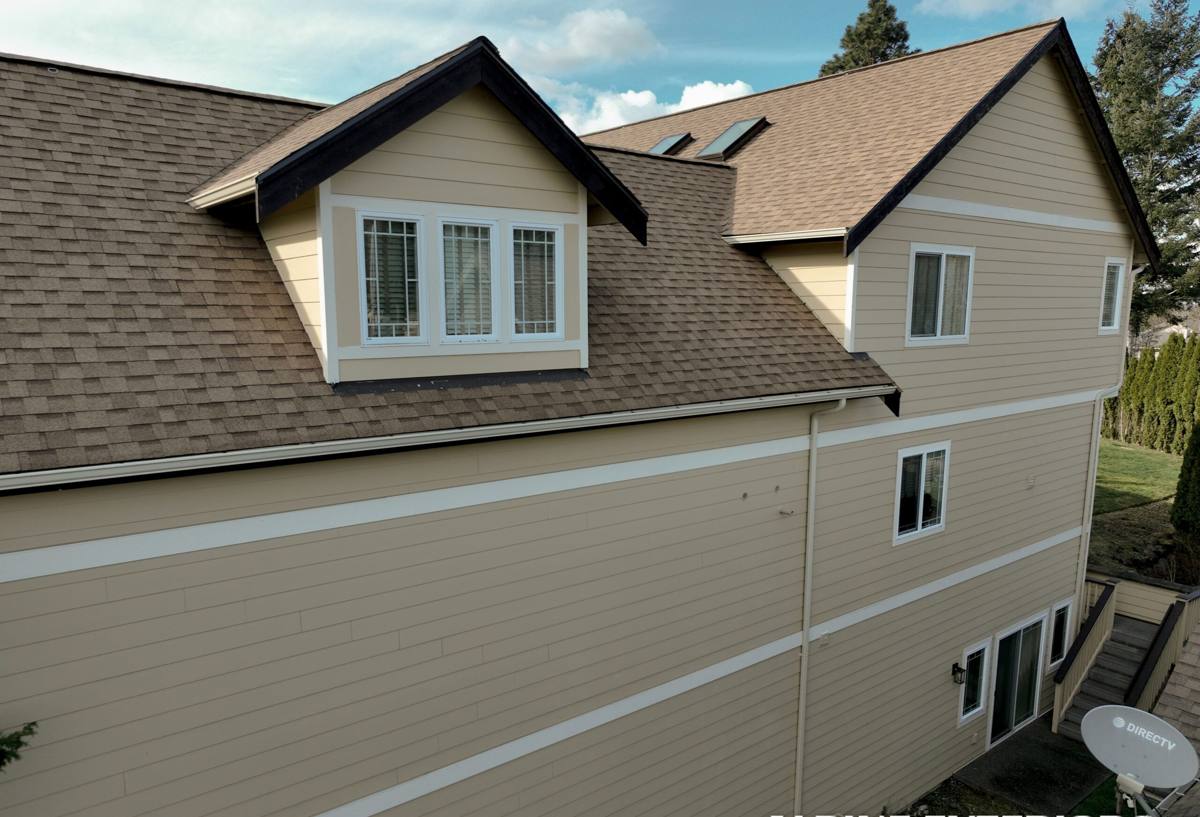
We install James Hardie fiber cement siding exclusively, and Edgemoor is a good illustration of why. Fiber cement is made from cement, sand, and cellulose fiber — it doesn't rot, it isn't a food source for the moss and mildew that thrive in this climate, and it doesn't expand and contract with moisture the way wood-based products do. That matters on a bluff where the siding is dealing with damp air more days than not.
The HZ5 Climate Engineering
James Hardie engineers its siding to regional exposure zones, and the Pacific Northwest falls under the HZ5 specification. That means the panels and lap boards used on an Edgemoor home are formulated for a wet, marine climate rather than a generic national product. It's a meaningful distinction — a siding line engineered for dry, low-humidity regions is not the same product performing the same way here.
ColorPlus Factory Finish vs. Field-Painted
Most Hardie siding we install carries the ColorPlus finish, baked on at the factory in a controlled environment rather than brushed or sprayed on-site. On a home exposed to salt air and constant rain, that matters because a factory finish resists fading and chalking better than field-applied paint, and it doesn't rely on weather conditions at the time of installation to cure properly. Fewer repaint cycles also means fewer maintenance visits to a bluff-top home where scaffolding and access aren't always simple.
What a Correct Installation Involves Here
James Hardie siding is only as good as the installation behind it. The product is engineered to perform in wet climates, but that engineering assumes the crew follows the manufacturer's specifications — not shortcuts that happen to look fine on the day the job wraps up.
Drainage Gap and Moisture Management
Correct installation includes a drainage gap (rain screen) between the siding and the weather-resistive barrier, so any moisture that gets behind the cladding has somewhere to go instead of sitting against the wall sheathing. On an exposed site like Edgemoor, where wind-driven rain pushes water harder against the building envelope than it would on a sheltered inland lot, that drainage gap is doing real work, not just checking a box.
Fastening and Flashing Details
Fasteners need to be corrosion-resistant and driven to the manufacturer's specified depth — over-driven nails crack the board's edge and create a moisture entry point, while under-driven ones leave the board loose. Flashing at windows, doors, and butt joints has to be layered correctly so water sheds down and out rather than behind the siding. Caulking is used at specified joints only — Hardie's own guidance calls for many joints to be left uncaulked and simply lapped correctly, and over-caulking a home to "seal everything" can actually trap moisture rather than keep it out.
Comparing Siding Options for an Exposed Coastal Lot
Homeowners in Edgemoor often ask how Hardie stacks up against other siding materials they've seen used around Bellingham. Here's an honest comparison based on how each material handles this specific climate:
| Material | Moisture Behavior | Maintenance in This Climate | Typical Lifespan |
|---|---|---|---|
| James Hardie fiber cement | Won't rot; engineered drainage plane sheds water | Occasional rinse; ColorPlus resists fading | Decades, per manufacturer warranty terms |
| Vinyl siding | Doesn't rot but can warp, and seams can allow water intrusion | Low, but cracks/fades and is hard to repair invisibly | Variable; shorter in high-wind, high-UV exposure |
| Cedar or primed wood | Absorbs moisture; prone to swelling, checking, and rot over time | Regular repainting/staining and moisture monitoring | Shorter without diligent upkeep in a wet marine climate |
| LP SmartSide (engineered wood) | Treated to resist moisture, but still wood-based and edge-sensitive | Field paint maintenance; edge sealing is critical | Depends heavily on installation and maintenance discipline |
We don't install vinyl, cedar, primed wood, or LP SmartSide, and this is why: each of those materials asks a homeowner on an exposed bluff lot to manage a maintenance burden or a moisture vulnerability that fiber cement simply doesn't carry to the same degree. That's a professional standard we hold, not a claim that those products fail everywhere — they just aren't the standard we're willing to put our name behind on a site like Edgemoor.
Our Process for an Edgemoor Siding Project
Every home is different, but the sequence stays consistent:
- On-site assessment — we look at wall orientation, existing moisture damage, window and door flashing condition, and how exposed each elevation is to wind and rain.
- Tear-off and sheathing check — old siding comes off and we inspect the sheathing underneath for rot or damage before anything new goes up, since covering a hidden problem only guarantees a bigger one later.
- Weather-resistive barrier and drainage plane — installed per manufacturer spec, with special attention to the elevations that take the most direct rain.
- Hardie installation — fastening, flashing, and joint treatment to Hardie's published installation guide, not a generalized "how we always do it" approach.
- Final inspection — checking fastener lines, caulked vs. lapped joints, and trim details before we call the job done.
Why a Crew That Already Works Edgemoor Matters
Edgemoor's homes sit on a range of lot conditions — some tucked and more sheltered, others fully exposed to bay wind and salt spray — and knowing which elevations of a given home need the most attention comes from having worked the neighborhood before. A crew unfamiliar with waterfront Bellingham exposure can install siding correctly by the book and still miss the judgment calls that matter on a bluff lot: where to be more conservative with flashing, which walls will take the worst of the weather, and how the neighborhood's architectural character should inform trim and reveal choices.
There's also a practical side. Bellingham's permitting and inspection expectations, and the realities of access and staging on hillside and bluff-adjacent lots, are things a local crew has already solved for rather than learning on your project.
Maintenance Checklist for Edgemoor Homeowners
Correctly installed Hardie siding is low-maintenance, not no-maintenance. In this climate, a little seasonal attention goes a long way:
- Rinse siding periodically to clear salt residue and airborne grime, especially on bay-facing walls
- Keep gutters clear so overflow doesn't run down and pool against siding at corners
- Trim back vegetation and tree cover that keeps shaded walls damp longer, which encourages moss
- Check caulked joints (not the lapped ones) annually for cracking or separation
- Watch for any soft spots, staining, or paint failure near ground level, which can signal a drainage or grading issue rather than a siding problem
- Address moss or algae growth promptly with a gentle wash rather than pressure washing, which can force water behind panels
Warranty and Long-Term Value
James Hardie backs its siding with a substantial, transferable limited warranty, and ColorPlus finishes carry their own separate finish warranty. That transferability matters in a desirable neighborhood like Edgemoor, where it can add real weight at resale — a buyer inheriting a home with correctly installed, warrantied Hardie siding is inheriting a known quantity, not a maintenance question mark. The warranty is only as strong as the installation behind it, which is why manufacturer-spec installation isn't optional on our jobs — it's the whole point of choosing this material in the first place.
If you're weighing a siding replacement for an Edgemoor home, we're happy to walk the property, look at your specific exposure, and put together a straightforward, no-pressure estimate — just fill out the form below.