 Bellingham Roofing
 Decking Built for Sehome's Weather, Not Just Its View
Sehome sits on a wooded, sloped stretch of Bellingham close enough to the water to catch salt-laden air off Bellingham Bay, and shaded enough by mature trees that decks here rarely get a full day of sun to dry out. That combination is tougher on outdoor structures than most homeowners expect. Salt air accelerates corrosion on fasteners and hardware. Driving rain off the Strait pushes moisture sideways under railings and door thresholds, not just straight down. And the long moss season that Whatcom County is known for turns any deck surface that holds shade and damp into a green, slick problem by late fall.
A composite deck built correctly for this environment can shrug off all of that for decades. One built without accounting for it will show algae streaking, soft spots at the ledger board, and corroded fasteners within a handful of winters. The difference isn't the composite material itself — it's the substructure, drainage, and hardware choices underneath it.
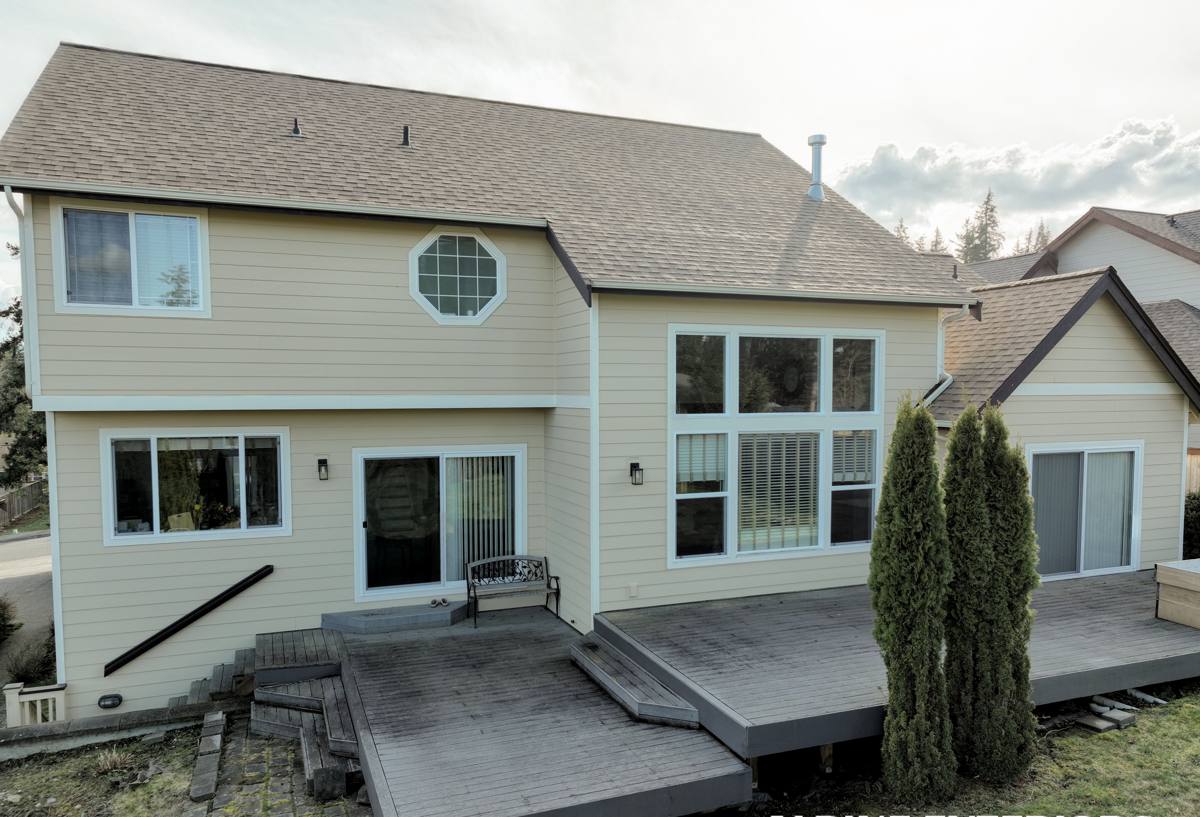
What Sehome's Climate Actually Does to a Deck
Moss and Algae
Composite decking doesn't rot, but it isn't immune to surface growth. In shaded, damp yards — common on Sehome's tree-covered lots — pollen, needles, and organic debris settle into board grain and gutters, and stay wet for days at a time during the region's long wet season. Left alone, that buildup feeds moss and algae, which makes boards slippery and dulls the finish over time.
Driving Rain and Wind-Driven Moisture
Storms coming off the water don't just fall straight down — wind pushes rain sideways under rail caps, around post bases, and into any gap where flashing was skipped. Composite boards handle direct wetting fine, but the wood-framed substructure underneath, and any ledger connection to the house, still needs to shed water properly or you end up with hidden rot where nobody can see it until it's a structural problem.
Salt Air and Corrosion
Being close to Bellingham Bay means airborne salt reaches decks that aren't even waterfront. Standard zinc-coated screws and brackets corrode faster here than they would inland, staining boards with rust streaks and eventually failing at the connection. This is a hardware selection problem, not a composite decking problem, but it only gets solved if the installer treats it as one from the start.
What a Correctly Built Composite Deck Includes
The composite boards on top get all the attention, but almost every long-term failure we get called out to inspect in this area traces back to what's underneath or how it was fastened. A correct install covers:
- Ledger flashing: a properly flashed and sealed ledger connection where the deck meets the house, so wind-driven rain can't work its way behind the siding.
- Joist spacing matched to the product: composite boards typically need tighter joist spacing than wood decking, especially on angled or picture-frame layouts — manufacturer spec, not a guess.
- Corrosion-resistant fasteners and hardware: stainless steel or coated hardware rated for coastal exposure, used at every connection point, not just the visible ones.
- Ventilation underneath: enough clearance and airflow below the deck surface so moisture doesn't sit trapped against joists year-round.
- Proper board gapping: spacing that accounts for composite expansion and contraction across our temperature swings, and that lets water drain through rather than pool.
- Hidden fastener systems where appropriate: cleaner surface, fewer penetration points for water to find.
Composite vs. Other Decking Options for a Shaded, Wet Lot
| Material | Moss/Algae Resistance | Maintenance | Long-Term Cost |
|---|---|---|---|
| Composite decking | Good — surface doesn't absorb moisture like wood, though periodic cleaning is still needed in shade | Occasional washing, no staining or sealing | Higher upfront, lower over 15-20 years |
| Pressure-treated wood | Poor — absorbs moisture readily, feeds moss and algae fastest in shaded yards | Annual cleaning, periodic staining/sealing | Lower upfront, ongoing maintenance cost adds up |
| PVC decking | Good, similar to composite | Low, but can look and feel less like natural wood | Comparable to or higher than composite |
| Natural cedar | Fair — naturally rot-resistant but still needs finish upkeep in wet shade | Regular sealing and inspection | Moderate, with recurring maintenance |
For Sehome specifically, where shade and moisture linger longer than in open, sunnier parts of Whatcom County, composite's main advantage is that the board itself won't rot or splinter even when it stays damp for extended stretches. It still needs occasional cleaning to keep moss from taking hold — no decking material is maintenance-free under a tree canopy — but it removes the sealing and staining cycle entirely.
Our Process on a Sehome Composite Deck Project
1. Site and Structure Evaluation
We start by looking at drainage patterns around the existing deck or build site, how much direct sun the area actually gets through the tree cover, and the condition of any existing ledger connection or footings. This tells us what the substructure actually needs, not just what the finished surface will look like.
2. Framing and Flashing
We build or reinforce the substructure to the spacing the composite manufacturer specifies, flash the ledger connection properly, and select fasteners and brackets rated for coastal, high-moisture conditions.
3. Board Installation
Boards go down with correct gapping for expansion and drainage, with attention to how water will move across and off the surface rather than pool in low spots.
4. Finish Details
Fascia, stairs, and railing get the same fastener standard as the field of the deck — no mixing in standard hardware at the edges where it's less visible, since that's usually where corrosion shows up first.
5. Walkthrough
We go over what maintenance the deck actually needs (usually just periodic washing) and what's covered under the manufacturer's warranty versus our workmanship.
Living With a Composite Deck in a Wet, Shaded Yard
Composite decking is low-maintenance, not no-maintenance, especially on a shaded Sehome lot. A simple seasonal routine keeps it looking right and prevents the slippery buildup that moss season causes:
- Sweep debris — leaves, needles, pollen — off the surface regularly rather than letting it compost in place.
- Wash the deck with water and a soft-bristle brush a couple of times a year, more often in heavily shaded spots.
- Keep gutters and downspouts near the deck clear so water isn't dumping directly onto or under it.
- Trim back overhanging branches where practical to let more light and airflow reach the surface.
- Check railing and stair hardware periodically for early rust staining, which is easier to address early than after it's spread.
Cost Factors for a Sehome Composite Deck
| Factor | Why It Matters Here |
|---|---|
| Substructure condition | Sloped Sehome lots and shaded, damp ground can mean more footing or framing work than a flat, dry site |
| Deck size and layout | Multi-level decks or picture-frame board patterns need more structural planning and material |
| Railing and hardware grade | Coastal-rated fasteners and railing hardware cost more upfront but avoid early corrosion |
| Board tier | Composite lines vary in color-fade and stain resistance, which matters more under constant shade and moisture |
| Access for equipment | Tree cover and slope can limit equipment access, affecting labor time |
We won't quote a number without seeing the site — every deck in this neighborhood sits a little differently on its lot — but we're always upfront about what's driving the cost and where corners get cut on jobs that fail early.
Why Hiring a Crew That Already Works in Sehome Matters
A crew that only occasionally works this side of Bellingham can miss the details that matter here: how much shade a lot actually holds through the seasons, how far salt air reaches inland from the bay, and how long moss season really runs in a given yard versus a textbook estimate. We work decks across Whatcom County and know that a Sehome lot under tree cover behaves differently than an open lot a mile away, even though both are technically "Bellingham." That local pattern recognition is what keeps the fastener choice, the framing spec, and the drainage plan matched to the actual site instead of a generic install.
It also means we're a short trip away for a warranty check or a question a year or two down the line, not a crew that has to be booked back out from across the county.
Is Composite Decking the Right Call for Your Sehome Property?
If your lot gets significant shade, sits close enough to catch salt air off the bay, or you're tired of the annual staining cycle on an aging wood deck, composite is usually the more sensible long-term choice. If you get more direct sun and don't mind the upkeep, wood or cedar can still make sense — we'll give you an honest read on your specific site rather than push one product across the board.
If you're planning a new deck or replacing one that's showing rot, rust staining, or moss buildup, we're happy to walk the site with you and lay out what a correctly built composite deck would look like for your yard specifically. Reach out for a free, no-pressure estimate using the form below.