 Bellingham Roofing
 Why Decking in Barkley Takes a Different Approach
Barkley sits close enough to Bellingham Bay that salt-laden air is a constant factor in how exterior materials age, and far enough into the Pacific Northwest weather pattern that driving rain and a long, damp moss season are just part of the calendar. A deck built here isn't fighting one problem — it's fighting several at once: moisture that never fully dries out between storms, organic growth that thrives in shade and dampness, and metal hardware that corrodes faster near salt air than it would inland. None of that is unique to Barkley, but the combination is exactly why a deck that performs well in a drier climate can struggle here within a few seasons.
Composite decking exists largely to solve this exact problem. It doesn't rot, it doesn't need annual staining, and it handles standing moisture far better than wood. But composite is not a material you can install the same way you'd install pressure-treated lumber and expect the same results. The framing underneath, the fasteners holding it together, and the way the deck sheds water all matter as much as the boards themselves — arguably more, in a climate like Whatcom County's.
What Local Homes Actually Need From a Deck
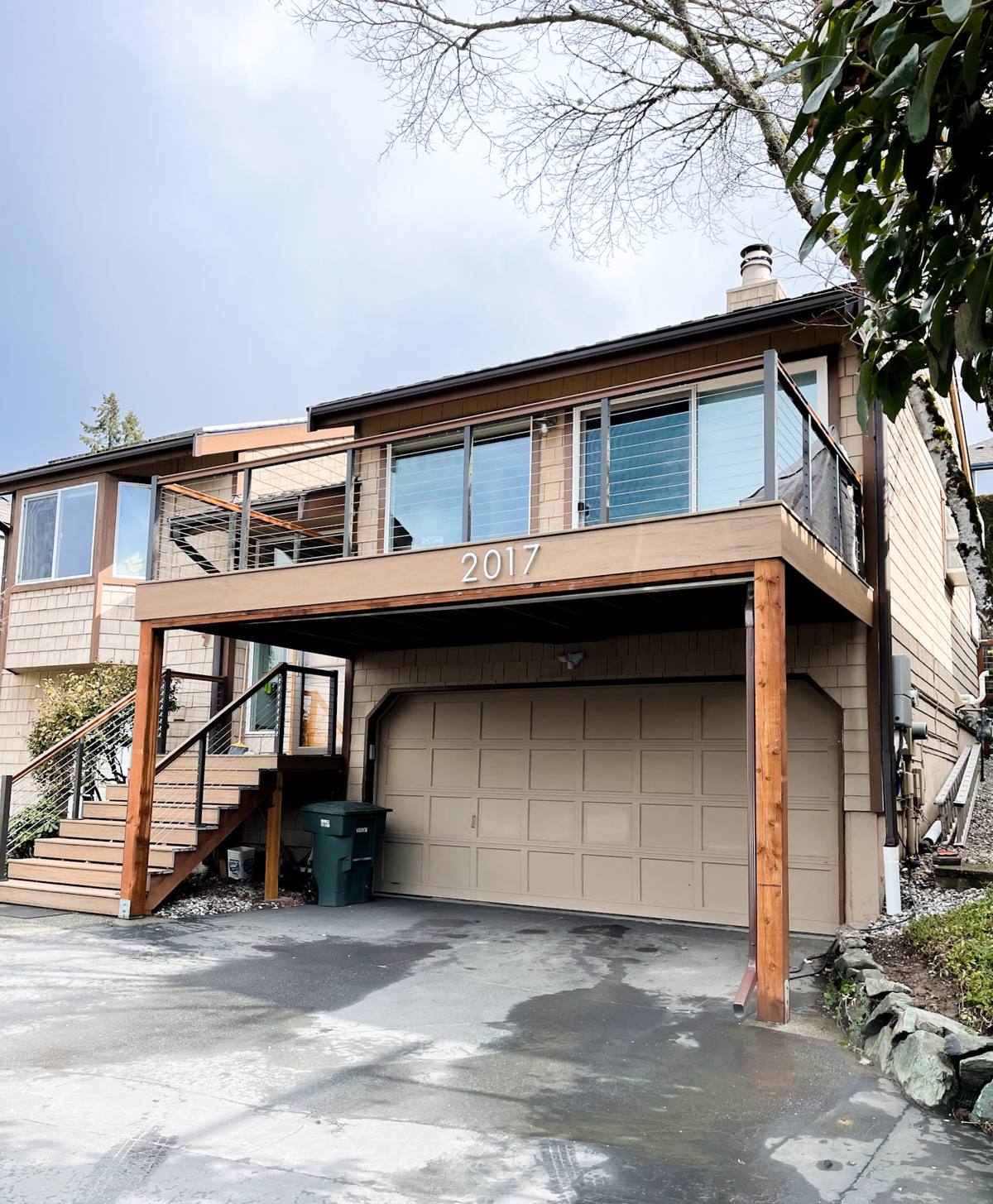
Most of the decks we look at in and around Barkley aren't failing because the composite boards themselves wore out. They're failing because of what's underneath or around them: a ledger board that was never properly flashed against the house, joists that trap water instead of shedding it, or a shaded corner of the yard where moss and algae get a permanent foothold. A correct installation addresses all three, not just the visible surface.
In practice, that means:
- Framing and hardware rated for coastal moisture exposure, not standard interior-grade fasteners
- A ledger board connection that's properly flashed and sealed where the deck meets the house
- Joist spacing and blocking that accounts for composite's slightly different flex characteristics compared to wood
- Airflow underneath the deck so moisture doesn't sit trapped against the framing
- A board pattern and drainage path that actually directs water away from the house instead of pooling near the foundation
Composite vs. Wood vs. PVC — How They Actually Compare Here
Homeowners in Barkley usually end up choosing between three options: pressure-treated wood, composite, and full PVC decking. Each has a real place, but the climate here changes the math compared to a drier region.
| Material | Moisture Behavior in This Climate | Maintenance Reality | Typical Lifespan Locally |
|---|---|---|---|
| Pressure-treated wood | Absorbs and releases moisture repeatedly; prone to cupping, splitting, and mildew staining in shaded, damp areas | Needs sealing or staining every 1-2 years to hold up against constant rain exposure | 10-15 years before major boards need replacing |
| Composite decking | Doesn't absorb water into the board itself; capped composite resists mold staining far better than wood | Periodic cleaning to stay ahead of moss and algae in shaded spots; no staining or sealing | 25-30+ years with proper installation |
| Full PVC decking | Fully waterproof, no organic material for moisture to feed into | Lowest maintenance of the three, but higher upfront cost | 30+ years |
Composite hits the middle ground most Barkley homeowners are actually looking for: a material that shrugs off the rain and salt air without the ongoing upkeep of wood, at a cost that's more accessible than full PVC. Where we don't recommend a product, it's usually a maintenance or moisture-performance trade-off worth knowing about upfront — not a knock on any manufacturer.
Capped vs. Uncapped Composite
Not all composite is built the same. Capped composite boards have a protective polymer shell around the wood-plastic core, which is what actually gives them their resistance to moisture absorption, staining, and fading. Uncapped or older-generation composite can still absorb some moisture at the core over time, which matters a great deal in a climate that stays damp for months at a stretch. For decks going in around Barkley, we lean toward capped composite specifically because of how long the wet season runs here.
What a Correct Installation Involves
The board itself is the part homeowners see, but the work that determines whether a composite deck lasts 10 years or 30 happens before a single board goes down.
Framing and Substructure
We build the substructure to handle sustained moisture exposure, not just occasional rain. That means corrosion-resistant fasteners and hardware throughout — standard hardware corrodes noticeably faster this close to Bellingham Bay's salt air — along with joist spacing that matches the composite manufacturer's span ratings rather than assuming wood-frame spacing will work the same way.
Ledger Board and Flashing
Where the deck attaches to the house is the single most common failure point we find on older decks in this area. If that connection isn't properly flashed, water works its way behind the ledger board and into the house's structure over time — a slow problem that isn't visible until it's already caused damage. We flash this connection correctly every time, no exceptions.
Drainage and Airflow
A deck built low to the ground or over a shaded, damp part of the yard needs a real plan for airflow underneath it. Without it, moisture gets trapped against the framing and the underside of the boards, which is exactly the environment moss and mildew need to take hold. We grade and vent the substructure so water actually moves away from the house instead of sitting there.
Cost Factors Worth Understanding Upfront
Composite decking costs more per square foot than pressure-treated wood upfront, but the comparison isn't just material cost — it's total cost over the life of the deck, including the maintenance wood requires that composite doesn't.
| Factor | What Drives the Cost |
|---|---|
| Deck size and layout | Square footage, number of levels, stairs, and railing complexity |
| Substructure condition | Whether existing framing can be reused or needs full replacement — common on older Barkley properties |
| Board tier | Capped composite vs. premium capped composite vs. full PVC |
| Site access and grading | Sloped lots, tree cover, and limited access can add labor time |
| Railing and fascia choice | Composite fascia and matching railing systems cost more than basic wood-and-composite combinations |
Rather than quote a number that doesn't reflect your actual property, we walk the site, look at what's already there, and give a straightforward estimate based on what your deck actually needs — not a generic template.
Our Process, Start to Finish
- On-site assessment — we look at the existing deck or the build site, check drainage, sun exposure, and how the structure ties into the house
- Honest scope and estimate — a clear breakdown of what needs to happen and why, with no pressure to upgrade beyond what makes sense for your home
- Framing and structural work — substructure built or reinforced to the standard this climate actually requires
- Flashing and waterproofing details — the ledger connection and any transitions against the house are sealed correctly before boards go down
- Composite board installation — hidden-fastener systems where appropriate, proper board spacing for expansion, and clean fascia work
- Final walkthrough — we go over the finished deck with you and explain basic care specific to your yard's sun and shade pattern
Living With a Long Wet Season and Moss Pressure
Even the best composite deck benefits from a little seasonal attention in a climate where moss season runs long and shaded corners rarely fully dry out. Composite doesn't need staining or sealing, but it isn't immune to surface growth if debris and moisture are left to sit.
- Sweep off fallen leaves and needles regularly, especially under tree cover — trapped organic debris is what feeds moss and algae
- Rinse the deck surface periodically during the wetter months rather than waiting for visible buildup
- Check that gaps between boards stay clear so water can drain through rather than pooling
- Keep gutters and downspouts near the deck clear so runoff isn't discharging directly onto or under it
- Inspect railing posts and ledger flashing once a year for any signs of movement or water intrusion
None of this is heavy maintenance — it's the difference between a deck that looks the same in year fifteen as it did in year one, and one that starts showing green staining in shaded corners within a couple of seasons.
Why Hiring a Crew That Already Works in Barkley Matters
A lot of deck problems we get called out to fix weren't caused by bad materials — they were caused by a crew that installed the deck the same way they would in a drier part of the country. Whatcom County's rain patterns, the salt exposure this close to the water, and the shade and tree cover common on Barkley lots all change what "correct installation" actually means. A contractor who works this area regularly already knows where water tends to collect on these lots, which hardware holds up and which corrodes early, and how to flash a ledger board so it doesn't become next year's hidden rot problem.
That local familiarity isn't a marketing point — it's the difference between a deck that needs attention in five years and one that doesn't need much of anything for the next two decades.
Questions Worth Asking Before You Commit
Whoever you choose to build your deck, a few questions will tell you a lot about how seriously they take the details that matter in this climate:
- Do they use corrosion-resistant fasteners and hardware, or standard interior-grade hardware?
- Do they flash the ledger board connection to the house, and can they explain how?
- Do they follow the composite manufacturer's span and spacing ratings, or just build it like a wood deck?
- Have they built decks elsewhere in Bellingham or Whatcom County that you could see in person?
- Are they upfront about maintenance expectations, or promising zero-maintenance in every scenario?
If you're weighing a new composite deck or replacing one that's not holding up to Barkley's weather, we're happy to take a look and give you a straightforward, no-pressure estimate — just fill out the form below.