 Bellingham Roofing
 Why Siding Fails Faster in Blaine Than Almost Anywhere Else in Whatcom County
Blaine sits about as close to open water and prevailing coastal weather as a Whatcom County home can get. That location is part of what makes it a great place to live, and it's also exactly why siding here takes more abuse than siding on a home twenty miles inland. Salt-laden air off the water accelerates corrosion on fasteners, trim, and any siding product that isn't formulated to handle it. Wind-driven rain doesn't just fall on Blaine homes — it gets pushed sideways into seams, laps, and trim joints that a calmer climate would never test. And the long, damp shoulder seasons that define Pacific Northwest weather give moss, algae, and mildew months at a time to take hold on anything that stays wet.
None of this is exotic. It's the same basic climate physics every coastal Whatcom County home deals with. But the closer a property sits to the water and open exposure, the more those forces compound. A siding job that would hold up fine in a sheltered inland neighborhood can start showing problems within a few years in Blaine if it wasn't installed with that exposure in mind.
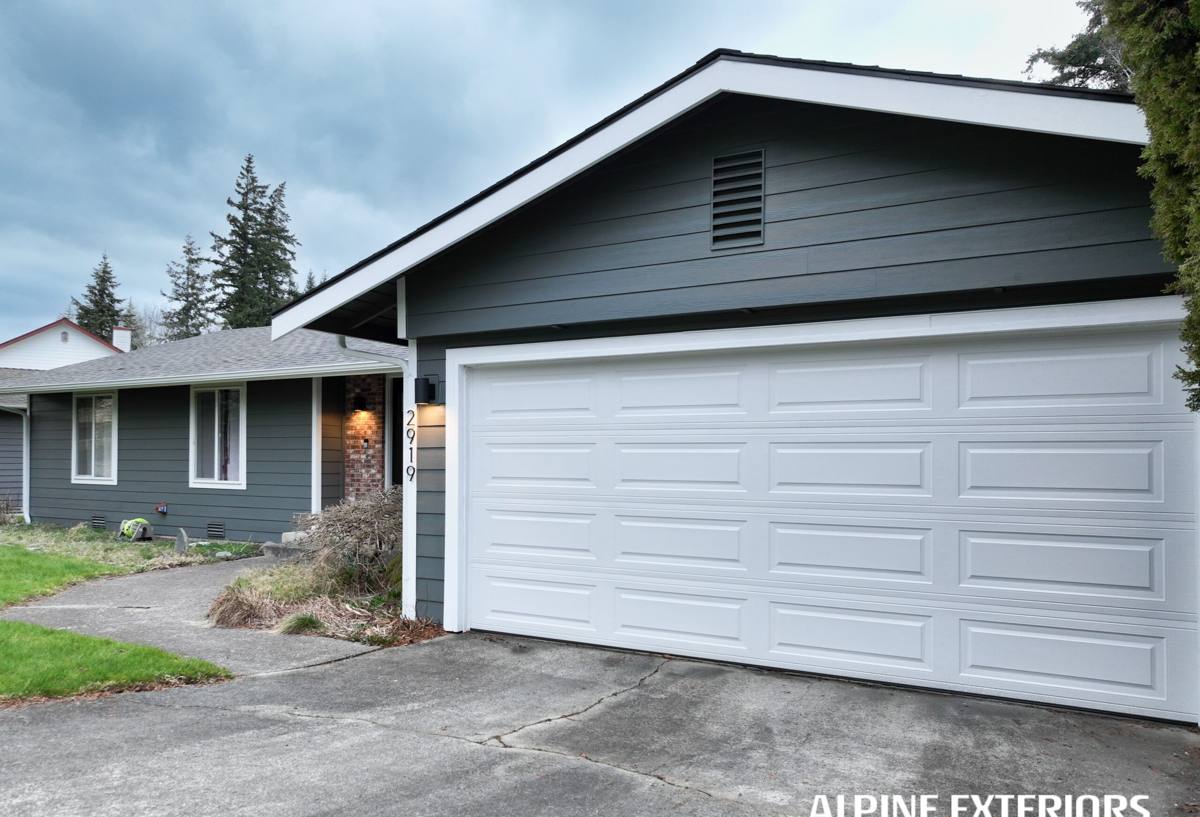
What Blaine Homes Actually Need From Their Siding
Boiled down, a Blaine home's siding has three jobs to do that matter more here than almost anywhere else in the region:
- Shed wind-driven water — not just rain falling straight down, but rain being pushed horizontally into laps, corners, and penetrations.
- Resist salt exposure — corrosion-resistant fasteners and trim details, and a siding material that doesn't degrade or swell when it stays damp with salt-laden moisture.
- Discourage moss and mildew growth — a stable, factory-finished surface that doesn't give organic growth the porous, absorbent surface it needs to colonize.
Homes that don't get all three end up with the classic coastal siding complaints: streaking and green growth on north- and west-facing walls, soft or swollen material at the bottom courses, rust bleeding from fastener heads, and paint that needs recoating far sooner than it should.
Why We Install Only James Hardie Fiber Cement
We made a deliberate decision as a company to install one siding system — James Hardie fiber cement — and not vinyl, LP SmartSide, or wood-based products. That's not a marketing position, it's a practical one built around what actually holds up in this climate.
Fiber cement doesn't absorb water the way wood-based or engineered-wood products can, so it doesn't swell, delaminate, or feed rot at cut edges and butt joints the way products with wood fiber content are prone to over time in a wet, coastal environment. It's also non-combustible, which matters more every year as wildfire smoke and ember exposure become a regional concern even in the wetter parts of the state. And James Hardie's ColorPlus factory finish is baked on under controlled conditions rather than field-applied, which gives it better adhesion and color retention against sun, salt, and constant moisture cycling than a job-site paint job typically achieves.
Vinyl has its place in some markets, but it isn't dimensionally stable the way fiber cement is — it expands and contracts with temperature swings, and in high-wind coastal exposure it's more prone to rattling, warping, or blowing off at the edges over time. LP SmartSide and similar engineered-wood products perform reasonably in drier climates, but their long-term track record in constant coastal moisture is the specific trade-off we're not willing to put on a Blaine home. We'd rather install one product correctly than offer several and hope the cheaper ones hold up.
The James Hardie HZ5 Advantage
James Hardie engineers its siding in climate-specific formulations called HZ (Hardie Zone) products. The Pacific Northwest, including Whatcom County, falls into a wetter, moisture-heavy zone, and Hardie's HZ5 product line is engineered specifically for that kind of exposure — better resistance to moisture-related damage than a one-size-fits-all product would offer. That regional engineering is part of why we don't treat "siding" as a generic product category; the specific formulation matters as much as the installation.
What Correct Installation Actually Involves
Fiber cement siding is only as good as the water-management system behind it. Most siding failures we see — regardless of brand — trace back to installation shortcuts, not the material itself. In a wind-driven-rain environment like Blaine, these details aren't optional extras; they're the difference between siding that lasts decades and siding that fails at year eight.
Flashing and Water Management
Every window, door, and penetration needs proper flashing that directs water out and away from the wall assembly, not just caulk bridging a gap. Weather-resistant barrier needs to be lapped correctly, shingle-style, so water moving down the wall never finds a seam to get behind. Butt joints and corners need to be treated as water-entry points, not just visual seams.
Fastening and Clearances
Fasteners need to be corrosion-resistant and set to Hardie's specification — not overdriven, not underdriven, and placed where the manufacturer's engineering says they belong. Siding needs proper clearance from grade, roof lines, decks, and other transitions so it isn't sitting in standing water or splash-back, which is one of the most common causes of premature failure at the bottom courses of a wall.
Caulking and Sealant Discipline
Sealant is a supporting detail, not a substitute for proper flashing and lapping. We use it where the manufacturer specifies it and rely on correct water-shedding geometry everywhere else — a wall that depends on caulk to stay dry is a wall that will eventually leak once that caulk ages, and in Blaine's climate, sealant ages faster.
Our Installation Process
| Stage | What Happens |
|---|---|
| Assessment | Inspect existing siding, sheathing, and trim for hidden moisture damage before any material is ordered |
| Prep & Water Barrier | Remove old siding as needed, repair or replace damaged sheathing, install and properly lap weather-resistant barrier and flashing |
| Installation | Install James Hardie panels or lap siding to manufacturer fastening and clearance specifications |
| Trim & Finish | Install corner trim, window and door trim, and touch-up per ColorPlus finish guidelines |
| Walkthrough | Final inspection with the homeowner to confirm the work matches what was scoped |
We don't skip the assessment stage, even on jobs that look straightforward from the outside. In a coastal environment, sheathing damage can hide behind siding that still looks fine from the street, and installing new siding over a compromised wall assembly just delays the same problem a few years.
How Coastal-Grade Siding Options Compare
| Material | Salt Air Resistance | Wind-Driven Rain Performance | Moss/Mildew Resistance | Typical Maintenance |
|---|---|---|---|---|
| James Hardie Fiber Cement | Strong — non-porous, factory finish | Strong when properly flashed and lapped | Strong — stable surface, factory finish | Low; periodic cleaning and inspection |
| Vinyl | Moderate; hardware can corrode | Moderate; prone to movement in high wind | Moderate; can trap moisture behind panels | Low, but limited repair options if damaged |
| LP SmartSide / Engineered Wood | Moderate; sensitive to prolonged moisture | Moderate; edge and joint sealing critical | Moderate; wood-based core is vulnerable if compromised | Moderate; coating and joint maintenance needed |
| Primed Spruce / Cedar | Weaker in constant salt exposure without diligent upkeep | Weaker without frequent recoating | Weaker; organic material feeds growth | High; regular refinishing required |
This isn't a knock on every other product on this list — vinyl and engineered wood both have legitimate uses in the right climate and budget. It's simply why, for the specific combination of salt air, driving rain, and moss season that defines Blaine's exposure, we standardized on the one material that consistently holds up best.
Signs Your Blaine Home's Siding Needs Attention
- Green or black streaking that returns quickly after cleaning, especially on north- or water-facing walls
- Soft, swollen, or spongy material near the bottom courses or around window sills
- Rust streaks bleeding from fastener heads or trim
- Paint that's peeling, chalking, or fading noticeably faster than the rest of the house
- Visible gaps, warping, or movement at seams and corners after wind events
- Interior signs like musty smells or discoloration near exterior walls, which can point to moisture getting behind the siding
Any one of these on its own might just need monitoring. Several at once, especially combined with the home's age, usually means the water-management layer behind the siding has been compromised and a proper inspection is worth doing before it turns into a larger repair.
Why It Matters That We Already Work in Blaine
Coastal wind and rain exposure isn't uniform even within Whatcom County — a home with open exposure toward the water needs more attention to flashing and clearance details than one tucked into a sheltered lot a few miles away. Crews that primarily work drier, inland jobs don't always carry that instinct into a coastal install, and it shows up years later in the form of moss growth, streaking, or soft trim that a crew used to this specific exposure would have caught and designed around from the start.
We also deal with the practical side of working near the border and along the coast regularly — site access, weather windows, and the realities of scheduling exterior work around this area's rain patterns. That familiarity translates into fewer surprises and a job that's planned around Blaine's actual conditions rather than a generic install checklist.
Get a Straightforward Look at Your Siding
If your Blaine home's siding is showing its age, or you're planning ahead before it becomes a problem, we're happy to take a look and give you an honest read on what's going on and what it would take to fix it right. Request a free, no-pressure estimate using the form below.