 Bellingham Roofing
 Sudden Valley's Siding Problem Isn't Like the Rest of Bellingham
Sudden Valley sits against Lake Whatcom, wrapped in second-growth forest that shades most lots for a good part of the day. That combination — lake humidity, heavy canopy, and limited direct sun — creates a microclimate that's tougher on exterior siding than a typical in-town Bellingham lot. Add in Whatcom County's broader marine climate — driving rain off the Puget Sound weather systems, salt-laden air working its way inland on winter storms, and a moss and algae season that can run eight months or more — and you've got a neighborhood where siding either holds up for decades or starts failing within five to eight years, with very little in between.
We've replaced siding on enough Sudden Valley homes to know the failure patterns aren't random. They cluster on the shaded north and east elevations, around roof-to-wall transitions where runoff concentrates, and on older wood or engineered-wood products that were never rated for this much sustained moisture exposure. A correct siding replacement here isn't just a cosmetic upgrade — it's a decision about which product and which install details will actually survive the site conditions.
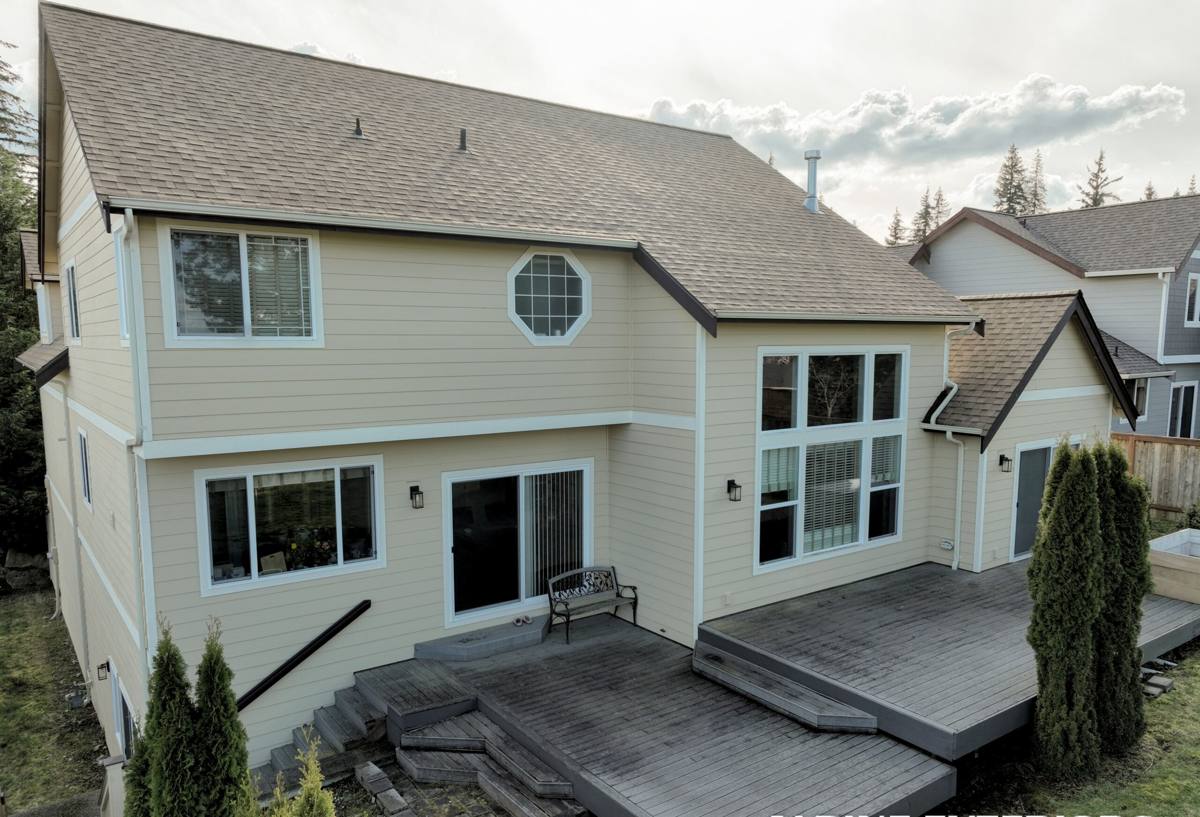
Why Standard Siding Struggles in a Lake-and-Forest Setting
Three site factors drive most of the siding problems we see when we're called out to Sudden Valley:
- Slow drying cycles. Tree cover blocks sun and wind that would otherwise dry out siding after rain. Wet siding that stays wet for days at a time is exactly what moss, algae, and rot need to take hold.
- Lake humidity. Proximity to Lake Whatcom keeps ambient moisture higher than drier upland Bellingham neighborhoods, especially in fall and winter.
- Driving rain and wind-blown moisture. Storms moving through Whatcom County push rain sideways into wall assemblies, not just straight down onto roofs — which is why flashing and water-resistive barrier details matter as much as the siding material itself.
None of these factors are unique to Sudden Valley individually, but the combination — heavy shade plus lake moisture plus regional wind-driven rain — is more aggressive than what most siding products were designed to tolerate over the long term.
Signs Your Siding Has Reached the End of Its Service Life
Homeowners often wait too long because siding damage in a shaded, wooded setting doesn't always look dramatic from the ground. Look for these signs during a walk around the exterior, particularly on the shaded sides of the house:
- Soft or spongy spots when you press on siding near the bottom courses or below windows
- Persistent green or black staining that returns within weeks of cleaning
- Visible buckling, cupping, or separation at seams and butt joints
- Paint that's peeling or bubbling rather than just fading
- Gaps opening up around trim, corner boards, or window and door casings
- A musty smell in adjoining interior rooms, which can indicate moisture has worked its way behind the siding
Any one of these can be an isolated repair. Several together, especially on a home with older wood or engineered-wood siding, usually means the assembly underneath has been compromised and a full replacement — done correctly this time — is the more honest recommendation.
Why We Only Install James Hardie Fiber Cement Here
We install exclusively James Hardie fiber cement siding, and we don't offer vinyl, LP SmartSide, cedar, primed spruce, Cemplank, or Allura as alternatives. That's a deliberate standard, not a sales pitch, and it matters more in a setting like Sudden Valley than almost anywhere else in our service area.
Fiber cement is non-combustible and dimensionally stable — it doesn't swell, warp, or feed rot the way wood-based products can when they stay damp for extended periods. That matters directly here: a shaded lot with slow drying cycles is precisely the environment where wood fiber products (including engineered wood siding) are most likely to take on moisture at cut edges and panel joints and begin breaking down from the inside out. Vinyl, meanwhile, can look fine for years while trapping moisture behind it against the sheathing, and it doesn't hold paint if a homeowner later wants to change the color. We've seen both patterns play out on Sudden Valley homes, which is why we stopped offering those systems rather than continuing to install something we knew wouldn't hold up to the site conditions.
James Hardie's ColorPlus factory-applied finish also matters here specifically because these lots don't get consistent sun exposure to help cure and maintain field-applied paint. A factory finish baked on under controlled conditions holds up more evenly across sun and shade than paint applied on site, which is exactly the kind of uneven exposure a wooded lake lot produces.
Matching the Right Hardie Product to Your Lot
HZ5 vs. HZ10 Engineering
James Hardie engineers its siding in climate-specific "HZ" (HardieZone) formulations. Our region falls into the wetter HZ zone designation used for the Pacific Northwest, and Hardie's HZ5 products are formulated with moisture and freeze-thaw performance suited to exactly this kind of climate — as opposed to the drier HZ10 formulation used in the desert Southwest. Getting the correct HZ product isn't optional; it's a baseline requirement we build into every quote.
Plank, Panel, or Shingle Profile
Most Sudden Valley homes we work on use HardiePlank lap siding for the main field, sometimes paired with HardieShingle in gable ends or accent areas for a more textured look against the wooded backdrop. HardiePanel vertical siding shows up on some contemporary lake-facing homes. The right choice depends on your home's existing architecture and how much of the wall area sits in deep shade versus partial sun, since that affects how visible streaking and staining will be over time on different textures.
| Product Line | Best Use | Why It Fits Sudden Valley |
|---|---|---|
| HardiePlank Lap Siding | Primary wall field, most home styles | Proven long-term performance in wet, shaded conditions; wide color range |
| HardieShingle | Gable accents, craftsman-style detailing | Textured look that complements a forested setting without the moisture risk of real wood shingles |
| HardiePanel | Vertical siding on modern or lake-facing elevations | Clean lines; performs the same as lap siding when flashed and jointed correctly |
| HardieTrim | Corner boards, window and door trim, fascia | Matches siding lifespan so trim doesn't fail years before the field siding |
What a Correct Installation Actually Involves
Tear-Off and Inspection
We remove the existing siding down to the sheathing and inspect the wall assembly before anything new goes up. In a moisture-heavy setting like Sudden Valley, this step often reveals soft sheathing, compromised framing, or water-resistive barrier that failed years before the siding itself showed visible damage. Any of that gets repaired before we install a single course of new siding — covering over a wet wall assembly with new siding just hides the problem for a few more years.
Water-Resistive Barrier and Flashing
This is the step that determines whether siding lasts 30 years or 8. We install a continuous water-resistive barrier, then flash every window, door, deck ledger, and roof-to-wall transition so that any water that does get behind the cladding has a clear path back out rather than a place to pool. Given how much wind-driven rain this area sees, we pay particular attention to horizontal transitions and any point where a roofline meets a wall — the most common failure points we find on older Sudden Valley homes.
Installing to James Hardie's Fastening and Clearance Specifications
James Hardie's warranty depends on installation to its published specifications — correct fastener type and spacing, minimum clearance from grade, decks, patios, and roof lines, and proper gapping and caulking at butt joints. We follow these specs as a baseline on every job, not as an upsell, because deviating from them is the single most common reason fiber cement siding fails to reach its expected service life.
Finishing Details
Corner boards, trim, and caulking get finished to shed water rather than trap it, and we coordinate paint or color touch-up so cut edges and field seams blend with the ColorPlus factory finish.
Our Process, Start to Finish
- Free on-site evaluation of your current siding, wall assembly, and problem areas specific to your lot's sun and shade exposure
- Written estimate detailing product line, color, and scope — no vague allowances
- Scheduling that accounts for Whatcom County's wetter months, since fiber cement installation needs dry working conditions for proper sealing and finishing
- Tear-off, sheathing inspection, and any necessary repairs before new materials go up
- Installation of water-resistive barrier, flashing, and Hardie siding to manufacturer specification
- Final walkthrough and site cleanup, including removal of old materials and debris
What Affects the Cost of a Siding Replacement in Sudden Valley
| Factor | Why It Matters Here |
|---|---|
| Extent of hidden sheathing or framing damage | Shaded, slow-drying walls are more likely to need structural repair before new siding goes on |
| Home access and lot grading | Sudden Valley's terrain and tree cover can affect staging, scaffolding, and material delivery |
| Product line and profile mix | Combining lap siding with shingle accents or trim upgrades adds labor and material cost |
| Number of penetrations and transitions | Homes with more windows, decks, and roof-to-wall intersections require more flashing detail work |
| Color and finish choice | Factory ColorPlus finishes vs. field-applied paint affect both cost and long-term maintenance |
We give a firm written quote after the site visit rather than a phone estimate, because so much of the real cost here depends on what condition the wall assembly is in once the old siding comes off.
Questions Worth Asking Before You Hire a Siding Crew for a Lake Lot
- Do you inspect and repair sheathing before installing new siding, or install over existing conditions?
- What water-resistive barrier and flashing details do you use at windows, decks, and roof transitions?
- Are you a James Hardie-trained installer, and do you follow their published fastening and clearance specs?
- Have you worked on homes in Sudden Valley or similar shaded, lake-adjacent lots specifically?
- What does your workmanship warranty cover, separate from the manufacturer's product warranty?
- How do you schedule around our wet season to make sure the siding is installed and sealed under proper conditions?
Why Local Experience in This Neighborhood Matters
Sudden Valley isn't a generic Bellingham subdivision — the combination of lake proximity, tree canopy, and limited road and lot access shapes both how siding fails and how a replacement job needs to be staged and executed. A crew that's worked this neighborhood before knows which elevations to inspect most carefully, how to plan around the moss and algae season for scheduling, and how site access typically works on these lots. That local pattern recognition shows up in fewer surprises once tear-off starts and in a finished job that's actually built for the conditions it has to survive, not just for a dry afternoon during the estimate.
If your Sudden Valley home's siding is showing staining that won't stay clean, soft spots, or open seams, we're happy to take a look and give you a straight answer about what's going on and what it will take to fix it right. Request a free, no-pressure estimate using the form below and we'll schedule a site visit.