 Bellingham Roofing
 Why Storm Damage Hits Fairhaven Roofs Differently
Fairhaven sits close to the water, and that location shapes what a roof has to put up with. Wind gusts coming off Bellingham Bay hit rooflines at different angles than they do a few miles inland, salt-laden air speeds up corrosion on fasteners and flashing, and the tree cover that makes the neighborhood shady and pleasant also keeps roof surfaces damp longer after a storm passes. None of this means Fairhaven roofs are poorly built. It means the maintenance and repair standard here has to account for conditions that a generic roofing checklist doesn't cover.
Storm damage repair in this part of Whatcom County is rarely about one dramatic event. More often it's a wind event or a hard rain that exposes a weak point that's been building for a while, whether that's aging flashing, a shingle that lost its seal, or moss that's been holding moisture against the deck longer than it should have.
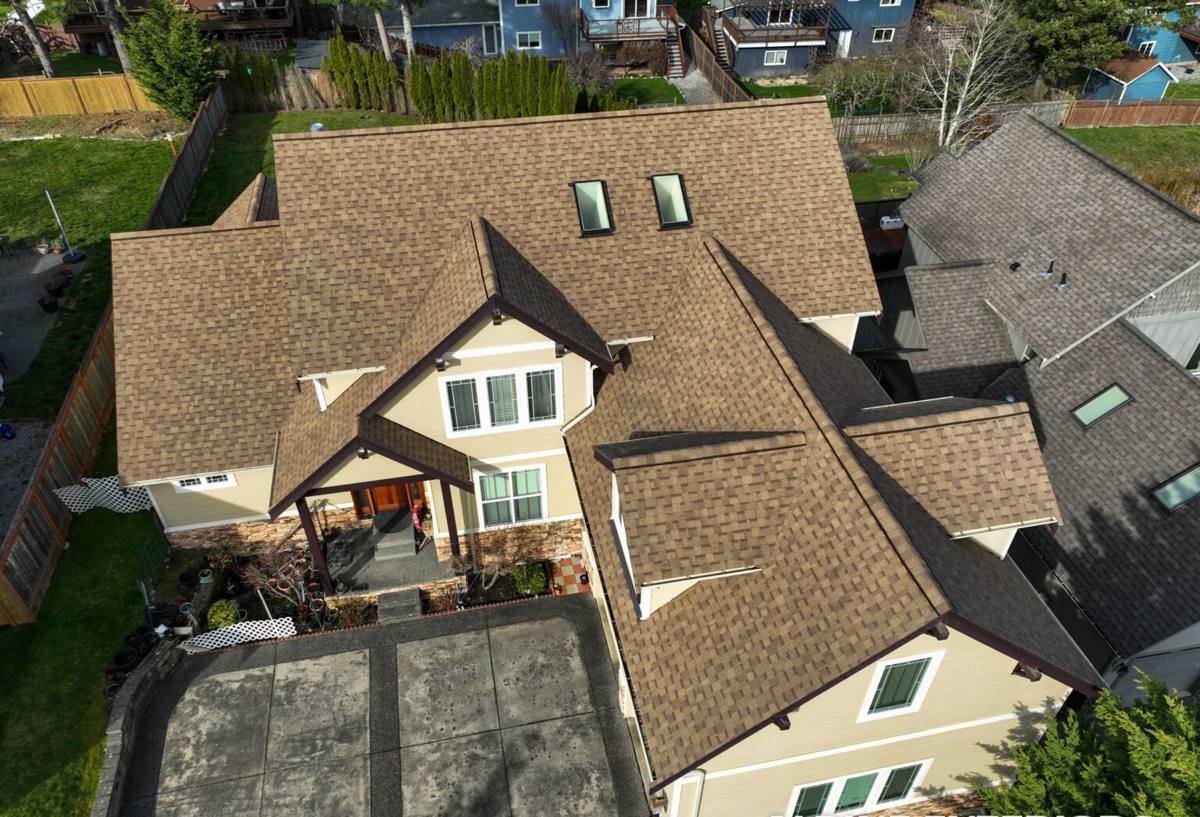
What Storm Damage Actually Looks Like
Storm damage isn't always obvious from the ground. It helps to know what you're actually looking for, or what a contractor should be looking for on your behalf.
Wind and Gust Damage
Sustained wind and sharp gusts can lift shingle tabs, crease them, or tear them off outright. Even when a shingle isn't missing, a lifted or creased tab has usually broken its seal, which means it's no longer shedding water the way it's supposed to. Exposed nail heads are another common sign — the nail is still holding, but the shingle around it has shifted or curled.
Water Intrusion Points
Most leaks after a storm don't come through the shingle field itself. They come through the transitions: flashing around chimneys and skylights, valleys where two roof planes meet, and the rubber boots around plumbing vents. These are the parts of a roof that rely on sealant and metalwork rather than shingle overlap, and they're the first things we check after wind-driven rain.
Moss, Debris, and Slow Damage
A long moss season means moss can establish itself on north-facing and shaded slopes well before anyone notices it from the street. Moss holds moisture against the roofing material, and during a storm that saturated moss adds weight and can work granules loose. Storm-blown debris — branches, needles, cones — can pile up in valleys and behind chimneys, creating small dams that back water up under the shingles above them.
Why Small Damage Doesn't Stay Small Here
In a drier climate, a small gap in flashing or a lifted shingle tab might sit for months without causing real harm. That's not really the case in a region that sees extended stretches of rain. Once water finds a way past the roofing surface, it doesn't take long for the plywood or OSB decking underneath to start absorbing moisture, and wet decking is where the real cost of a delayed repair shows up — soft spots, rot, and eventually the need to replace sheathing that a simple repair would have protected.
This is the main reason we push for a prompt inspection after any storm that produced strong wind or heavy rain, even if nothing looks obviously wrong from inside the house yet. Interior stains often show up weeks after the water intrusion actually started.
How We Handle a Storm Damage Repair Call
Our process is built around getting an honest read on the damage first, protecting the house from further water intrusion second, and doing the repair itself once we know exactly what we're dealing with.
- Inspection. We walk the roof (or use a lift/drone when conditions call for it) and check the shingle field, all flashing points, valleys, and any visible interior signs of leaking.
- Documentation. We photograph the damage in detail. This matters both for our own repair planning and because it's the kind of documentation an insurance adjuster will want to see if you're filing a claim.
- Temporary protection. If there's an active leak or exposed decking, we'll tarp or otherwise weatherproof the area before we leave, so the house isn't exposed to the next rain while a repair plan comes together.
- Repair plan and estimate. We tell you plainly whether you're looking at a targeted repair or something bigger, and why — no upselling a full replacement when a repair will genuinely hold up.
- Repair work. Damaged shingles, flashing, or decking get replaced with materials that match or reasonably blend with the existing roof wherever possible.
- Final check and cleanup. We confirm the repair is watertight, clear debris and old materials from the property, and leave the site clean.
Repair or Replace? What Actually Decides It
Homeowners often assume storm damage means a full roof replacement. Sometimes it does, but a lot of storm damage calls in Fairhaven end up being straightforward repairs. The table below covers the factors that actually drive that decision.
| Factor | Leans Toward Repair | Leans Toward Replacement |
|---|---|---|
| Roof age | Under roughly two-thirds of expected material lifespan | Near or past expected lifespan for the material |
| Extent of damage | Isolated to one section or a handful of shingles/flashing points | Spread across multiple slopes or the whole roof |
| Decking condition | Dry, solid sheathing under the damaged area | Soft, delaminated, or rotted decking found during inspection |
| Repair history | First or second repair on this roof | Repeated repairs on the same roof over recent years |
| Material match | Matching shingles/products still available | Discontinued product, visible mismatch would result |
We'll walk through where your roof falls on each of these before recommending either path, and we're not shy about recommending a repair when a repair is the honest answer.
Materials We Use for Salt Air and Moss Season
Flashing and Fasteners
Given the salt air off the bay, we favor corrosion-resistant flashing and fasteners over standard-grade hardware, even when it costs a bit more up front. Flashing is a low-visibility, high-consequence component — it's cheap compared to the rest of a roofing job, but it's also where most leaks originate, so it's not a place to cut corners.
Underlayment
We generally use synthetic underlayment rather than traditional felt for repair work in this climate. It handles prolonged damp conditions better and gives the repair a stronger secondary barrier during the stretch between the shingle going down and it fully sealing.
Product Choices We're Selective About
Some roofing products that work fine in drier climates aren't a great fit for a region with a long wet season and heavy shade cover. As a professional standard, we're cautious about products with known moisture-retention or installation-sensitivity issues in persistently damp conditions — not because any particular product is inherently bad, but because getting it right requires precise installation and ongoing maintenance that not every roof gets. We'll always explain the trade-offs of a given material rather than just steering you toward what's easiest for us to install.
Insurance Claims, Handled Straight
A fair amount of storm damage repair work ends up going through a homeowner's insurance policy, especially after a significant wind or rain event. We're not a public adjuster and we don't represent your insurance company, but we do provide the kind of documentation — photos, a written scope of damage, and a clear repair estimate — that makes the claims process go smoother. We report what we actually find, not an inflated version of it, and we're glad to be present or available by phone if your adjuster has questions about the scope of work.
Why a Crew That Already Works Fairhaven Matters
Roofing in a coastal Whatcom County neighborhood isn't identical to roofing twenty miles inland. A crew that already does regular work in Fairhaven has a working sense of how the local housing stock is built, which slopes tend to hold moss the longest, and how quickly a given roof style tends to age under salt air and shade. That familiarity shows up in faster, more accurate inspections and repair recommendations that hold up rather than needing to be revisited a year later.
It also matters for response time. Storm damage is time-sensitive — the sooner a compromised roof gets a tarp or a repair, the less chance water has to reach the decking or the inside of the house. A crew already working in and around Bellingham can typically get eyes on your roof faster than one dispatching from farther away.
A Quick Post-Storm Checklist
After any storm with strong wind or heavy rain, it's worth doing a quick check before damage has a chance to sit unnoticed.
- Walk the interior ceilings and upper closets for new stains, soft spots, or a musty smell
- Look at the yard and gutters for shingle granules, shingle pieces, or flashing debris
- Check the attic (if accessible) for daylight, damp insulation, or water stains on the underside of the decking
- Note any visibly lifted, missing, or curled shingles from ground level with binoculars rather than climbing up yourself
- Clear obvious debris from gutters and downspouts so water isn't backing up against the roof edge
- Call for an inspection promptly rather than waiting to see if a small issue gets worse
If a recent storm has you wondering whether your Fairhaven roof needs attention, we're glad to take a look. We offer a free, no-pressure estimate — you'll get a straight answer about what we find and what it would take to fix it, with no obligation to move forward. Reach out using the form below to get on the schedule.