 Bellingham Roofing
 South Hill's Siding Problem Isn't Like Other Neighborhoods'
South Hill sits up above the flats of Bellingham, close enough to Bellingham Bay to catch salt-laden air off the water, exposed enough on its higher, more open stretches to take driving rain sideways during winter storms, and shaded enough on its tree-lined blocks to grow moss on anything that stays damp too long. That combination — salt air, wind-driven rain, and heavy tree cover — is a harder environment for exterior siding than most homeowners realize until they're dealing with the results: chalky paint, soft trim, streaking, and green growth that keeps coming back no matter how many times it's washed off.
Whatcom County's marine climate means moisture is present in some form for most of the year. It's rarely a single hard freeze or one big storm that damages siding here — it's the slow, repeated cycle of rain, humidity, and shade that never fully dries out between weather systems. Older siding materials on South Hill homes are often doing fine on the sunny, wind-sheltered side of the house and failing badly on the north or west wall, which tells you everything about how localized the damage really is.
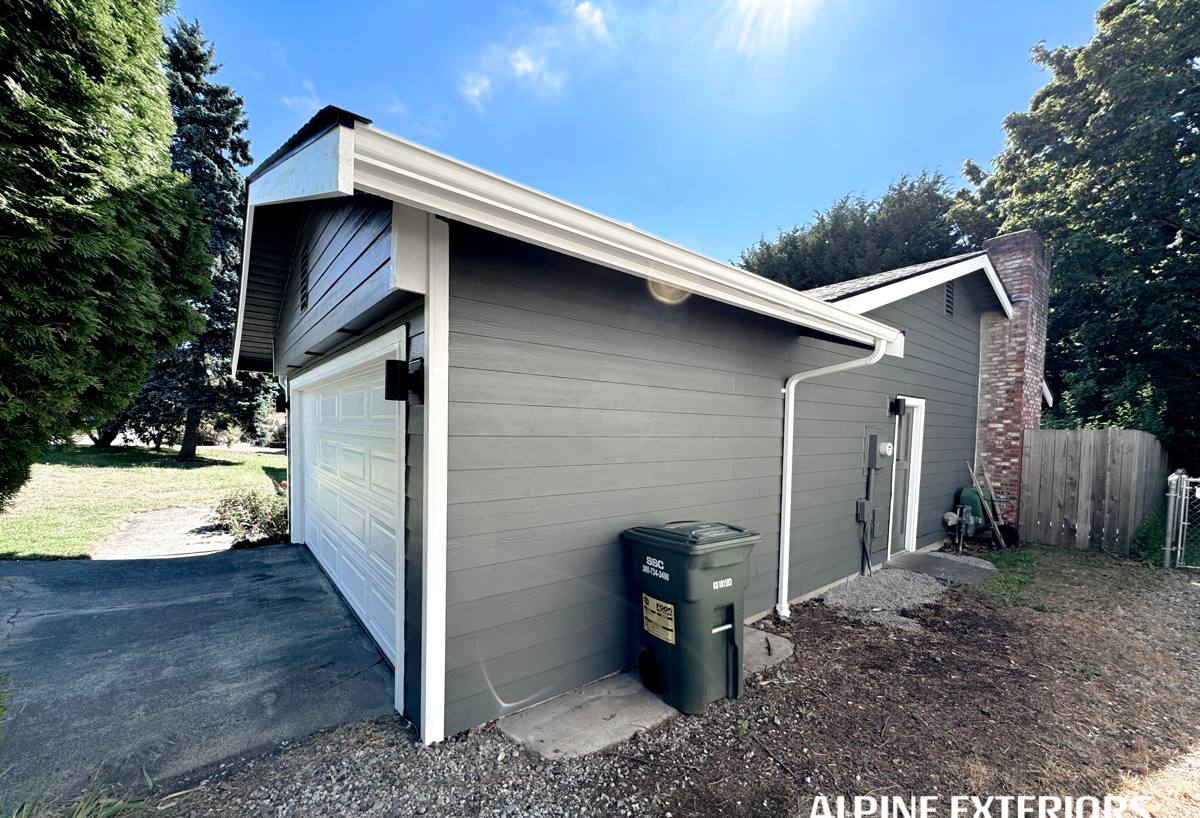
What James Hardie Siding Solves for This Neighborhood
James Hardie fiber cement is engineered around exactly this kind of moisture exposure. It's a non-combustible cement-based material, not wood or a wood byproduct, so it doesn't absorb water the way wood-based siding does, doesn't provide the organic material that moss and mildew feed on the way untreated wood fiber can, and doesn't swell, cup, or rot when it stays wet for extended stretches. That matters directly for South Hill, where shaded, north-facing walls can stay damp for days at a time during the fall and winter.
The factory-applied ColorPlus finish is the other half of the equation. It's baked on under controlled conditions rather than brushed or sprayed on site, which means it resists the fading, chalking, and peeling that field-applied paint struggles with under repeated rain and UV cycling. For a neighborhood with a mix of sun-exposed and shaded elevations on the same street, that consistency matters — the paint job doesn't age differently depending on which side of the house it's on.
Salt Air, Specifically
Homes closer to the bay-facing side of South Hill deal with airborne salt in a way that inland Whatcom County homes don't. Salt accelerates corrosion on fasteners and trim hardware and speeds up the breakdown of some paint films. Fiber cement itself isn't reactive to salt the way some metals are, but it still matters what fasteners, flashing, and trim products go with it — which is why the installation details below aren't optional extras.
Choosing the Right Hardie Product Line for South Hill
James Hardie makes climate-specific product lines, and for Whatcom County we install the HZ5 formulation, engineered for wetter, freeze-thaw climates rather than the HZ10 line built for hot, dry regions. Beyond that, the choice usually comes down to lap siding versus panel systems and how much of a role trim and accent material plays.
- HardiePlank lap siding — the most common choice for South Hill's traditional and craftsman-style homes; available in several exposure widths and smooth or cedar-textured finishes.
- HardiePanel vertical siding — used for accent sections, gables, or more contemporary homes, often paired with battens.
- HardieTrim — fascia, corner boards, and window/door trim in a matching factory finish, which avoids the mismatched aging you get when fiber cement siding is paired with painted wood trim.
- HardieSoffit — vented or non-vented panels for eave and overhang protection, an area that takes a steady beating from driving rain runoff.
Color selection matters more here than in drier climates. Darker ColorPlus tones handle UV fine but show water spotting differently than lighter tones on shaded walls, and we walk homeowners through how a given color is likely to read on a tree-covered lot versus an open one before anything gets ordered.
What a Correct Installation Actually Involves
Fiber cement siding is only as good as the water management system behind it. Most of the siding failures we get called out to inspect on Bellingham homes aren't a materials problem — they're a flashing, clearance, or fastening problem that let water behind the siding regardless of what brand was on the face of the wall. In a climate like South Hill's, those details are non-negotiable.
| Installation Detail | Why It Matters in South Hill's Climate |
|---|---|
| Weather-resistive barrier and proper overlap | Second line of defense behind the siding when wind-driven rain gets past the surface |
| Correct flashing at windows, doors, and roof lines | Prevents the concentrated water intrusion points that cause hidden rot behind the cladding |
| Minimum ground and roof clearance per Hardie spec | Keeps splash-back and pooled moisture off the bottom edge of the siding |
| Correct fastener type, spacing, and depth | Prevents nail pops, cracking, and premature corrosion from salt-influenced air |
| Caulking only where Hardie specifies it — not at every seam | Over-caulking traps moisture instead of letting the assembly drain and dry as designed |
| Proper joint treatment between panels | Reduces the visible seam lines and water entry points over time |
Why This Trips Up Installers Unfamiliar With the Product
Fiber cement is heavier and cuts differently than wood or vinyl, and it has its own fastening and clearance specifications that don't match what a general siding crew is used to. An installer who treats it like just another lap siding product tends to under-flash, over-caulk, or crowd the ground clearance — mistakes that don't show up as problems for a year or two, and then show up as exactly the moisture damage the product was supposed to prevent.
Our Process, Start to Finish
- On-site assessment — we look at the existing siding, sheathing condition where accessible, trim, flashing, and the specific exposure of each elevation (sun, shade, wind direction, roof runoff paths).
- Scope and product selection — lap width, texture, trim package, and color, matched to the home's style and its actual exposure on the lot.
- Written estimate — a clear breakdown of material, labor, and any additional work the assessment turned up (rot repair, flashing replacement, etc.).
- Tear-off and substrate check — old siding comes off and the sheathing underneath gets inspected before anything new goes on; hidden damage gets addressed, not covered up.
- Weather barrier and flashing install — the part of the job that determines whether the siding performs for 30+ years or 10.
- Hardie installation to manufacturer spec — correct fasteners, clearances, and joint treatment throughout.
- Final walkthrough — we go over the finished work with the homeowner before calling the job done.
Why We Only Install James Hardie
We get asked fairly often about vinyl, LP SmartSide, and other fiber cement brands, and it's a fair question. Vinyl is inexpensive and low-maintenance in the sense that it doesn't need painting, but it's a petroleum-based product that can warp in heat, crack in cold, and simply doesn't hold up as well against the freeze-thaw and constant-moisture cycle Whatcom County sees. LP SmartSide is a wood-strand product with real strengths — it's lighter and easier to install than fiber cement — but it's still an engineered wood product at its core, meaning it depends on an intact factory coating and careful field sealing at every cut edge to keep moisture out; in a climate this wet, that's a maintenance burden we're not willing to put on a homeowner's roof over their head. Other fiber cement brands compete on price but generally don't match Hardie's regional-specific engineering, factory finish warranty, or track record in Pacific Northwest conditions.
We standardized on James Hardie because it's non-combustible, doesn't feed moss and mildew the way organic-based siding can, holds its factory finish longer under UV and rain cycling than field-applied paint, and comes with a strong transferable warranty when installed to spec. That last part matters — the warranty is only as good as the installation behind it, which is why we don't treat the flashing and clearance details as optional.
Living With Hardie Siding on South Hill
Fiber cement is low-maintenance, not no-maintenance. A little seasonal attention goes a long way toward getting the full lifespan out of the material and the finish.
- Rinse the siding down once or twice a year, especially on shaded, moss-prone walls, using a garden hose — avoid high-pressure washing directly at seams and joints.
- Keep gutters clear so roof runoff isn't sheeting down the siding face during heavy rain.
- Trim back tree branches and shrubs that keep a wall shaded and damp longer than the rest of the house.
- Check caulking at trim and penetration points every year or two and have any gaps addressed before winter.
- Watch for any soft spots, staining, or bubbling at the bottom edge near grade — an early sign of a clearance or flashing issue worth having checked.
Cost Factors for a South Hill Siding Project
Every home is different, but the variables that move the price on a South Hill job tend to be the same ones.
| Factor | How It Affects the Job |
|---|---|
| Home size and number of stories | More surface area and elevated work (scaffolding/lifts) on multi-story homes |
| Existing siding removal | Tear-off adds labor and disposal cost versus a bare-sheathing install |
| Hidden sheathing or framing repair | Rot or moisture damage found underneath needs to be fixed before new siding goes on |
| Trim and accent complexity | Multiple gables, dormers, and trim details add labor beyond flat wall area |
| Product line and finish selection | Panel texture, exposure width, and color all carry different material costs |
| Site access | Tree-covered or tight lots common in South Hill can slow staging and material handling |
We give a written, itemized estimate after the on-site assessment rather than a rough phone quote, because the tear-off and substrate condition genuinely can't be judged accurately from the street.
Why a Crew That Already Works This Neighborhood Matters
South Hill's mix of elevation, tree cover, and proximity to the bay means the right approach on one block can be the wrong approach two streets over — a shaded, moss-prone lot needs different attention than an open, wind-exposed one. A crew that's already worked in the neighborhood has a feel for which elevations tend to take the worst of the weather, what the older housing stock in the area typically has going on behind the existing siding, and how to sequence a job around Bellingham's rain patterns instead of getting caught mid-installation by a system rolling in off the water.
If you're weighing a siding replacement on a South Hill home, we're happy to come take a look, walk the property with you, and put together a straightforward, no-pressure estimate — no obligation, just a clear picture of what your home needs and what it would take to do it right.