 Bellingham Roofing
 Happy Valley's Siding Problem Isn't Like Everywhere Else
Happy Valley sits close enough to Bellingham Bay that salt-laden air is a constant background condition on your home's exterior, not an occasional event. Combine that with the driving, wind-pushed rain that comes off the water during fall and winter storms, and you get a siding environment that's harder on materials than most inland neighborhoods in Whatcom County ever see. Add a moss season that can run eight months out of the year on shaded, north-facing walls, and you have three separate stresses — salt, water, and organic growth — working on your siding at the same time, year after year.
A lot of the siding failure we see in this neighborhood isn't dramatic. It's slow: a little more moisture wicking into a seam each winter, a little more moss holding dampness against the wall each spring, a little more UV and salt breaking down a factory coating each summer. By the time it's visible from the street, the damage underneath is usually further along than it looks. That's the case for treating a siding replacement here as a system decision, not just a materials swap.
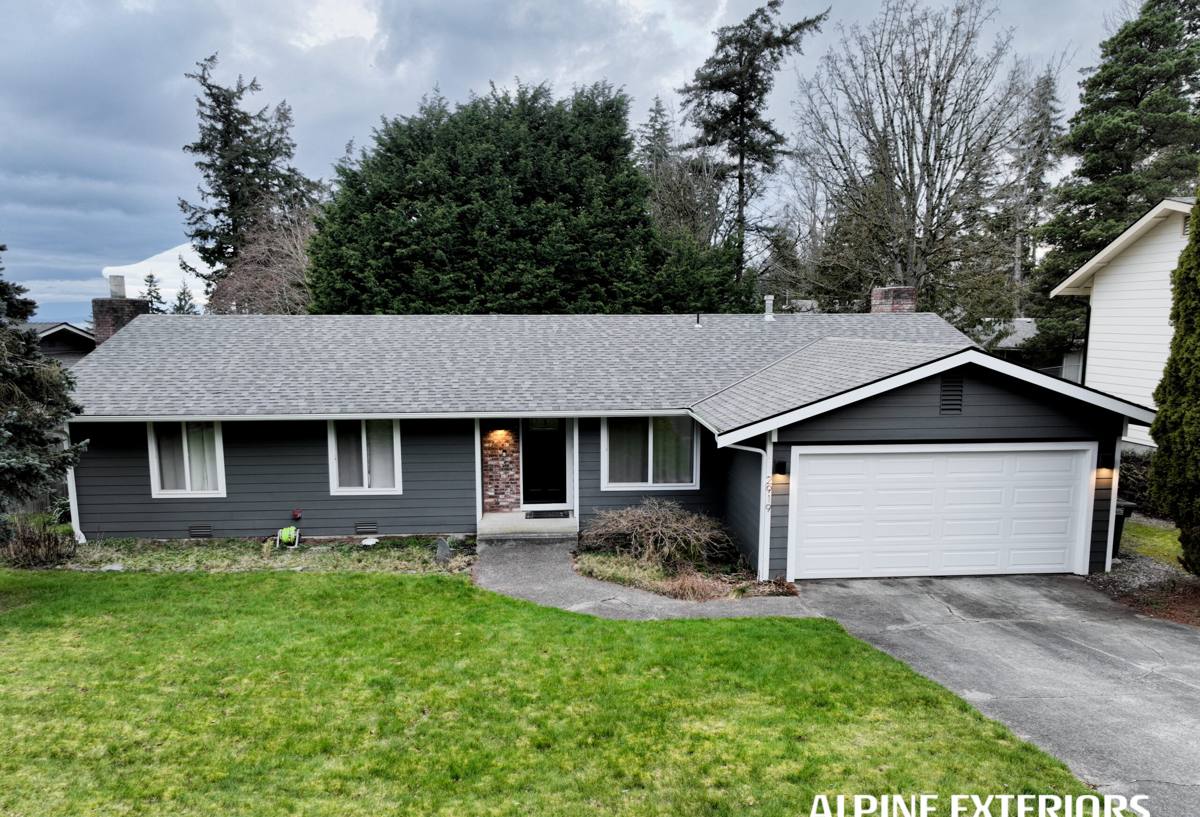
How Salt Air, Rain, and Moss Actually Damage Siding
Salt Air
Airborne salt is corrosive to fasteners and hard on paint films and factory finishes. On lower-grade siding products, salt exposure accelerates chalking, fading, and coating breakdown at a rate you won't see on a home twenty miles inland. It also finds its way into any tiny gap in flashing or caulk and keeps that gap wet longer than plain rainwater would.
Driving Rain
Bellingham's storms often come with real wind behind them, which pushes water sideways and upward into laps, seams, and trim intersections that were only ever designed to shed water moving straight down. Siding that depends on paint or caulk alone to stay watertight — rather than on the material's own resistance to moisture — is the siding that fails first in this kind of weather.
Moss and Organic Growth
Shaded walls, roof overhangs, and the tree cover common in established Bellingham neighborhoods keep certain wall sections damp for extended stretches. Moss and algae don't just look bad — they hold moisture directly against the siding surface, which is exactly the condition that causes wood-based and poorly sealed products to swell, delaminate, or rot from the inside out.
What This Means for Your Home Specifically
If your Happy Valley home still has its original siding — whether that's aging cedar, an older fiber cement product, or vinyl installed decades ago — the combination above has likely been working on it the whole time. Common signs we look for during an assessment include soft or spongy spots near the bottom courses and around window trim, visible moss or dark staining on north- and west-facing walls, paint that's chalking or peeling faster than it should, and any siding that flexes or feels hollow when pressed. None of these are cosmetic issues by the time they're visible — they're indicators of moisture that's already moved past the surface.
Why We Install Only James Hardie Fiber Cement Here
We made a standing decision as a company to install James Hardie fiber cement siding exclusively — not vinyl, not LP SmartSide, not Cemplank or Allura, not primed spruce or cedar. That's not a marketing position; it's a response to exactly the conditions described above. Hardie's fiber cement is non-combustible and dimensionally stable, meaning it doesn't expand, contract, warp, or absorb water the way wood-based or engineered-wood products can. In a neighborhood dealing with constant moisture cycling, that stability matters more than almost anything else.
Hardie also builds region-specific product lines engineered for the exact climate zone a home sits in. For Whatcom County's marine, wet-winter climate, that means an HZ5 formulation designed to resist moisture intrusion and freeze-thaw stress better than a generic all-climate board. The factory-applied ColorPlus finish is baked on under controlled conditions and backed by its own finish warranty, which holds up to salt air and UV exposure far better than field-applied paint. We're not against every alternative product on its own merits — some perform reasonably well in mild, dry climates. But we don't think they're the right call for a neighborhood this close to the water, and we'd rather turn down that install than warranty a product we don't trust in these conditions.
What a Correct Siding Replacement Actually Involves
Tear-Off and Wall Inspection
Every proper replacement starts with full removal of the existing siding, not a re-side over the top of it. This is the only point where we can actually see the sheathing, framing, and any hidden moisture damage. In older Happy Valley homes, this step sometimes turns up soft sheathing or past water intrusion around windows and corners that needs to be repaired before any new siding goes on — covering that up would just seal the problem inside the wall.
Water-Resistive Barrier and Flashing
A weather-resistive barrier goes over the sheathing, and flashing gets installed at every window, door, and horizontal trim transition — the exact spots where wind-driven rain finds its way in. This layer does most of the real waterproofing work; the siding itself is the second line of defense, not the only one.
Hardie Panel Installation
Fiber cement has to be installed to manufacturer spec to perform as designed — correct fastener type and placement, proper clearance from grade and roof lines, and correctly lapped and caulked joints. Installation quality is the single biggest variable in how long any siding job lasts, regardless of material.
Trim, Caulking, and Finish Details
Corner boards, trim, and caulking at penetrations are finished last. In a high-moisture neighborhood, these details are often where premature failure starts if they're rushed, so we treat them as part of the water management system rather than an afterthought.
Comparing Siding Options for This Climate
| Material | Moisture Behavior in Salt Air/Rain | Maintenance Burden | Typical Longevity Here |
|---|---|---|---|
| James Hardie Fiber Cement (HZ5) | Dimensionally stable, engineered for wet marine climates | Low — factory finish resists chalking and fading | Decades with correct install |
| Vinyl | Doesn't absorb water, but can warp/crack under UV and temperature swings; seams are vulnerable | Low, but repairs and color-matching are difficult | Variable; brittleness increases with age |
| LP SmartSide / Engineered Wood | Wood-based core is moisture-sensitive if any seal point fails | Moderate — depends heavily on caulk/paint upkeep | Shorter if moisture gets behind the surface |
| Cedar / Primed Spruce | Natural wood; absorbs moisture, prone to rot and moss retention | High — regular refinishing and inspection needed | Shortest without frequent maintenance |
This isn't a claim that every alternative fails on every home — climate, exposure, and maintenance habits all matter. It's why, specifically for a neighborhood with Happy Valley's exposure profile, we've standardized on the option in the table that needs the least ongoing intervention to hold up.
What Affects the Cost of a Siding Replacement
| Factor | Why It Matters |
|---|---|
| Home size and wall complexity | More corners, gables, and trim detail mean more labor and material |
| Condition of the sheathing underneath | Rot or water damage found during tear-off adds repair scope |
| Siding profile and accessories | Lap width, trim style, and accent details affect material cost |
| Access and site conditions | Slopes, landscaping, and setbacks common in older Bellingham lots can affect staging |
| Existing siding removal | Layers of old material or hazardous coatings can add disposal time |
We don't quote firm numbers until we've actually looked at the home, because guessing at any of these factors sight-unseen does homeowners a disservice. What we can say honestly is that fiber cement typically costs more upfront than vinyl and comparably to or less than ongoing-maintenance wood options once you account for repainting and repair over the life of the siding.
Our Process, Start to Finish
- On-site assessment of current siding condition, moisture signs, and problem areas specific to your home's exposure
- Written proposal covering Hardie product line, color, trim details, and full scope of work — no vague allowances
- Scheduled tear-off with sheathing inspection and repair of any hidden damage before new siding goes on
- Installation of water-resistive barrier, flashing, and Hardie panels to manufacturer spec
- Final trim, caulking, and cleanup, with a walkthrough before we consider the job done
- Manufacturer warranty paperwork registered on your behalf
Why Hiring a Crew That Already Works Happy Valley Matters
A siding replacement is only as good as the water management decisions made during installation, and those decisions change depending on exposure, wall orientation, and how a specific neighborhood's weather behaves. A crew that's replaced siding across Bellingham and Whatcom County has already seen how salt air and driving rain interact with flashing details, where moss tends to build first, and which wall orientations in this area need extra attention at trim and penetrations. That's not something you get from a crew that mostly works dry inland subdivisions — the failure points are different, and the fixes are different.
If your siding is showing moss buildup, soft spots, peeling paint, or you're just planning ahead before small problems become expensive ones, we're glad to walk your home with you. The estimate is free, there's no pressure, and you'll get a straight answer about what your siding actually needs — not just a sales pitch. Use the form below to get started.