 Bellingham Roofing
 Why Siding Fails Faster in Blaine
Blaine sits at the northern edge of Whatcom County, right up against the water and the Canadian border, and that location comes with a specific set of siding problems. Homes here take a steady diet of salt-laden air, wind-driven rain off the water, and a moss season that runs longer than it does even a few miles inland. None of that is unique to any one house — it's the baseline every property in this stretch of coastline deals with, and it's why siding that looks fine on a spec sheet can still fail early once it's actually installed here.
Salt Air and Metal Fasteners
Airborne salt accelerates corrosion on anything metal — nail heads, flashing, trim fasteners, even the staples or screws holding siding panels in place. Once a fastener starts to rust, it loses its grip, and a panel that used to sit flat starts to lift, gap, or rattle in the wind. On homes closer to the water, we see this show up years before it would on a similar house further inland.
Driving Rain and Wind Exposure
Storms coming off the water don't just fall straight down — wind pushes rain sideways and up under laps, seams, and trim edges that were never meant to take water from that angle. Over time, that wind-driven rain finds every weak seam, every under-caulked joint, and every spot where a panel has started to separate from the wall.
Moss and Algae Season
Whatcom County's damp, mild winters keep moss and algae active for a large part of the year. On siding, that growth holds moisture against the surface long after a storm has passed, which is exactly the condition that leads to rot, paint failure, and swelling in anything that isn't genuinely moisture-resistant.
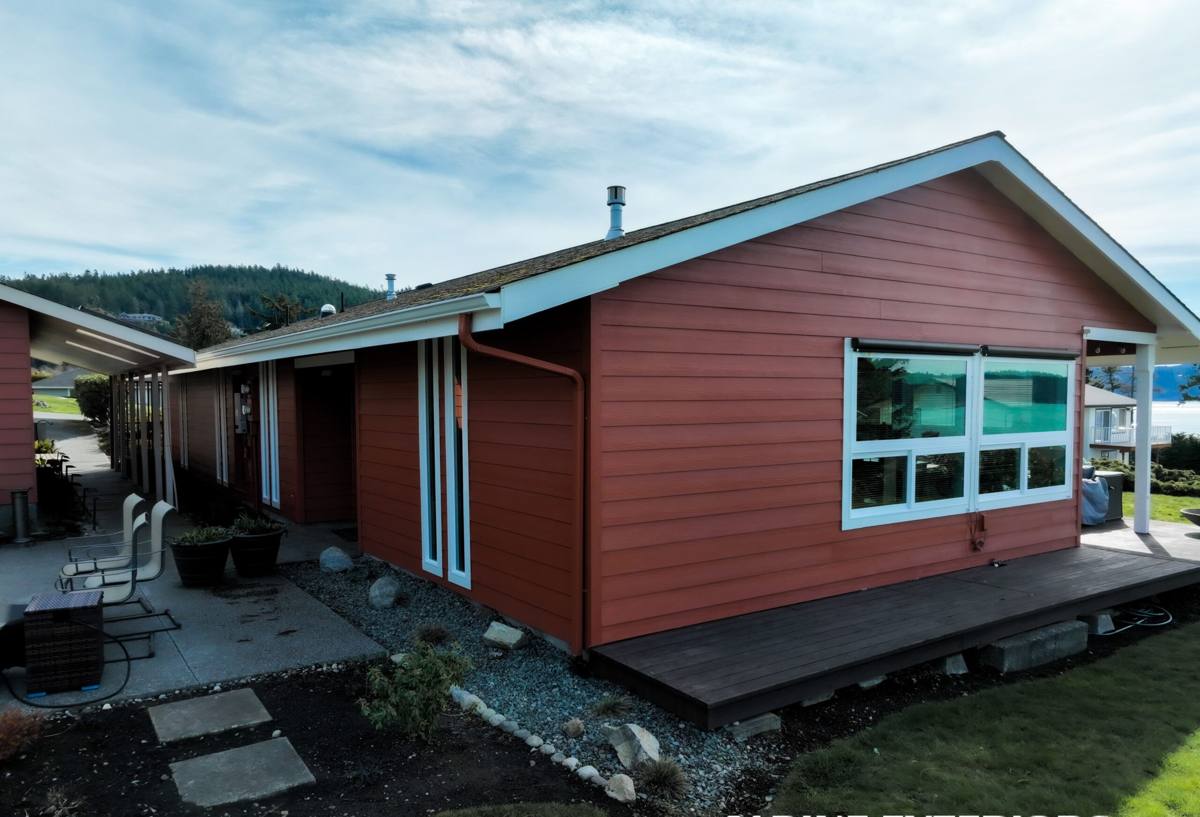
Signs Your Blaine Home Needs Siding Repair
Most siding problems don't show up as a dramatic failure — they show up as small, easy-to-miss changes that get worse if they're ignored through another wet season. Walk your exterior and look for:
- Panels or boards that look warped, bowed, or separated from the wall
- Soft or spongy spots when you press on the siding, especially near the bottom courses
- Paint that's peeling, bubbling, or chalking well before you'd expect a repaint
- Visible gaps at seams, corners, or around window and door trim
- Rust streaks running down from nail heads or metal trim pieces
- Persistent moss or dark staining that keeps coming back after cleaning
- Any section that feels noticeably colder or damper than the rest of the wall
Any one of these on its own might be minor. Several together, or one that's spreading, usually means water has already gotten past the surface and into the wall assembly.
Repair vs. Replacement: How We Decide
Not every problem calls for tearing off a wall's worth of siding. But repairing the wrong section — or repairing when the underlying sheathing is already compromised — just delays a bigger job and costs more in the end. Here's how we think through it on a Blaine call:
| Factor | Leans toward repair | Leans toward replacement |
|---|---|---|
| Extent of damage | Isolated to one or two panels or a single wall section | Spread across multiple elevations or recurring in the same areas |
| Sheathing condition | Dry, solid wood behind the siding once opened up | Soft, delaminating, or visibly rotted sheathing |
| Age of existing siding | Newer install with a clear, isolated cause (storm, impact, one bad fastener run) | Older siding already near the end of its service life |
| Cause of failure | One-off event — impact damage, a single failed caulk joint | Systemic issue — product-wide moisture behavior, chronic fastener corrosion |
| Color/product match | Matching material or paint is available and will blend acceptably | Original product is discontinued, faded, or a poor match is unavoidable |
We'll always tell you honestly which side of that table your house falls on. If a targeted repair will hold up through Blaine's next few wet seasons, that's what we'll recommend — we don't upsell a full re-side when it isn't warranted.
What a Correct Siding Repair Involves
A repair that's done right isn't just swapping a damaged board for a new one. It involves:
- Opening up the damage to see how far it actually extends — surface damage often hides wet or soft sheathing underneath.
- Checking the water-resistive barrier (the house wrap or building paper) behind the siding for tears, gaps, or improper lapping that let water in to begin with.
- Replacing any compromised sheathing or framing before new siding ever goes back on — covering up wet wood just hides the problem.
- Correcting flashing and drainage details at the point of failure so the same spot doesn't fail again next storm season.
- Installing new siding to the manufacturer's fastening and clearance specs — proper nail placement, gapping, and ground clearance matter as much on a repair as on a full install.
- Matching and finishing so the repaired section blends with the surrounding wall as closely as the situation allows.
Skip any of those steps and you've patched the symptom while leaving the cause in place — which in a climate like this one just means a repeat call in a year or two.
Why We Only Repair and Replace With James Hardie
When we're called out to repair a section of siding, homeowners sometimes expect us to patch it with whatever product is already on the house — vinyl, LP SmartSide, cedar, or a fiber cement brand other than Hardie. We don't stock or install those products, and we want to be upfront about why.
Vinyl expands and contracts with temperature and can crack or warp under impact, and it isn't the most forgiving material against long-term moisture exposure at seams. Engineered wood products like LP SmartSide perform well when the coating and sealed edges stay intact, but any breach — a saw cut, a fastener hole, an impact — exposes wood fiber that can swell if moisture gets in, which is a hard risk to manage in a wet, salt-air climate. Primed spruce and cedar are real wood, with real wood's maintenance demands: repainting, sealing cut ends, and ongoing vigilance against rot, especially with the moss and moisture load Blaine sees for much of the year. Other fiber cement brands can be reasonable products, but we've standardized on one system so every repair we do meets the same install spec and carries the same warranty backing.
James Hardie fiber cement is non-combustible, engineered specifically for wet, coastal Pacific Northwest conditions in its HZ5 product line, and comes with a factory-applied ColorPlus finish that resists fading and doesn't require repainting on the same schedule as field-painted materials. It holds up to the freeze-thaw, moss, and driving rain this stretch of coastline delivers, and it carries a strong transferable warranty when installed to Hardie's specifications — which is exactly what our crews are trained to do. When we repair a section, we can tie new Hardie material into existing Hardie siding cleanly. When the existing siding is a different product, we'll say so plainly and talk through whether a repair will actually hold, or whether it's time to talk about replacement.
Our Process for Blaine Siding Repair Calls
We keep the repair process straightforward:
- A hands-on inspection of the damaged area and the surrounding siding, not just a glance from the ground
- An honest assessment of whether the sheathing and framing behind the siding are still sound
- A clear explanation of what caused the failure, so you're not guessing whether it'll happen again
- A written scope and price before any work starts — no surprise add-ons mid-job
- Repair work scheduled around Whatcom County's weather windows, since siding work needs reasonably dry conditions to be done right
- A finished repair that matches the surrounding wall as closely as the situation allows
What Happens When Repairs Get Put Off
In a drier climate, a small gap or a loose panel might sit for a season without much consequence. In Blaine, driving rain and a long moss season don't give damaged siding that kind of grace period. Water that gets behind siding and stays there — held in by moss, trapped by a failed seam, wicking up through a soft board — moves from a repair job to a rot and sheathing job faster than most homeowners expect. Catching the early signs and calling for a repair while it's still a repair is almost always the cheaper and less disruptive path.
Why a Crew That Already Works Blaine Matters
Siding repair in a coastal, high-moisture climate isn't identical to siding repair inland, and a crew that mostly works drier parts of the county can miss things that are obvious to someone who deals with this coastline regularly — where salt corrosion tends to concentrate, which wall orientations catch the worst of the driving rain, how aggressive the moss growth actually gets here compared to a textbook estimate. Working in Blaine and the surrounding Whatcom County coastline means we're not guessing at how these homes age; we're seeing it on repeat calls and building our repair details around what actually holds up.
If you're seeing early signs of siding damage on your Blaine home — or you're not sure whether what you're looking at is a simple repair or something bigger — we're happy to come take a look. Reach out for a free, no-pressure estimate using the form below, and we'll give you a straight answer about what your siding needs.