 Bellingham Roofing
 Why Lynden Roofs Age Differently Than Roofs Inland or Down South
Lynden sits in the part of Whatcom County where weather doesn't really take a break. The rain isn't always heavy, but it's frequent and it lingers — roofs here can stay damp for days at a stretch during the fall and winter months. Add in the moss season that stretches longer than most homeowners expect, plus the salt-tinged air that moves inland off the Sound and Strait on windy days, and you've got a combination that shortens the working life of a roof that wasn't built or installed with this climate in mind.
A new roof installation in Lynden isn't just about swapping old shingles for new ones. It's about choosing materials and installation details that hold up to sustained moisture, resist moss colonization, and shed driving rain instead of letting it work its way under the edges. Homes that get a generic installation — the kind that would be fine in a drier region — tend to show moss growth, granule loss, and soft decking years before they should.
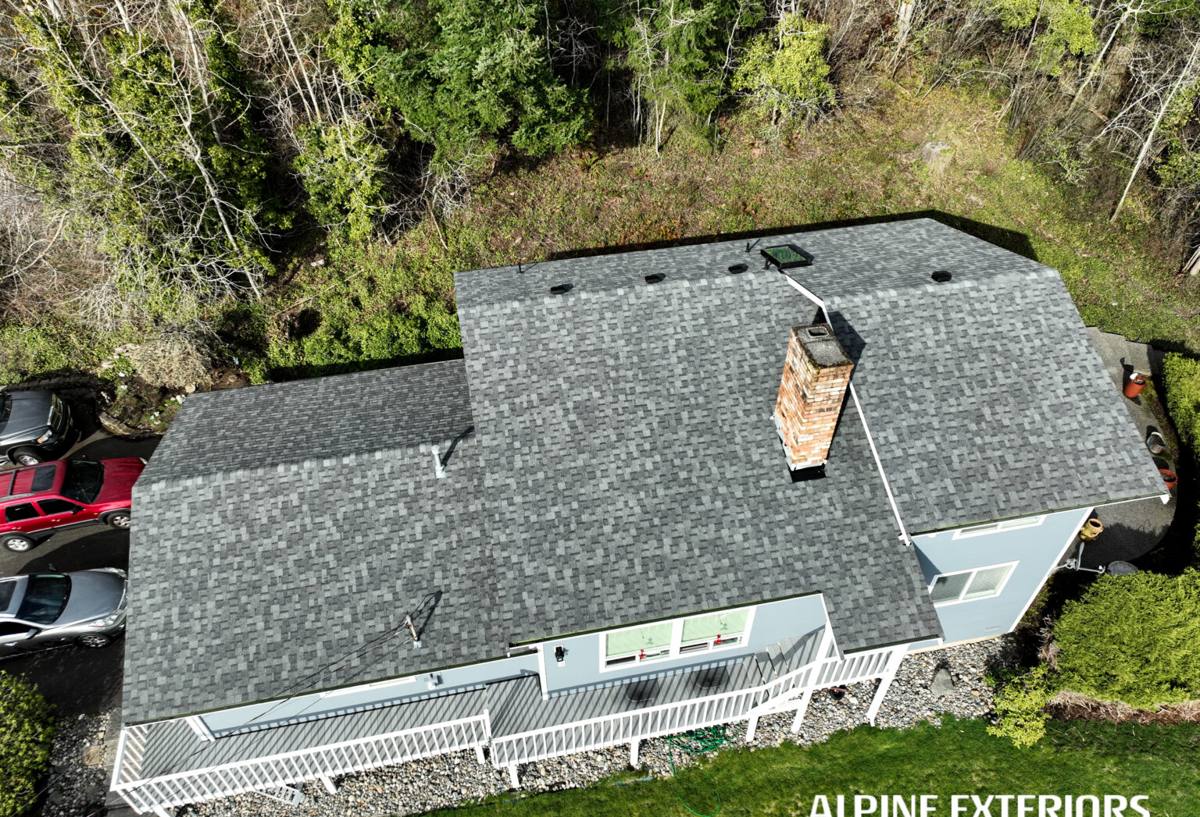
Signs a Lynden Home Needs a New Roof, Not Another Repair
Repairs make sense when the problem is localized — a damaged vent boot, a handful of lifted shingles after a windstorm, a small flashing leak. Full replacement becomes the honest recommendation when the roofing system itself is failing, not just a piece of it. Common signs we see on Lynden homes include:
- Granules collecting in gutters and downspouts in noticeable amounts, especially after rain
- Shingles that look cupped, curled, or brittle when you look closely from ground level
- Moss establishing itself across large sections of the roof, not just in shaded north-facing spots
- Soft or spongy spots on the decking, felt from the attic or noticed during a repair visit
- Daylight visible through the roof deck in the attic, or water staining on rafters
- A roof that's already 18-25+ years old, depending on the original material and installation quality
If a roof is only showing one or two of these signs, a repair or a partial section replacement may genuinely be the right call. We'll tell you that plainly if that's what the roof needs — a full tear-off isn't the answer to every problem, and we're not going to recommend one just because it's the bigger job.
What a Correct New Roof Installation Actually Involves
It starts with the tear-off, not the shingles
A new roof is only as good as what's underneath it. That means a full tear-off down to the deck, an inspection of the sheathing for rot or soft spots, and replacement of any decking that won't hold a nail properly. Installing new shingles over compromised decking just hides a structural problem under a cosmetic fix — it doesn't solve it.
The underlayment layer matters more here than in drier climates
In a region where the roof stays wet for extended periods, the underlayment is doing real work, not just serving as a formality between the deck and the shingles. We use synthetic underlayment as the standard base layer, with self-adhering ice-and-water shield membrane at the eaves, valleys, and around every penetration — chimneys, skylights, plumbing vents. Those are the spots where wind-driven rain finds its way in first, and they're the spots a rushed installation skips or shortchanges.
Flashing is where most leaks actually start
Step flashing at walls and chimneys, proper valley metal, and correctly lapped drip edge at the eaves and rakes prevent the majority of the leaks we get called out to diagnose on other contractors' work. Flashing done right is quiet — you never think about it. Flashing done wrong shows up as a stain on a ceiling eighteen months later.
Ventilation ties the whole system together
A roof that can't breathe traps moisture in the attic, which shortens the life of the decking, the insulation, and the shingles from underneath — regardless of how good the surface materials are. We balance intake at the soffits with exhaust at the ridge or gable vents so the attic actually moves air instead of just holding it.
Choosing a Roofing Material for Whatcom County Weather
There's no single "best" roofing material for Lynden — the right choice depends on your budget, how long you plan to stay in the home, and how much moss and moisture resistance you want to build in up front. Here's how the common options compare for this climate specifically:
| Material | Moisture & Moss Resistance | Typical Lifespan Here | Trade-offs |
|---|---|---|---|
| Standard 3-tab asphalt shingle | Fair — needs regular moss treatment | 15-20 years | Lowest upfront cost, shortest lifespan in wet climates |
| Architectural (laminate) asphalt shingle | Good with algae-resistant granules | 25-30 years | Best balance of cost and durability for most Lynden homes |
| Standing seam metal | Excellent — sheds moisture, resists moss | 40-50+ years | Higher upfront cost, requires a crew experienced with metal detailing |
| Composite/synthetic shake or slate | Very good | 30-50 years | Higher cost, appearance-driven choice for period or high-end homes |
For most Lynden homes, an architectural shingle with algae-resistant (copper-infused) granules gives the best real-world value — it resists moss noticeably longer than standard 3-tab shingles without pushing the budget into metal-roof territory. We'll walk through the honest cost-versus-lifespan math for your specific roof rather than steering you toward whatever's easiest to install.
Our New Roof Installation Process, Start to Finish
- On-site inspection and estimate — we measure the roof, check the attic for ventilation and moisture issues, and identify any decking concerns before quoting
- Material selection — we go over the options above based on your budget, how long you're planning to stay, and any HOA or neighborhood considerations
- Scheduling around weather — we work with Whatcom County's rain patterns, not against them, and won't tear off more roof in a day than we can fully dry-in before conditions turn
- Tear-off and deck inspection — full removal of old roofing, with any compromised decking replaced and documented before covering it back up
- Underlayment and flashing installation — ice-and-water shield at vulnerable points, synthetic underlayment across the field, new flashing at every wall, chimney, and penetration
- Shingle or material installation — installed to manufacturer specification, which is also what keeps the material warranty valid
- Ventilation check — intake and exhaust balanced before we consider the job finished
- Final walkthrough and cleanup — magnetic sweep for nails, debris removed, and a walkthrough so you know exactly what was done
Ventilation and Moss Prevention Aren't Optional Extras
A lot of the moss problems we see on older Lynden roofs trace back to poor attic ventilation as much as they do to the shade and moisture from tree cover. Moss holds water against the shingle surface, and over time that moisture works its way into the granule layer and then the mat underneath. Copper or zinc strips near the ridge can help slow new moss growth on a new installation, and we'll discuss whether that's worth adding for your specific property based on tree cover and roof orientation. It's a small addition at install time and a much bigger job to retrofit later.
Why Hiring a Crew That Already Works in Lynden Matters
Roofing crews that mostly work drier regions or unfamiliar climates tend to install to a generic standard — enough to pass in most places, but not necessarily enough for a roof that sits under sustained Whatcom County rain and a long moss season every year. A crew that regularly works Lynden and the surrounding area already knows which details can't be shortcut here: the underlayment coverage that matters more in this climate, the flashing details that prevent the leaks we get called to fix on other contractors' jobs, and the ventilation balance that keeps moss from taking hold again within a few years.
Local experience also means straightforward answers about permitting, realistic scheduling around the rainy season, and a crew that's still around and reachable if a question comes up after the job is done — not a name you found once and can't get back in touch with.
Questions Worth Asking Any Roofer Before You Hire Them
- Do you do a full tear-off, or do you ever install over existing layers?
- What underlayment and ice-and-water shield do you use, and where specifically is it installed?
- How do you handle flashing at chimneys, walls, and skylights?
- What's your plan for attic ventilation on this specific roof?
- Is your written estimate itemized, or is it one lump number with no breakdown?
- What's covered under the workmanship warranty, separate from the manufacturer's material warranty?
What Affects the Cost of a New Roof in Lynden
Every estimate is specific to the home, but the main cost drivers on a Lynden new roof installation are consistent: the total roof area and its complexity (number of valleys, chimneys, and penetrations), the pitch and how safely it can be worked, the condition of the decking underneath the old roof, the material you choose, and how much of the old roofing needs to be hauled away. A simple, low-pitch roof with few penetrations will cost meaningfully less than a steep, cut-up roof of the same square footage — that's true regardless of who you hire, and any honest estimate should reflect it.
If you're noticing granule loss, moss spreading across your roof, or a roof that's simply reaching the age where replacement makes more sense than another repair, we're glad to come take a look. The estimate is free, there's no pressure attached to it, and you'll get a straight answer about whether you need a full replacement or something smaller — use the form below to get started.