 Bellingham Roofing
 Siding for a Columbia Home Has a Specific Job to Do
Columbia is one of Bellingham's older, closer-to-the-water neighborhoods, and that location shapes what siding on a Columbia home actually has to survive year after year. Salt-tinged air off Bellingham Bay, rain that arrives sideways more often than straight down, and a moss season that can run most of the year on shaded and north-facing walls all put steady, cumulative stress on a home's exterior. A siding material that looks fine in a showroom or on a sunny install day doesn't tell you much about how it will hold up on a Columbia wall through its fifteenth wet winter.
We install James Hardie fiber cement siding exclusively — no vinyl, no LP SmartSide, no Cemplank, no Allura, no primed spruce, no cedar. That's not a marketing line; it's a decision we made after weighing what actually holds up in Whatcom County's marine climate against what looks acceptable at handoff. This page walks through what Columbia's conditions demand from siding, what a correct James Hardie installation involves, and how our process works for homes in this part of Bellingham.
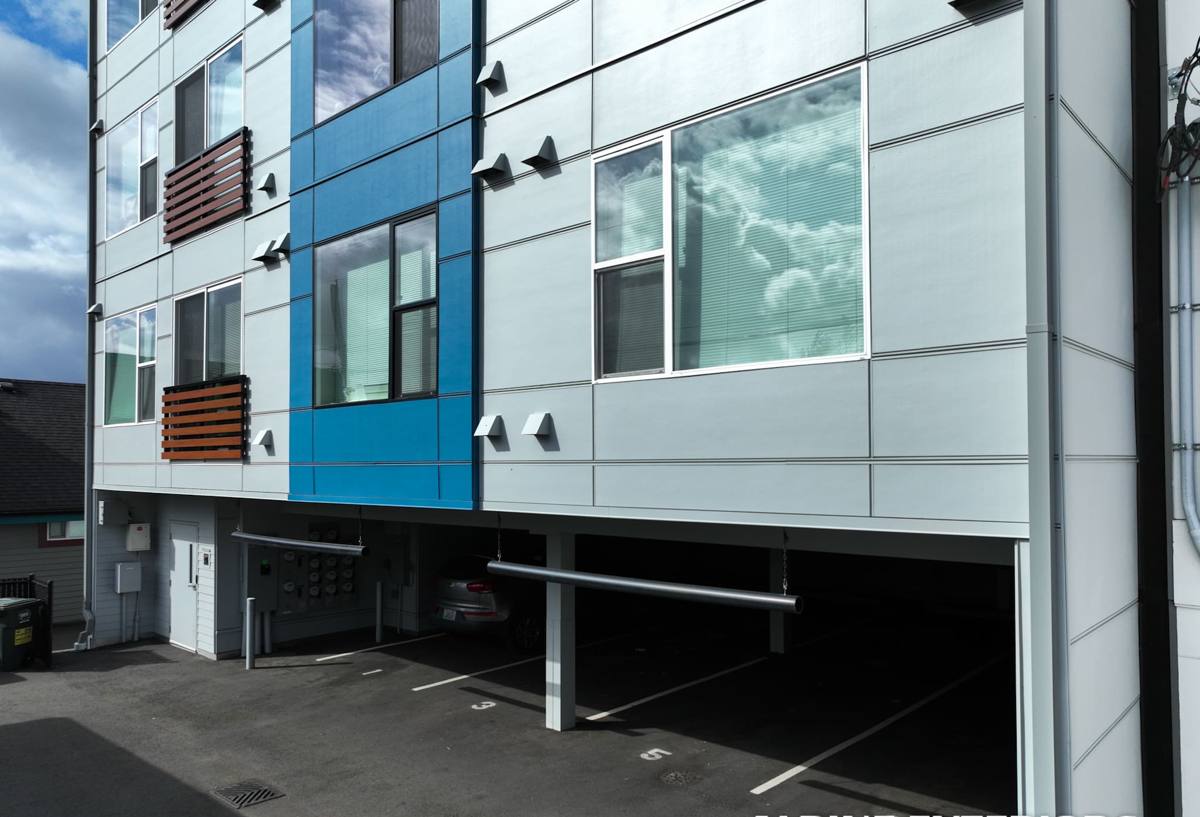
What Bellingham's Climate Does to a Wall Over Time
Salt Air and Slow Material Breakdown
Homes near Bellingham Bay sit in a steady low-level salt exposure that's easy to underestimate because it doesn't announce itself the way a storm does. Salt-laden air is hard on exposed metal fasteners and trim, and it accelerates the breakdown of finishes that weren't engineered to handle it. Over enough years, that exposure separates siding materials that were built for coastal-adjacent conditions from ones that were built for a generic national spec.
Driving Rain, Not Just Rainfall
Whatcom County's rain is frequently wind-driven, which means it hits walls at an angle instead of simply running down a roof and off the eaves. That matters more than most homeowners expect, because a siding system's weak points are almost always at the seams, laps, and penetrations — the places wind can push water into rather than the flat field of the wall itself. A material or installation that handles vertical rain fine can still fail against sideways rain if the details weren't built for it.
A Long Moss Season
Shaded and tree-covered walls, which are common in an established neighborhood like Columbia with mature landscaping, stay damp longer after every rain than a sun-exposed wall does. That extended dampness is exactly what moss and algae need to take hold, and it's also what softens wood-based siding materials over time if they aren't sealed and maintained on a strict schedule. In this climate, moss isn't a cosmetic nuisance so much as a sign of how long a wall is staying wet.
Why We Standardized on James Hardie
Fiber cement, vinyl, engineered wood, and real wood all handle Columbia's conditions differently, and the differences show up more in year ten and twenty than they do on install day. James Hardie's fiber cement core is dimensionally stable — it doesn't swell, cup, or absorb moisture the way wood-based products do, and it's non-combustible, which matters increasingly in a region where wildfire smoke and fire risk have become part of the annual conversation. The factory-applied ColorPlus finish is baked on under controlled conditions, which gives it a level of consistency and fade resistance that field-applied paint has a harder time matching over a Bellingham wall's lifetime.
| Material | Moisture Behavior | Maintenance in This Climate | Realistic Lifespan |
|---|---|---|---|
| James Hardie fiber cement | Doesn't swell, rot, or absorb water into the core | Low; factory finish resists moss staining and fading | 30+ years with correct installation |
| LP SmartSide (engineered wood) | Vulnerable at cut edges and fastener holes if sealing lapses | Moderate; edge sealing and paint touch-up needed on a schedule | 15-25 years, climate-dependent |
| Vinyl | Can warp, gap, or crack with temperature swings | Low, but moisture behind panels is hard to spot | 20-30 years, variable |
| Cedar | Absorbs moisture readily without regular sealing | High; recurring staining or sealing cycle required | 15-25 years with consistent upkeep |
None of these are dishonest products — other contractors install them competently, and each has a legitimate place in the market. We simply concluded that for the conditions Columbia and the rest of Bellingham deal with, standing behind one fiber cement system we trust completely serves homeowners better than offering a lower-cost material that shifts maintenance risk onto them five or ten years down the road.
HardieZone: Siding Engineered by Climate
James Hardie designs its products in different formulations for different climate zones, a system it calls HardieZone. Homes in the Pacific Northwest fall into the HZ5 zone, which accounts for the freeze-thaw cycling, sustained dampness, and moss-prone conditions common here — a different engineering target than the hot, dry-summer HZ10 formulation sold in other parts of the country. That distinction matters: siding built for a desert climate and siding built for a marine climate are not interchangeable products wearing the same brand name, even when they look identical off the truck.
For Columbia homes, that typically means lap siding as the primary field material, with panel siding, shingle-style siding, and trim boards available for accents, gables, and architectural detail. All of it comes through the same HZ5 engineering and the same ColorPlus finish options, so the whole exterior reads as one coherent system rather than a patchwork of materials aging at different rates.
Color and Finish
ColorPlus finishes are factory-applied and cured before the siding ever reaches the jobsite, which is different from field-painted materials where the finish quality depends on weather conditions during the paint job and on how evenly it gets applied. The color selection is broad enough to match most architectural styles found in an older neighborhood like Columbia, from traditional lap profiles to more modern trim combinations, and the factory finish carries its own warranty coverage separate from the substrate warranty.
What a Correct Installation Actually Involves
The material is only half of what determines whether siding performs for thirty years or needs attention in ten. Installation detail matters just as much, especially in a climate where wind-driven rain is routine. A correct James Hardie install includes:
- A weather-resistive barrier installed and properly lapped, shingle-style, before any siding goes up
- A drainage gap or rainscreen behind the siding so incidental moisture can dry out instead of sitting against the sheathing
- Fasteners placed at the spacing and depth James Hardie's installation spec calls for — overdriven or underdriven nails are one of the most common causes of early siding problems
- Properly flashed and lapped transitions at windows, doors, corners, and the base of the wall, where water pressure concentrates during a wind-driven storm
- A weep screed or drainage path at the base of the wall so water working its way down behind the siding has somewhere to exit
- Field-cut edges primed before installation, since factory ColorPlus coverage doesn't extend to a raw cut edge left unsealed
Skip any of these and the wall can look correct for a year or two before problems start showing at seams, corners, and the base of the wall — exactly the kind of slow-developing issue that's easy to miss during a quick install and expensive to trace back later.
Our Process for a Columbia Project
On-Site Assessment
We start by walking the specific home — which walls take the brunt of the weather, which stay shaded and slower to dry, and whether the existing wall assembly shows any signs of moisture damage that needs to be addressed before new siding goes on. Installing new siding over an already-damp wall just buries the problem instead of solving it.
Tear-Off and Substrate Check
Once the old siding comes off, we check the sheathing underneath for soft spots, rot, or prior water damage. This is often the point where a homeowner learns whether a past siding job was actually keeping water out or just hiding a slow leak — it's better to find that out now than after new siding is already up.
Weather Barrier and Drainage Detail
We install the weather-resistive barrier and drainage plane to spec, since this layer is what protects the wall even if water occasionally gets past the siding's outer surface — which it will, over enough years and enough storms, regardless of material.
Installation to Manufacturer Spec
Every fastener, flashing lap, and clearance follows James Hardie's published requirements for our climate zone, not a generic national standard. That's what keeps the manufacturer's warranty valid and what determines whether the wall performs the way it's supposed to for decades.
Final Walkthrough
We walk the finished job with you, cover what little maintenance James Hardie siding actually needs, and make sure you know what a healthy wall looks like if you ever want to check it yourself down the road.
Cost Factors for a Columbia Home
Every home is different, so we'll always give you real numbers from a walkthrough rather than a rough estimate off square footage alone. A few things consistently move the price on projects in this part of Bellingham:
| Factor | Why It Matters |
|---|---|
| Home size and wall complexity | More corners, dormers, and transitions mean more cuts and flashing details |
| Existing siding removal | Multiple layers or hard-to-remove old materials add labor time |
| Substrate condition | Rot or moisture damage found during tear-off needs repair before new siding goes up |
| Siding profile chosen | Lap, panel, and shingle-style siding differ in material and labor cost |
| Trim and window detailing | More openings mean more flashing and finish work around each one |
| Access and site conditions | Older, closely-spaced lots common to established neighborhoods can affect staging and labor time |
Signs a Columbia Home May Need New Siding
Given how gradually siding failure tends to develop in this climate, it helps to know what to actually look for during a normal walk around the house:
- Soft or spongy spots when you press on the siding, especially near the base of walls or under windows
- Paint or finish that keeps peeling or bubbling in the same spots no matter how often it's touched up
- Moss or algae staining that returns quickly after cleaning, particularly on shaded or north-facing walls
- Visible warping, cracking, or gapping between boards or panels
- Rising heating bills that seem tied to drafts rather than the furnace itself
- Siding that's original to a home built more than twenty to twenty-five years ago, especially older wood or first-generation vinyl
Why a Crew That Already Works in Columbia Matters
General siding knowledge and neighborhood-specific knowledge aren't the same thing. A crew that has already worked walls in Columbia and similar close-in Bellingham neighborhoods has seen which orientations need extra drainage attention because of shade and mature tree cover, which older homes tend to have specific substrate quirks under the existing siding, and how Bellingham's permitting and inspection process works for exterior projects. That familiarity doesn't show up on a price sheet, but it shows up in fewer surprises mid-project and in a wall that's still performing the way it should well past the first decade.
Getting It Right the First Time
Siding is not a project most homeowners want to redo twice in one decade, and a wall built to correct spec the first time is a lot cheaper over its lifetime than one that needs early repairs because a detail was skipped. That's why we treat the assessment and planning phase of every project with the same seriousness as the install itself.
If you're weighing new siding for a home in Columbia, we're happy to walk the property, talk through what your specific walls need given their exposure and condition, and give you a straightforward, no-pressure estimate. There's a form below — reach out and we'll set up a time to take a look.