 Bellingham Roofing
 Composite Decking Built for Lynden's Climate
Lynden sits in one of the wetter corners of Whatcom County, and that shapes what "good decking" actually means out here. A deck that holds up fine in a dry inland climate can fail early once it's dealing with our long wet season, heavy morning dew off the farmland and river bottoms, and moss that will colonize any surface that stays damp for more than a few days at a time. Composite decking, installed correctly, is one of the few products that stands up to that combination without turning into a maintenance chore every spring.
This page is specifically about composite deck installation for homes in and around Lynden — not a generic decking overview. The material choices, framing details, and drainage planning below are the ones that matter for this part of the county, where driving rain comes sideways off the valley and a deck can sit shaded and damp for weeks at a stretch in the winter and early spring.
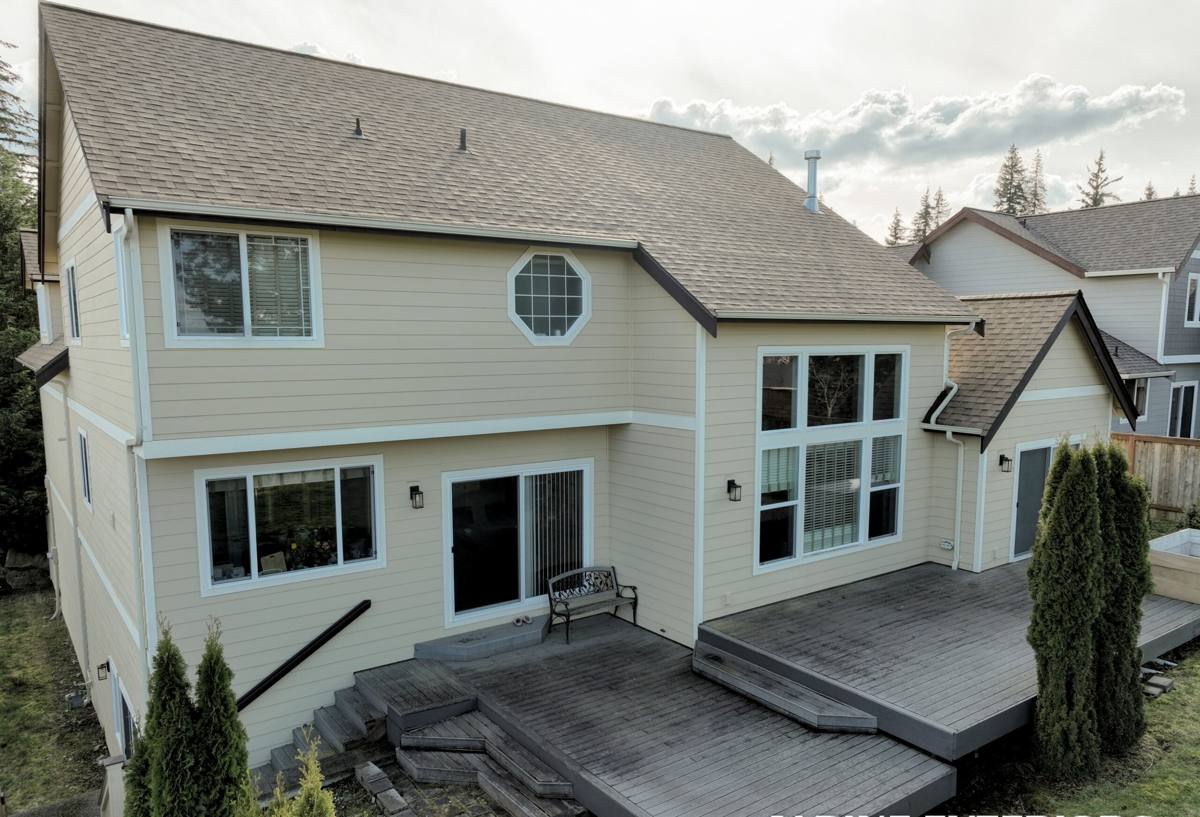
What Lynden's Weather Actually Does to a Deck
Whatcom County's marine-influenced climate means moisture is the constant variable, not the exception. A few specific ways that shows up on decks in the Lynden area:
- Moss and algae growth — shaded decks, north-facing decks, and anything under trees stay damp long enough for moss and green algae film to take hold, which makes boards slick and, on real wood, accelerates rot underneath the growth.
- Driving rain intrusion — wind-driven rain gets under railings, around post bases, and into any gap where flashing or sealant was skipped. Over a few wet seasons, that's where hidden framing damage starts.
- Salt-influenced air — Whatcom County's proximity to the Sound means metal hardware, fasteners, and railing components take more corrosion exposure than an inland climate would produce, even for homes not directly on the water.
- Freeze-thaw cycling — it doesn't get brutally cold here, but the repeated freeze-thaw swings through winter stress any wood that's already holding moisture, opening cracks that let more water in.
None of this is a reason to avoid an outdoor deck — it's a reason to be deliberate about material and installation detail. Composite decking, when it's capped composite and installed with the right substructure and drainage, is built to shrug off exactly this kind of exposure.
Composite vs. Wood vs. PVC — What Actually Fits This Climate
Every decking material has trade-offs. Here's an honest comparison for a Whatcom County climate specifically, not a marketing comparison.
| Material | Moisture Behavior Here | Moss/Algae Resistance | Maintenance | Typical Lifespan |
|---|---|---|---|---|
| Pressure-treated wood | Absorbs moisture readily; prone to cupping and splitting through repeated wet-dry cycles | Low — porous surface holds moisture, moss takes hold fast | Annual stain/seal to keep water out | 10–15 years with upkeep |
| Cedar | Naturally rot-resistant but still absorbs water; better than PT pine, still needs sealing | Moderate — still needs cleaning in shaded areas | Regular cleaning and re-oiling/staining | 15–20 years with upkeep |
| Capped composite | Non-porous outer shell sheds water, does not absorb or swell | High — smooth capped surface resists moss anchoring, cleans off easily | Periodic wash-down, no staining or sealing | 25–30+ years, manufacturer-warrantied |
| PVC decking | Fully synthetic, sheds water completely | High | Wash-down only | 25–30+ years |
We generally steer homeowners toward capped composite over uncapped composite or first-generation wood-composite blends. Uncapped boards have exposed wood fiber at the surface, which behaves more like real wood in a wet climate — it can absorb moisture at cut ends and along the board face, and that's exactly the failure mode that shows up first here. Capped composite's fully wrapped surface is the meaningful upgrade for this region's rain and moss exposure, not a marketing distinction.
Why Not Just Build in Wood?
Wood decks aren't wrong — plenty of Lynden homes have them and keep them looking good with consistent upkeep. The honest trade-off is time: a wood deck needs annual attention (cleaning, inspecting, re-sealing) to hold up against this climate, and skipping even one season lets moisture get ahead of you. Composite shifts that maintenance burden from "annual and mandatory" to "occasional and optional," which is the main reason it's become the standard recommendation for decks that see heavy shade or limited upkeep attention.
What a Correct Composite Deck Installation Involves
The board material only performs as well as what's underneath it. Most composite deck problems we get called to fix trace back to shortcuts in the framing and drainage, not the boards themselves.
Substructure and Framing
Composite boards are heavier than wood and behave differently under load and temperature swings, which means joist spacing and framing has to match the manufacturer's specification for that specific product — not generic deck-framing rules of thumb. We also use joist tape or an equivalent barrier over the framing lumber, which keeps standing moisture off the wood joists and dramatically extends the life of the substructure underneath the composite surface.
Ledger Attachment and Flashing
Where the deck attaches to the house is the single most common source of hidden water damage on any deck, composite or wood. Proper ledger flashing — installed so water sheds outward and away from the house band board — is not optional in a climate that sees as much driving rain as this one does. This is also the detail most likely to get skipped on a rushed or budget install, and the one that causes the most expensive repairs years later.
Drainage and Airflow Underneath
A deck that traps moisture underneath it stays damp longer after every rain, which feeds moss and slows drying. Proper spacing between boards, correct joist height off grade, and — where the deck is low to the ground or over a living space — a drainage system underneath all matter more here than in a drier climate.
Fasteners and Hardware
Given the corrosion exposure from Whatcom County's marine-influenced air, we use stainless or coated fasteners rated for exterior/coastal-adjacent use rather than standard exterior-grade hardware. Hidden fastener systems (clips rather than face screws) are also the norm on composite installs now — they keep the deck surface fully sealed with no screw holes for water to sit in.
Our Process, Start to Finish
- On-site assessment. We look at the existing structure (if replacing a deck), grading and drainage around the area, sun/shade exposure, and how the space is actually used before recommending anything.
- Material and layout selection. We walk through board color, finish, and railing options against your home's exposure — a heavily shaded north side gets a different recommendation than a sun-exposed south side.
- Written estimate. Clear scope, material spec, and price before any work starts — no surprise change orders for things we should have caught up front.
- Permitting. Deck work above certain heights or attached to the structure typically requires a permit; we handle that coordination as part of the project.
- Demo and framing (if applicable). Removal of the old deck, inspection of ledger and post condition, and framing built to the new decking manufacturer's spec.
- Installation. Composite boards, hidden fasteners, railing, and any fascia or trim, installed with attention to the drainage and flashing details above.
- Final walkthrough. We go over the finished deck with you, including basic care expectations, before calling the job done.
Choosing Board Style, Color, and Railing for a Lynden Property
Composite decking now comes in enough colors and finishes that matching a specific home's siding and trim is realistic rather than a compromise. A few practical notes specific to this climate:
- Lighter, streaked or multi-tonal board colors hide pollen, dust, and light moss film between cleanings better than solid dark tones — worth considering on decks under trees or with limited direct sun.
- Matte or low-sheen board finishes tend to show water spotting and mineral residue from sprinklers or rain less than higher-gloss finishes.
- Composite or aluminum railing systems pair well with composite decking for the same reason the decking itself makes sense here — no annual sealing or staining to keep up with, and better corrosion resistance than uncoated wood or basic steel components.
- Board direction and layout can be used to visually shorten or lengthen a deck's proportions — worth discussing at the design stage rather than defaulting to whatever's simplest to install.
Maintenance: What Composite Actually Needs in This Climate
Composite is low-maintenance, not no-maintenance. In a climate with this much moss and rain exposure, a small amount of seasonal attention keeps a composite deck looking new for its full warranty life.
- Sweep debris (leaves, needles, pollen) off regularly — organic debris trapped against the board surface is what feeds moss and algae growth, even on capped composite.
- Wash the deck surface once or twice a year with a soft-bristle brush, mild soap, and water — pressure washing is generally fine on capped composite at moderate pressure, but check the manufacturer's specific guidance first.
- Check and clear the gaps between boards seasonally so debris doesn't build up and hold moisture against the substructure.
- Inspect railing posts and ledger flashing once a year, especially heading into the wetter fall/winter months, for any sign of movement or water staining.
- Trim back overhanging branches where possible — reducing shade and leaf drop on the deck surface is the single biggest factor in how much moss pressure it sees.
Cost Factors for a Lynden Composite Deck Project
Composite decking costs more upfront than pressure-treated wood and less than most premium PVC systems. Actual project cost depends on several factors specific to the site, not just square footage:
| Factor | Why It Affects Cost |
|---|---|
| Deck height and structure | Elevated decks need more substantial framing, footings, and often stairs and additional railing |
| Existing structure condition | Reusing sound framing costs less than full demo and rebuild; hidden rot from past water intrusion adds scope |
| Board tier | Entry-level capped composite vs. premium composite/PVC lines carry a real price spread per square foot |
| Railing system | Composite or aluminum railing costs more than basic wood but needs no ongoing sealing |
| Site access | Material staging and equipment access affects labor time, especially on tighter in-town lots |
| Permitting scope | Attached and elevated decks generally require permitting, which adds coordination time to the schedule |
We give a written, itemized estimate before work starts so you know exactly what's driving the number — not a rough square-footage guess.
Why Hire a Crew That Already Works in Lynden
A lot of the detail work described above — flashing choices, fastener selection, framing spec — only matters if it's done right the first time, because it's largely invisible once the deck is finished. A crew that regularly works Whatcom County homes has already seen how this specific climate treats decks that were built to a generic spec versus one built for actual local conditions. That experience shows up in fewer callbacks for moss buildup, loose railings, or moisture damage a few years down the road, not in anything you'd notice on install day.
It also means straightforward answers about what your specific property needs — shade exposure, drainage, existing structure condition — rather than a one-size answer that doesn't account for the difference between a sun-exposed backyard and a shaded, tree-covered lot a few miles away.
If you're planning a new composite deck or replacing an aging wood deck in Lynden, we're glad to come take a look and put together a straightforward, no-pressure estimate. Use the form below to get started.