 Bellingham Roofing
 Decks in Happy Valley Face a Different Set of Problems
Happy Valley sits close enough to the water and the hills around Bellingham that its decks take on a specific combination of stress: salt-laden air drifting in off Bellingham Bay, long stretches of driving rain through the fall and winter, and a moss and algae season that can run eight months or more depending on how much sun a yard gets. None of that is unique to this one neighborhood, but the mix of tree cover, hillside lots, and older housing stock in this part of Bellingham means decks here tend to sit in shade longer, dry out slower, and collect more organic debris than decks in more open parts of Whatcom County.
A deck built without that context in mind will still look fine for the first year or two. The problems show up later — soft spots near ledger boards, black streaking in shaded corners, fasteners that back out, or a substructure that never quite dries between storms. Composite decking solves a lot of the wood-rot problems homeowners are used to, but only if it's installed with this climate in mind. A composite board dropped onto a framing system that wasn't built for our rain load and moss pressure will still cause headaches, even though the board itself won't rot.
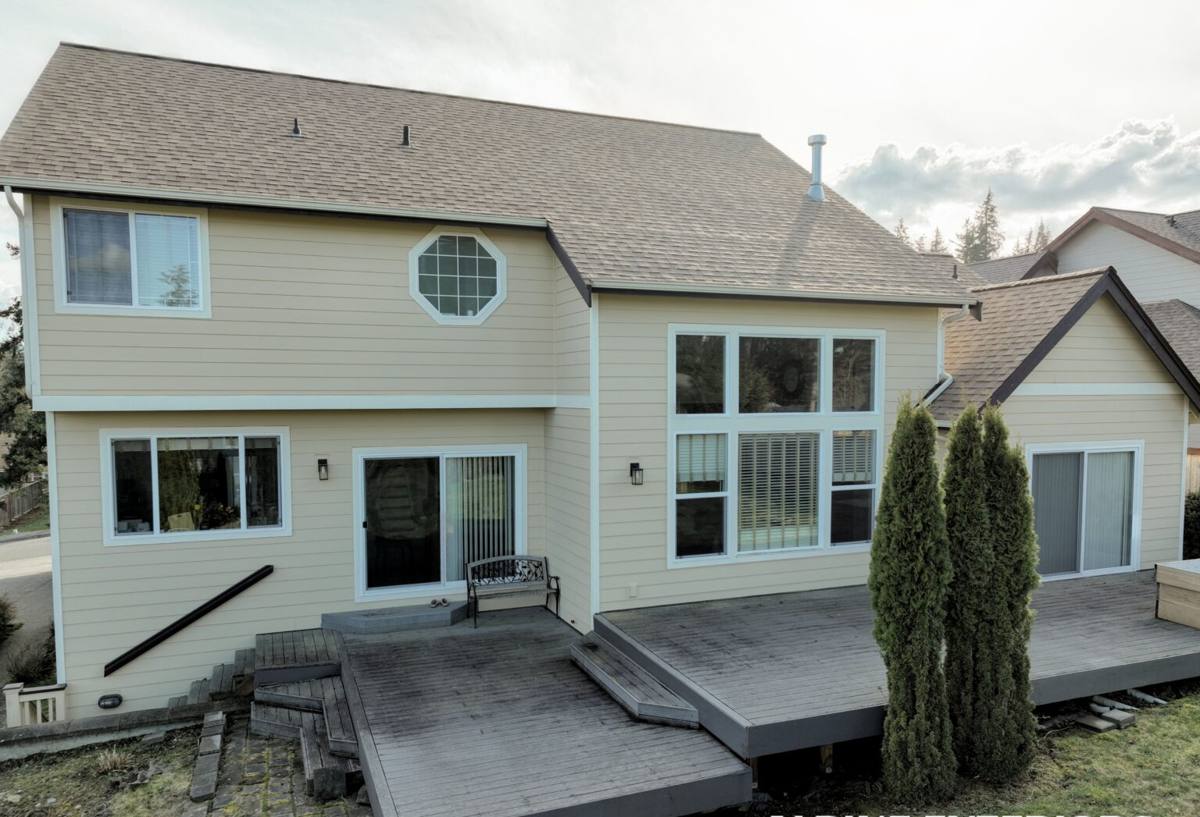
What a Correct Composite Deck Build Actually Involves
The composite boards get most of the attention, but the parts you don't see are what determine whether a deck holds up through a Whatcom County winter. We treat the substructure, drainage, and attachment details as the real work, and the decking surface as the finish layer on top of it.
Framing and Ledger Details
Where a deck attaches to the house, that ledger connection is the single most common source of hidden water damage on older Bellingham homes. Proper flashing behind the ledger board, correct fastener spacing, and a small gap or drainage path so water doesn't pool against the siding are non-negotiable on our jobs. We also use joist tape or an equivalent moisture barrier on top of framing lumber, since exposed cut ends and fastener holes are where rot typically starts, composite decking or not.
Airflow and Drainage Underneath
Low-clearance decks and decks tucked under tree cover — common in Happy Valley's more wooded lots — need extra attention to airflow underneath. Without it, the space under the deck stays damp for days after a storm, which accelerates mildew growth on the underside of boards and shortens the life of any wood framing. Where clearance is tight, we look at venting options and grading adjustments so water actually moves away from the structure instead of sitting under it.
Choosing a Composite Board for This Climate
Not all composite decking is built the same way, and the differences matter more here than they would in a drier climate. The main split is between capped and uncapped composite boards.
| Board Type | How It Handles Our Climate | Trade-Off |
|---|---|---|
| Capped composite (polymer shell over composite core) | Best resistance to moss, algae staining, and moisture absorption; easiest to keep clean | Higher upfront cost than uncapped boards |
| Uncapped composite | More prone to surface staining and slower to shed moisture in shaded, low-airflow areas | Lower material cost, but more maintenance over time |
| PVC (cellular vinyl) decking | Fully moisture-resistant, performs well in coastal and shaded conditions | Different look and feel than wood-grain composite; higher cost |
Most manufacturers — Trex, TimberTech, and Fiberon among them — offer capped composite lines specifically because uncapped boards struggle in wetter, shadier climates like ours. We generally steer Happy Valley homeowners toward capped boards for any deck area that gets significant shade or sits close to grade, since that's where moss and algae take hold fastest. This isn't a knock on uncapped composite — it's a legitimate, lower-cost product — it's just a maintenance trade-off worth knowing about before you buy.
Color Matters More Than People Expect
Darker composite boards hide organic staining better in the first year or two but run hotter underfoot in summer and can show mineral or hard-water spotting more visibly after heavy rain. Lighter and mid-tone boards show moss and algae growth faster, which sounds like a downside but actually makes it easier to catch and clean before it sets in. There's no universally "right" answer — it depends on how much sun the deck gets and how the homeowner wants to maintain it.
Moss and Algae: The Long Game
Composite decking doesn't feed moss the way untreated wood does, but moss and algae will still grow on any deck surface that stays damp and shaded long enough — including composite. In Happy Valley's tree-covered lots, that season can start earlier and run later than in more open parts of Bellingham. A few structural decisions make a real difference:
- Board spacing and gapping that lets water drain fast instead of sheeting across the surface
- Picking a board texture with enough grip that it doesn't trap standing moisture in fine grooves
- Positioning railings and structures so they don't create permanent shade pockets where possible
- Planning drainage so runoff from the roof or gutters isn't discharging directly onto the deck surface
None of this eliminates the need for occasional cleaning, but it cuts down how often and how aggressively you have to do it.
Our Process for a Happy Valley Deck Project
- On-site assessment — we look at sun exposure, drainage patterns, existing framing condition, and how the deck ties into the house before recommending a board type.
- Design and material selection — board type, color, and railing choices based on your budget and how much maintenance you actually want to do.
- Permitting — most new deck construction and many replacement decks in the City of Bellingham require a building permit; we handle that paperwork as part of the job.
- Demolition and framing correction — removing the old deck surface (and old framing, if needed) and correcting any flashing, ledger, or drainage issues found underneath.
- Composite installation — hidden or exposed fastening per manufacturer spec, proper gapping, and finish trim work.
- Final walkthrough — we go over basic care with you so the deck stays in the condition it was installed in.
What a Happy Valley Composite Deck Typically Costs
Composite decking costs more upfront than pressure-treated wood, but the calculation changes when you factor in the repainting, staining, and rot repair that wood decks in this climate usually need every few years. Broad cost drivers for this area:
| Factor | Why It Moves the Price |
|---|---|
| Board tier (uncapped vs. capped vs. PVC) | Capped and PVC boards cost more per square foot but need less upkeep in shade and moisture |
| Substructure condition | Rotted or undersized existing framing adds demolition and rebuild cost before decking even starts |
| Deck height and access | Elevated decks on hillside Happy Valley lots often need more engineering and structural support |
| Railing and stair complexity | Custom railing, multiple stair sets, or level changes add labor time |
| Drainage or venting upgrades | Correcting poor airflow or grading under a low-clearance deck adds scope but prevents future problems |
We give homeowners a real number after seeing the site, not a phone-quote guess — the substructure condition alone can swing a project significantly once we're actually under the old decking.
Caring for a Composite Deck in This Climate
Composite decking is lower-maintenance than wood, not maintenance-free. In Whatcom County's wet, shaded conditions, a little seasonal attention goes a long way:
- Sweep leaves and needles off regularly, especially in fall — trapped organic debris is the number one cause of moss and staining on composite
- Wash the surface with a soft-bristle brush and mild soap a couple of times a year, more often in shaded sections
- Keep gutters and downspouts clear so runoff isn't discharging directly onto the deck
- Check fastener lines and railing connections annually for movement
- Avoid pressure washing at close range or high PSI — it can etch or damage the surface texture on most composite boards
- Trim back overhanging branches where practical to cut down on shade and debris
Why It Matters That We Already Work in Happy Valley
A lot of deck problems we get called out to fix started with a crew that built a technically fine deck for the wrong climate — the right boards, installed without accounting for how much shade, rain, and salt air this specific area gets. Knowing which lots in Happy Valley run damp and shaded, how the drainage tends to behave on the hillside sections, and which framing details actually hold up through a Bellingham winter isn't something you get from a spec sheet. It comes from having built and repaired decks in this exact neighborhood.
If you're planning a new composite deck or replacing an aging one in Happy Valley, we're glad to come take a look and give you an honest, no-pressure estimate — including what your specific site's sun, shade, and drainage situation means for the build.