 Bellingham Roofing
 South Hill's Climate Is Hard on Siding
South Hill sits high enough above Bellingham Bay to catch salt-laden air off the water, and low enough into the tree line to stay damp under fir and cedar canopy for much of the year. That combination is tougher on exterior siding than most homeowners realize. Salt air accelerates corrosion on fasteners and trim metal. Wind off the bay pushes rain sideways into wall assemblies instead of letting it simply run down and off. And the long, mild, wet stretch that Whatcom County sees from late fall through spring gives moss and algae months at a time to colonize any siding surface that doesn't dry out between storms.
None of this is exotic — it's just what siding on a hillside home near the water has to deal with, season after season, for decades. The problem is that a lot of siding products, and a lot of siding installations, are not built with that specific combination of stresses in mind. This page covers one job in one neighborhood: fiber cement siding installation on South Hill homes, done to a standard that actually accounts for the climate it has to survive in.
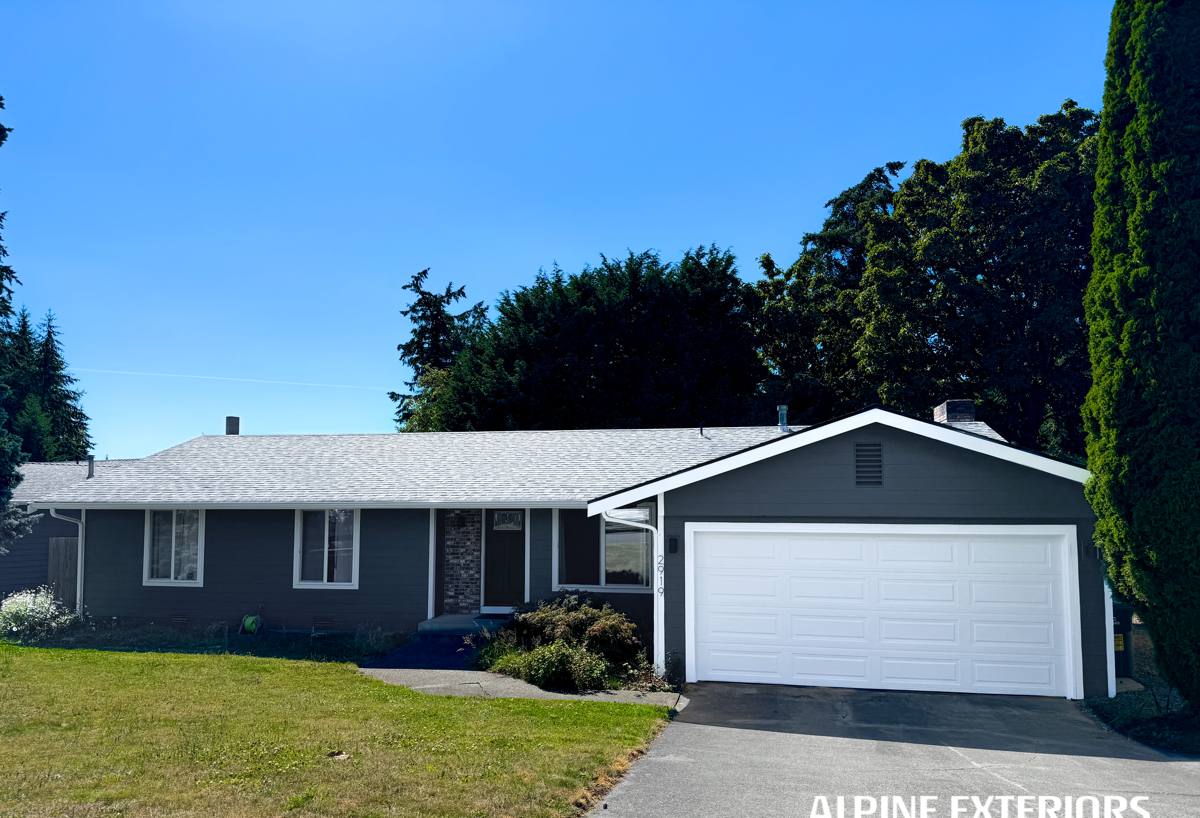
What South Hill Homes Need From Their Siding
Moisture Has to Get Out, Not Just Stay Out
Every siding system will eventually let some moisture past the surface — through a hairline gap at a butt joint, a fastener hole, or wind-driven rain forced under a lap. What separates a siding job that lasts from one that fails early isn't whether moisture ever gets behind the cladding; it's whether the wall assembly is built to let that moisture dry out again. On a shaded, tree-covered lot like much of South Hill, walls stay damp longer after a storm than they would on an open, sun-exposed site. That makes drainage and drying capacity behind the siding more important here than in drier parts of the state.
Wind-Driven Rain Changes Where Water Ends Up
Storms coming off Bellingham Bay don't just fall straight down — they arrive at an angle, and elevation and hillside exposure on South Hill can intensify that. Water gets driven up under laps, into corner boards, and around window and door trim in ways that a calmer climate wouldn't produce. Flashing details that would be adequate in a low-wind-exposure area aren't always enough here. This is a detail-work problem, not a material problem — it's solved by how the siding, flashing, and weather barrier are layered together, not by the siding brand alone.
Moss and Algae Aren't Just Cosmetic
Green-black staining on north-facing walls and under eaves is common across Whatcom County, and South Hill's tree cover makes it worse in shaded areas. Moss itself doesn't eat through fiber cement, but it holds moisture against the surface far longer than bare siding would dry on its own, and it's a sign that a wall isn't shedding water and drying the way it should. A siding product that resists moisture absorption and a finish that resists organic growth both matter more here than they would in a drier, sunnier neighborhood.
Why We Only Install James Hardie Fiber Cement
We standardized on James Hardie fiber cement siding for every home we side, including South Hill, and we don't install vinyl, LP SmartSide, Cemplank, Allura, primed spruce, or bare cedar. That's not a marketing position — it's a decision based on how these products actually perform over years of exposure to exactly the conditions described above: salt air, driving rain, and a long moss season.
Vinyl is inexpensive and low-maintenance in the sense that it doesn't need painting, but it's a thin, flexible plastic that expands and contracts with temperature and can warp, crack, or blow off in sustained wind exposure — a real consideration on an elevated, wind-exposed hillside lot. Engineered wood products like LP SmartSide use a wood-strand substrate that performs well when installation and maintenance are perfect, but any breach in the factory coating gives moisture a path into a wood-based core, and that's a harder failure to catch early than most homeowners expect. Bare or primed wood siding needs the most upkeep of any option — regular repainting, caulk maintenance, and vigilance against rot — which is a heavy ask in a climate that stays damp as long as this one does.
Fiber cement is a cement, sand, and cellulose fiber composite. It doesn't rot, it isn't a food source for moss the way wood is, it holds paint and factory finishes far longer than wood substrates, and it's non-combustible, which matters given how much of the Pacific Northwest's wildfire-season smoke and ember exposure has crept into what used to be considered "safe" zones. James Hardie is the manufacturer we trust to deliver that performance consistently, with product lines engineered for specific climate zones and a factory ColorPlus finish that's more durable than field-applied paint.
| Material | Moisture Behavior | Moss/Algae Resistance | Maintenance | Typical Lifespan |
|---|---|---|---|---|
| Vinyl | Doesn't absorb water, but seams and panels flex and can let water track behind | Moderate — grows on surface film if shaded and damp | Low, but repairs are patch-and-replace, not repair | 20–30 years, shorter with wind/UV stress |
| Cedar / Primed Wood | Absorbs moisture readily; prone to swelling and rot at joints | Poor — wood is an organic growth medium | High — repainting and caulk maintenance every few years | 15–25 years with diligent upkeep |
| Engineered Wood (LP SmartSide) | Good if coating stays intact; vulnerable once breached | Better than bare wood, dependent on coating condition | Moderate — coating and edge maintenance matter | 25–30 years under ideal conditions |
| James Hardie Fiber Cement | Dimensionally stable, resists moisture-driven swelling and rot | Strong — non-organic substrate, factory finish resists staining | Low — occasional wash, no repainting for years | 30–50 years with correct install |
What a Correct Fiber Cement Installation Involves
The material itself is only part of the equation. Most siding failures we get called out to inspect — on any brand — trace back to installation shortcuts, not the product. On a South Hill home, where wind-driven rain and prolonged dampness are the norm rather than the exception, these details aren't optional extras. They're the difference between siding that lasts thirty-plus years and siding that starts failing behind the surface in five.
Weather-Resistive Barrier and Drainage Gap
Correct installation starts with a weather-resistive barrier applied over the sheathing, lapped properly at every seam so water is shed downward and outward rather than trapped. Behind the siding itself, a drainage gap gives any moisture that does get past the cladding a path to drain and air to circulate, so the wall assembly can actually dry between storms instead of staying damp against the sheathing.
Flashing at Every Transition
Every window, door, roofline intersection, and deck ledger is a place where wind-driven rain wants to find a way in. Correct flashing — head flashing above openings, kick-out flashing where a roof meets a wall, proper step flashing on transitions — has to be installed before the siding goes on, not caulked over afterward as a substitute. Caulk is a backup layer, never the primary defense.
Fastener Pattern, Clearances, and Joint Treatment
James Hardie specifies fastener spacing, minimum clearances from grade, roof lines, and decks, and joint treatment at every butt seam. Skipping these — nailing too close to panel edges, closing up clearances that should let siding drain and dry, or leaving butt joints unsealed — voids manufacturer warranty coverage and creates exactly the kind of moisture entry points that show up as swelling or staining years later.
Factory Finish vs. Field-Applied Paint
Hardie's ColorPlus factory finish is baked on under controlled conditions and holds color and integrity far longer than paint applied on-site after installation, especially in a climate where a field-painted job has limited dry, mild days to fully cure. We install ColorPlus-finished product wherever the color selection allows it, because it removes an entire maintenance burden from the homeowner's plate for years.
How Our Process Works on a South Hill Job
- Walk-through and assessment: we look at existing siding condition, trim, flashing, moisture damage, and the specific exposure of your lot — shaded, wind-exposed, close to grade, tree cover — before recommending anything.
- Scope and product selection: we go over Hardie plank profiles, textures, and color options, including which are available in factory ColorPlus finish versus field paint.
- Removal and substrate check: old siding comes off and the sheathing underneath gets inspected for hidden rot or moisture damage before anything new goes up — this is where problems from a prior installation usually surface.
- Weather barrier and flashing installation: the drainage plane, flashing, and any needed sheathing repairs are completed and inspected before siding starts.
- Siding installation to manufacturer spec: correct fastener pattern, clearances, and joint treatment, with trim and corner details finished to match.
- Final walk-through: we go over the finished job with you, including care and maintenance specific to your home's exposure.
Why Hiring a Crew That Already Works South Hill Matters
Siding installation isn't identical from one neighborhood to the next, even within the same city. A crew that regularly works South Hill has already seen how tree cover on shaded lots keeps walls damp longer, how elevation and wind exposure change where flashing needs extra attention, and how salt air out of Bellingham Bay affects fastener and trim material choices over time. That's the kind of judgment that comes from doing the work here repeatedly, not from a general siding checklist applied the same way everywhere.
It also means fewer surprises during the job. A crew unfamiliar with the area might not anticipate how much a shaded, tree-lined lot slows drying time, or underestimate how exposed a hillside wall is to driving rain compared to a sheltered one a few blocks away. Getting those calls right the first time is what keeps a siding job performing for decades instead of needing early rework.
Maintaining Fiber Cement Siding in South Hill's Climate
James Hardie siding is genuinely low-maintenance compared to wood or engineered wood alternatives, but "low-maintenance" isn't "no-maintenance," especially in a climate with this much moss pressure and salt air. A little seasonal attention goes a long way toward protecting the investment and keeping the manufacturer warranty intact.
- Rinse siding gently once or twice a year, focusing on shaded, north-facing walls and areas under heavy tree cover where moss and grime build up fastest.
- Keep gutters clear and functioning — overflow running down a wall is one of the most common causes of localized moisture staining on any siding.
- Trim back vegetation and tree limbs that keep siding shaded and damp longer than necessary; airflow and sun exposure help siding dry between storms.
- Inspect caulking at trim, window, and door edges annually and have any cracked or missing caulk replaced before the wet season sets in.
- Watch for early moss growth in shaded corners and address it promptly rather than letting it establish and hold moisture against the surface.
- Avoid pressure washing directly at high pressure close to the surface — it can force water behind laps and joints; a gentle rinse is safer and just as effective.
Cost Factors on a South Hill Siding Project
Every home is different, and we don't quote pricing without seeing the actual scope, but a few factors consistently move the cost of a South Hill siding project up or down. Knowing them ahead of time makes for a more useful first conversation.
| Factor | Why It Matters |
|---|---|
| Existing siding removal and disposal | Tear-off of old wood, vinyl, or damaged siding adds labor and disposal cost before new siding can go on. |
| Substrate repair | Hidden sheathing rot or water damage found during tear-off has to be repaired before siding installation continues. |
| Home height and access | Multi-story sections, steep hillside grading, and limited access on tight South Hill lots affect staging and labor time. |
| Trim and detail complexity | Homes with more windows, dormers, and roof transitions require more flashing and trim work per square foot of siding. |
| Product line and finish | Panel profile, texture, and whether you choose factory ColorPlus finish versus field-applied paint affect material cost. |
| Site conditions | Tree cover, slope, and drainage on the lot can add site prep or protection measures during the job. |
If your South Hill home's siding is showing moss staining, soft spots, peeling paint, or you're simply planning ahead for a replacement, we're glad to take a look and give you a straightforward, no-pressure estimate — use the form below to get started.