 Bellingham Roofing
 Asphalt Shingle Roofing Built for Edgemoor's Waterfront Climate
Edgemoor sits close to Bellingham Bay, and that proximity to open water shapes everything about how a roof ages here. Homes in this part of Bellingham deal with a combination few inland neighborhoods see in the same intensity: salt-laden air drifting off the water, wind-driven rain that hits roof planes sideways during winter storms, and a long, damp moss season that runs from fall through spring. An asphalt shingle roof installed without those three factors in mind will look fine for a year or two and then start showing problems well ahead of schedule.
We work on roofs throughout Whatcom County, and Edgemoor's mix of mature tree canopy, bluff-adjacent lots, and bay exposure means we treat it as its own case, not a copy-paste of a standard Bellingham roof. The shingles themselves matter less than the details around them — underlayment choice, fastening pattern, ventilation, and flashing — and that's where most of the difference between a roof that lasts and one that doesn't gets decided.
What Edgemoor's Climate Actually Does to a Roof
Salt Air and Metal Components
Salt air doesn't damage the shingles themselves much, but it accelerates corrosion on every exposed metal component on a roof — nail heads, flashing, drip edge, and vent stacks. Standard electro-galvanized fasteners and thin-gauge flashing can start showing rust streaks and pinholing years before they would inland. That's a maintenance and longevity issue, not just a cosmetic one, since corroded flashing is one of the leading causes of roof leaks that homeowners don't catch until there's already water damage inside.
Wind-Driven, Sideways Rain
Storms moving in off the Sound and the Strait of Georgia don't just drop rain straight down — on exposed or elevated lots, wind pushes it sideways and up under shingle edges, at ridge caps, and around any roof penetration. A shingle roof that relies on gravity alone to shed water, without properly sealed underlayment and correctly lapped flashing, will let moisture work its way in during exactly these conditions, even if the shingles look intact from the ground.
Moss, Shade, and Moisture Retention
Edgemoor's tree cover is part of what makes the neighborhood attractive, but shaded, north-facing roof planes stay damp far longer after rain than open ones. Combined with our long wet season, that's ideal moss-growing weather. Moss holds moisture against the shingle surface, works its way under tabs as it grows, and can lift shingles enough to let wind and water underneath. Left untreated for years, it also breaks down the granule surface that protects shingles from UV and weather.
What a Correctly Installed Shingle Roof Includes Here
A shingle roof that's actually built for Edgemoor's conditions isn't a different shingle — it's a different set of decisions underneath and around the shingle field. Here's what we consider standard, not optional, for homes in this area:
- Corrosion-resistant fasteners and flashing (stainless or heavier-gauge coated metal) at all edges, valleys, and penetrations
- Ice-and-water shield or a full synthetic underlayment system rated for high wind-driven rain exposure, not just minimum code coverage
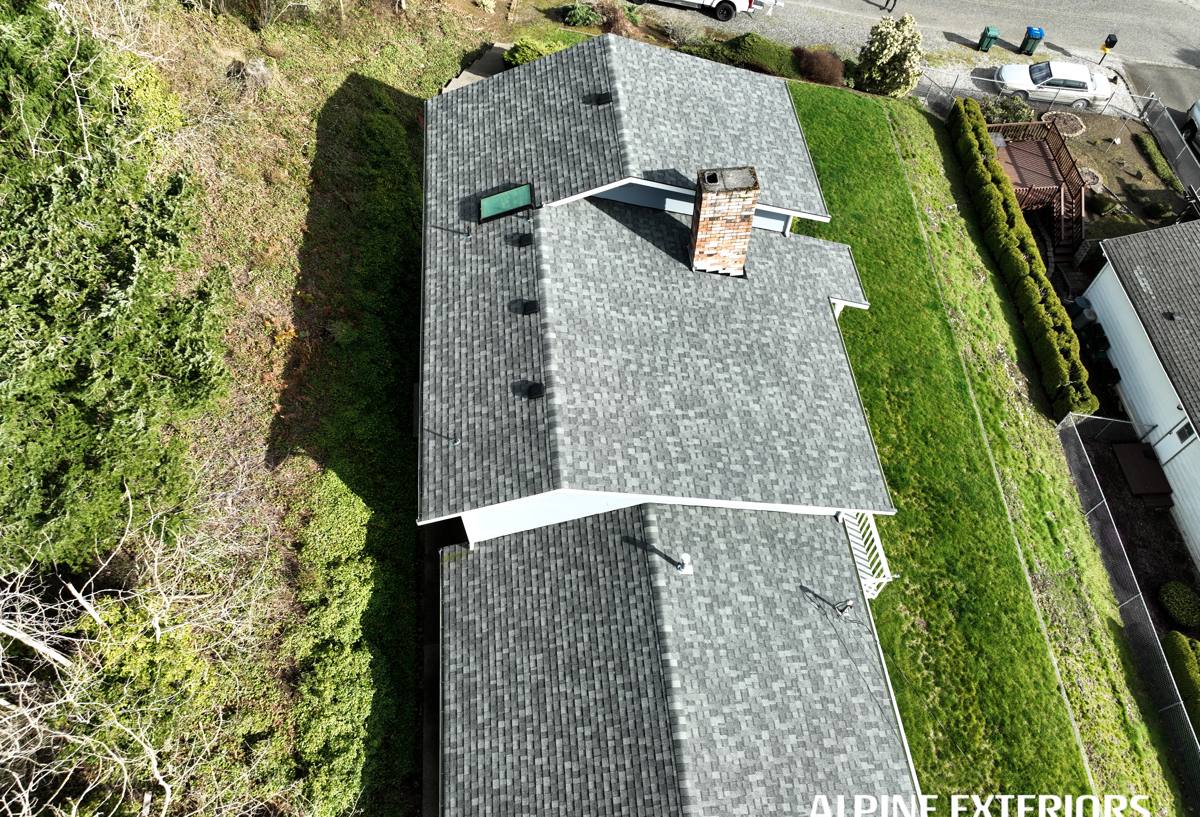
- Properly lapped and sealed step flashing at chimneys, walls, and dormers — a common failure point on older Edgemoor roofs
- Balanced intake and exhaust ventilation to keep the roof deck dry and reduce the moist, still air that moss favors
- Shingle selection with algae-resistant (AR) granules where moss and moss-related staining are a known local issue
- Careful attention to any shaded, tree-adjacent roof planes during layout and detailing, since these areas age faster than the rest of the roof
Our Process for Edgemoor Roofing Projects
Inspection and Honest Assessment
Every project starts with a full roof inspection — not just a look at the shingles, but the flashing, ventilation, decking condition where accessible, and any moss or moisture patterns specific to the lot. On a bay-adjacent or tree-shaded property, we're specifically checking for the early signs of the salt-air and moss issues described above, since those show up well before a homeowner sees an active leak.
A Straightforward, Written Plan
We explain what we found in plain terms — what's failing, what's still sound, and what your realistic options are. If a full replacement isn't necessary yet, we'll say so. If it is, we walk through material options, what each involves, and a written scope before any work starts. No pressure, no upsell for its own sake.
Installation Done to Local Conditions, Not Minimum Code
Washington building code sets a floor, not a target. For Edgemoor specifically, that means we install underlayment, flashing, and ventilation to the standard described above as a baseline, because minimum-code installation is what tends to fail early in this exact kind of exposure.
Cleanup and Final Walkthrough
We clear the site of old material and debris, do a magnetic sweep for stray fasteners, and walk the finished roof with you so you know exactly what was done and what maintenance, if any, to expect going forward.
Choosing the Right Shingle for This Environment
Not every asphalt shingle product is a good fit for a salt-air, high-moss environment. The table below covers the general categories homeowners in Edgemoor typically weigh, with honest trade-offs for each.
| Shingle Type | Typical Lifespan Here | Best Fit For | Trade-Offs |
|---|---|---|---|
| 3-Tab (standard) | 15–20 years | Budget-conscious projects, secondary structures | Lower wind rating, less algae resistance unless AR-rated; more exposed edges for wind-driven rain to reach |
| Architectural / Dimensional | 25–30 years | Most Edgemoor homes | Higher upfront cost than 3-tab, but the thicker profile and stronger wind rating hold up better against sideways rain and moss lift |
| Premium/Designer Architectural | 30+ years | Higher-exposure or higher-value properties | Highest material cost; benefit is mainly in wind rating, warranty terms, and appearance rather than dramatically different moss resistance |
Across all three categories, we generally recommend algae-resistant (AR) granules for Edgemoor roofs specifically because of the moss and algae pressure from tree shade and bay humidity — it's a modest cost difference that pays for itself in reduced staining and slower moss establishment.
Repair, Maintenance, or Full Replacement?
Not every roof problem in Edgemoor calls for a full tear-off. We look at three things to figure out which category a roof is in:
Repair
Isolated flashing failures, a handful of wind-lifted or cracked shingles, or moss growth caught early can often be addressed with targeted repair rather than replacement, especially on a roof that's otherwise mid-life.
Maintenance
Given the moss pressure in this neighborhood, periodic moss removal and treatment, plus a check of flashing and fastener condition every couple of years, extends the life of an otherwise healthy roof significantly. This is the cheapest option on the list and the one most homeowners skip until it's too late.
Replacement
Widespread granule loss, multiple past patch repairs, soft or stained decking, or a roof already past its expected lifespan for its type are signs it's time to plan for full replacement rather than keep patching a roof that's fighting a losing battle against the elements.
Why Local Experience Matters for This Neighborhood
A roofing crew that hasn't worked bay-adjacent, tree-shaded properties in Whatcom County will often under-spec the underlayment, use standard fasteners instead of corrosion-resistant ones, or skip the ventilation detailing that keeps moss and moisture from becoming a chronic problem. None of that shows up as a defect on day one — it shows up as a leak, premature moss, or rusted flashing three to five years in, right around when a homeowner assumes the roof should still be trouble-free.
We work in and around Bellingham regularly, which means we've seen how roofs in Edgemoor's specific conditions actually age over time, not just how they look freshly installed. That experience shapes the material and installation choices above — they're not upsells, they're what holds up here.
Practical Signs It's Time to Have Your Roof Looked At
- Visible moss growth on shaded or north-facing roof planes, especially near valleys or where sections stay damp longest
- Granules collecting in gutters or downspouts after rain
- Rust staining running down from flashing, vent stacks, or nail heads
- Curling, cracked, or missing shingles, particularly after a windy winter storm
- Any staining or moisture on interior ceilings, especially near chimneys or where roof planes meet walls
- A roof more than 15–20 years old that hasn't had a professional inspection in the last few years
Any one of these on its own isn't necessarily an emergency, but they're worth a professional look before the next major storm season, not after.
Get a Straightforward Estimate
If you're weighing repair versus replacement, dealing with moss you can't get ahead of, or just want an honest read on where your roof stands, we're glad to take a look. Use the form below to request a free, no-pressure estimate for your Edgemoor property.