 Bellingham Roofing
 Siding Built for Cordata's Climate
Cordata sits on the north side of Bellingham, close enough to Bellingham Bay and the Strait of Georgia that homes here deal with a steady diet of moisture-laden air, wind-driven rain off the water, and the long gray stretch of fall through spring when moss and algae get a real foothold on anything that stays damp. Whatcom County doesn't get the extreme temperature swings of inland climates, but it makes up for that with sheer duration of wetness. Siding here isn't tested by one big storm — it's tested by months of low-grade saturation, year after year.
That's the backdrop for every siding decision a Cordata homeowner makes. Wood-based products need constant upkeep to survive it. Vinyl can hold its own against moisture but has its own set of trade-offs we cover on our general siding pages. What we install, on every job we take in this neighborhood, is James Hardie fiber cement siding — and the reason comes down to how it's engineered specifically for climates like this one.
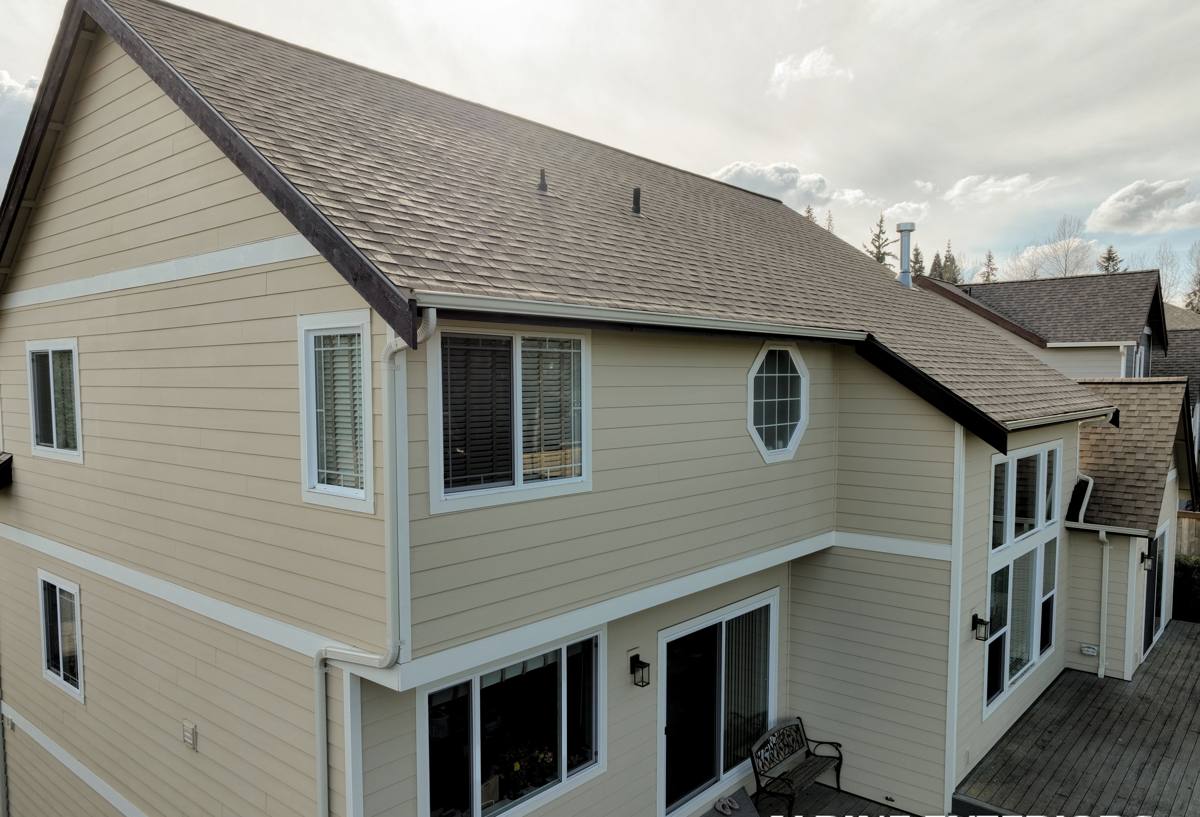
Why Fiber Cement Fits This Neighborhood
Fiber cement is a mix of cement, sand, and cellulose fibers, cured into a rigid board that doesn't rot, doesn't feed insects, and doesn't swell and shrink with every wet-dry cycle the way wood does. That last point matters more in Cordata than it would somewhere dry. Constant humidity is exactly the condition that causes wood siding to cup, crack at the joints, and eventually let water behind it. Fiber cement is dimensionally stable enough that it holds its seams and its finish through repeated soaking without the material itself breaking down.
It's also non-combustible, which is a real consideration during the dry stretches of summer when wildfire smoke and regional fire risk become a topic across the Pacific Northwest — not the dominant reason to choose it in a wet marine climate, but a genuine added benefit.
Salt Air and Coastal Exposure
Homes closer to the water deal with airborne salt that accelerates corrosion on fasteners, flashing, and unprotected wood fiber. James Hardie's fiber cement core isn't organic material for salt-laden moisture to break down, and when we install it we use fasteners and flashing rated for coastal exposure — that pairing matters as much as the siding material itself.
Moss and Algae
The long wet season in Whatcom County means north-facing walls, shaded elevations, and anything under tree cover stays damp for extended stretches. Moss and algae need moisture and organic material to establish themselves. James Hardie's factory-applied ColorPlus finish is baked on under controlled conditions, which gives it a harder, more consistent surface than field-applied paint — it doesn't stop moss from ever landing on a wall, but a sealed, consistent finish is far less hospitable to it than a porous or unevenly coated surface, and it's easier to rinse clean when it does show up.
What a Correct Installation Involves
Fiber cement siding is only as good as the install behind it. The material is engineered to handle Cordata's climate, but a rushed or generic installation defeats that engineering. A correct job includes:
- A proper weather-resistive barrier installed and lapped correctly behind the siding, not just stapled up as an afterthought
- Rainscreen or drainage gap detailing where the wall assembly calls for it, so incidental moisture has somewhere to go instead of sitting against the back of the board
- Correct flashing at every penetration — windows, doors, hose bibs, light fixtures — since most siding failures start at a poorly flashed opening, not the field of the wall
- Manufacturer-specified fastener spacing, type, and depth, matched to the board thickness and substrate
- Proper clearance at the bottom edge — siding held up off decks, patios, and grade so it isn't sitting in standing water or snowmelt runoff
- Caulked and painted cut ends where required, so the engineered core isn't left exposed to open moisture at every joint
Skip any one of these steps and you can end up with premature failure on a product that's rated to last decades. This is why we treat installation detail as seriously as material selection — the two are inseparable in a climate like Whatcom County's.
Our Process for Cordata Jobs
We start with an on-site walkthrough of the home, checking the existing wall assembly, any signs of past moisture intrusion, and the condition of trim, flashing, and window details before we ever talk siding profile or color. From there we put together a scope that covers tear-off, any sheathing repair that's needed, house wrap, flashing, and the Hardie install itself — with a written breakdown so there's no ambiguity about what's included.
During installation we follow James Hardie's published installation instructions for our region, which specify fastener patterns, clearances, and flashing details suited to high-moisture climates. We don't treat those specs as optional guidance — following them to the letter is what keeps the manufacturer's warranty intact and what actually keeps water out of the wall.
Choosing the Right Hardie Product Line and Profile
James Hardie makes several siding profiles and product lines, and the right pick for a Cordata home depends on the style of the house and the specific exposure of each elevation.
| Product | Best Use | Notes for This Climate |
|---|---|---|
| HardiePlank lap siding | Most common residential profile, traditional or modern homes | Available in several plank widths and textures; the standard choice for full-house re-siding |
| HardiePanel vertical siding | Modern facades, accent walls, gable ends | Clean vertical lines; detailing at horizontal joints needs extra care in a wet climate |
| HardieShingle | Craftsman and cottage-style homes, accent sections | Adds texture; more seams means flashing and installation precision matter even more |
| HardieTrim boards | Corners, window and door surrounds, fascia | Matches the siding's moisture resistance so trim doesn't become the weak point |
James Hardie also engineers its boards by climate zone — HZ5 for colder, wetter regions like the Pacific Northwest. We install the HZ10 line suited to our zone, which is formulated for the freeze-thaw and moisture cycling that's typical of Whatcom County winters, rather than a generic national product.
Color and Finish: ColorPlus vs. Site-Painted
Homeowners have a choice between James Hardie's factory-applied ColorPlus finish and having the boards primed and painted after installation. In a climate that stays wet as long as ours does, this decision has real consequences.
ColorPlus is baked on in a controlled factory environment across multiple coats, which gives a harder, more UV- and moisture-resistant finish than most field painting can match, along with touch-up product for any spots that need it later. Site-applied paint gives more color flexibility and can be repainted whenever the homeowner wants a change, but it depends on ideal weather conditions during application and on the quality of the paint crew — conditions that aren't always easy to guarantee in a place where dry stretches are limited. For most Cordata homeowners we recommend ColorPlus for the durability, but we'll walk through both options honestly based on your specific project.
Maintenance: What Fiber Cement Actually Needs
One of the real advantages of fiber cement over wood siding is how little upkeep it requires — but "low maintenance" doesn't mean "no maintenance." A simple annual routine keeps it performing the way it should:
- Rinse the siding down once or twice a year, more often on shaded or north-facing walls where moss tends to establish
- Walk the exterior after major storms and check caulking at windows, doors, and trim joints for gaps or cracking
- Keep gutters clear so overflow isn't running down the face of the siding
- Trim back vegetation and tree cover that keeps a wall section shaded and damp longer than the rest of the house
- Address any touch-up needs at cut ends or fastener heads promptly rather than letting them sit
Why a Crew That Already Works This Neighborhood Matters
Bellingham's neighborhoods aren't uniform — a home a few blocks from the water deals with different exposure than one further inland, and lot conditions in Cordata specifically (mature tree cover, mixed sun and shade, proximity to green spaces) affect where moss and moisture pressure show up first on a given house. A crew that's worked this area regularly has a feel for those patterns before they ever start tear-off: which elevations to flash extra carefully, where drainage details matter most, and what Whatcom County's wet season actually does to a wall assembly over time. That local pattern recognition is worth as much as the product spec sheet — it's what keeps a correctly chosen material from being undermined by a generic installation.
If you're weighing a siding replacement for a Cordata home, we're happy to walk the property, look at your specific exposure and existing wall condition, and put together a straightforward, no-pressure estimate — just fill out the form below to get started.