 Bellingham Roofing
 Decking in South Hill Has to Answer to the Climate First
South Hill sits up above downtown Bellingham with mature tree cover, older homes, and in many spots a clear line of sight down to the bay. That elevation and tree canopy make for one of the more pleasant settings in the city to sit outside — but they also create a specific set of problems for any deck. Overhanging trees mean shade and organic debris most of the year. Proximity to Bellingham Bay means salt-laden air moving through on a west wind. And Whatcom County's long, wet stretch from October through April means any horizontal wood surface up here spends half the year damp.
None of that is unique to South Hill by itself, but the combination — shade, moss pressure, and salt air together — is what pushes us to talk homeowners through composite decking as a real option rather than a sales pitch. It's not the right call for every budget or every style of house, but for a lot of South Hill properties it solves problems that wood decking simply keeps handing back to you year after year.
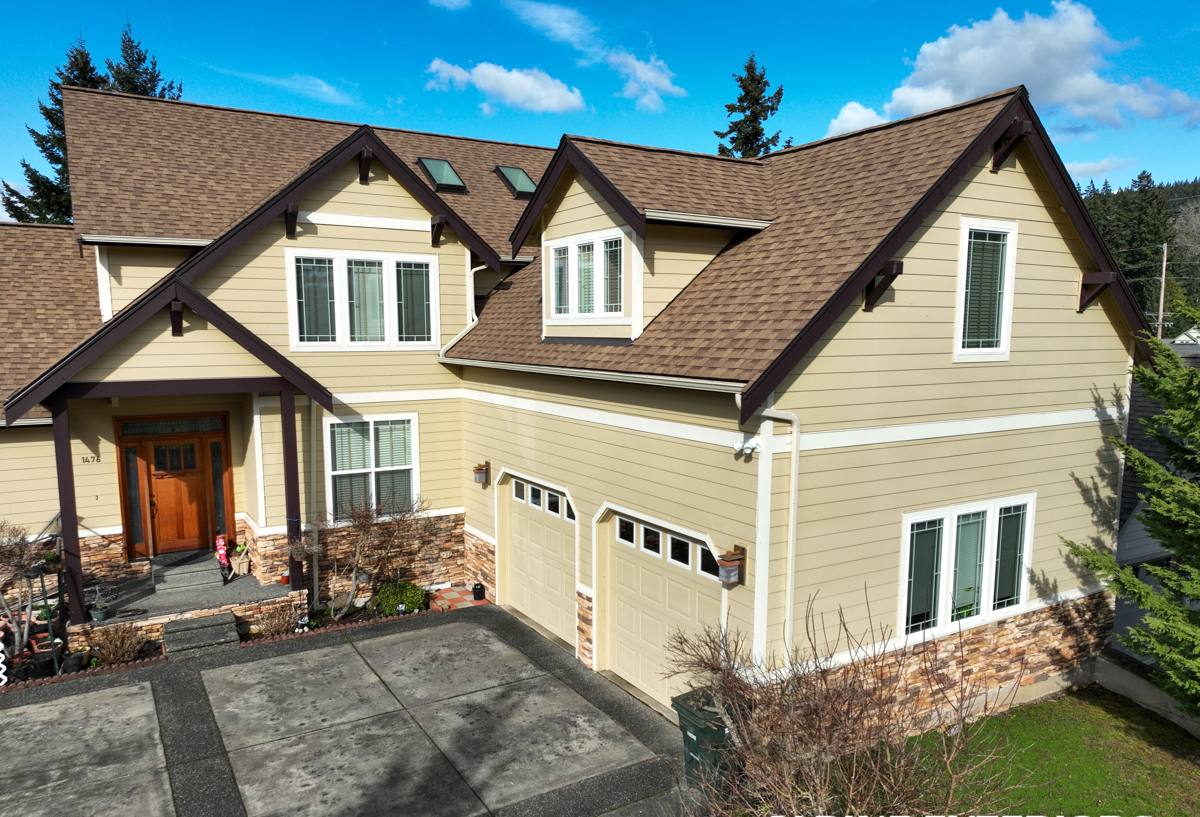
What Local Homes Are Actually Fighting
Moss and organic buildup
Shaded decks under mature trees collect needles, leaves, and pollen that hold moisture against the deck surface. On wood, that turns into moss and algae growth fast, and moss on a walking surface isn't just unsightly — it's slick and it accelerates rot underneath it. On composite boards, the surface itself won't rot, but moss and algae can still grow on top of accumulated grime if a deck never gets cleaned. The difference is what's happening underneath: with composite, you're dealing with a surface cleaning problem, not a structural one.
Driving rain and standing water
Whatcom County storms often come in sideways off the water, which pushes rain up under rail caps, into fastener holes, and along board ends — the exact spots where wood decking fails first. Composite boards handle this differently because the board material itself doesn't absorb and swell the way wood fibers do, but the installation still has to manage water at the substructure, ledger board, and joist level or you just move the failure point down one layer.
Salt air corrosion
Homes closer to the bay see faster corrosion on fasteners, brackets, and railing hardware. This is a hardware and fastener selection issue as much as a decking-material issue — stainless or coated fasteners rated for coastal exposure matter on every deck out here, composite or not.
What a Correct Composite Deck Build Involves
The board on top is the part homeowners see, but it's the smallest factor in whether a deck holds up in this climate. A correct build includes:
- Ledger flashing and attachment that keeps water from tracking back into the house rim joist
- Joist spacing matched to the specific composite product's span rating — composite boards generally need tighter joist spacing than wood, and this varies by manufacturer
- Coastal-rated, corrosion-resistant fasteners and hidden fastener systems sized for the board profile
- Joist tape or a comparable protective barrier on top of the framing to keep the structural lumber dry even though the decking above it won't rot
- Proper end-gapping and ventilation so boards can expand and contract without buckling
- Drainage planning underneath the deck so water doesn't pool against posts, footings, or the house foundation
Skip any one of those and you can end up with a deck surface that looks fine for years while the framing underneath quietly rots — which is a common failure we see on composite decks that were installed by someone treating it like a wood deck with different boards.
Composite vs. Other Decking Options for This Climate
| Material | Moss/moisture behavior | Salt air exposure | Ongoing maintenance |
|---|---|---|---|
| Composite decking | Board itself won't rot; surface grime and algae still need periodic cleaning | Board material unaffected; hardware still needs coastal-rated fasteners | Occasional wash-down; no staining or sealing |
| Pressure-treated wood | Absorbs moisture, prone to moss growth and rot in shaded, damp spots | Fasteners and hardware corrode faster; wood itself is chemically treated for rot but not immune | Regular cleaning, staining/sealing every 1-3 years |
| Cedar | Naturally rot-resistant but still absorbs moisture and grays/moss in deep shade | Softer wood, more prone to surface wear near salt air | Sealing and moss treatment on a regular schedule |
| PVC decking | Fully synthetic, similar moisture resistance to composite | Unaffected; hardware still the limiting factor | Low; can look more "plastic" than modern composite blends |
We don't push one product line over another as a blanket rule — the right call depends on budget, the look you want, and how much shade the specific site gets. What we won't do is install a wood deck in a heavily shaded, moss-prone spot and tell a homeowner it'll be low-maintenance, because it won't be.
How We Approach a South Hill Composite Deck Project
1. Site assessment
We look at sun exposure, tree cover, existing drainage patterns, and how close the site is to prevailing weather off the bay. This tells us how aggressive the joist protection and fastener spec needs to be before we ever talk board selection.
2. Structural check
On a rebuild or resurface, we check the existing ledger, posts, footings, and framing before covering anything new on top of it. Composite boards last decades — there's no point putting new decking over framing that's already compromised.
3. Framing and protection
Joist tape, correct fastener spacing for the chosen board's span rating, and flashing details at the house connection get handled before a single board goes down.
4. Installation
Boards go down with hidden fastener systems where the product supports it, proper end-gapping for expansion, and attention to drainage so water sheds off the deck instead of pooling.
5. Walkthrough
We go over what maintenance actually looks like for the specific product installed — most composite lines need far less than homeowners expect, but "none at all" isn't accurate either.
Maintenance That Actually Fits This Climate
Composite decking cuts out sanding, staining, and sealing, but it isn't maintenance-free in a spot with heavy tree cover and long wet seasons. Realistic upkeep looks like:
- Sweeping off leaves and needles regularly during fall so organic debris doesn't sit and hold moisture on the surface
- A seasonal wash-down (soap and water or a manufacturer-approved cleaner) to keep algae and pollen film from building up
- Keeping gutters and downspouts near the deck clear so runoff isn't dumping extra water onto the deck surface
- Checking railing hardware annually for corrosion, especially on homes with more direct bay exposure
What Drives Cost on a South Hill Composite Deck
| Factor | Why it matters here |
|---|---|
| Deck size and layout | Larger footprints and multi-level decks common on South Hill's sloped lots add framing complexity |
| Substructure condition | Older homes may need ledger, joist, or footing repair before new decking goes on |
| Board tier | Composite product lines range from entry-level to premium capped boards; this is usually the single biggest cost swing |
| Railing system | Composite or metal rail systems cost more than basic wood rail but hold up better to salt air and rain |
| Site access | Sloped or tree-crowded lots can add labor time for material staging and demo hauloff |
We give a real number after seeing the site — not a phone estimate — because framing condition and access are the two factors that move a quote the most, and neither one is visible from a description over the phone.
Why Local Experience on This Specific Job Matters
A crew that's built and repaired decks around Bellingham Bay knows which fastener grades actually hold up to salt air over years, not just on paper. They know which shaded, tree-heavy lots need extra joist protection before the first board goes down. And they know that a deck spec that works fine on a dry, open lot on the other side of town can fail fast on a shaded South Hill slope a mile away. That local pattern-recognition is the difference between a deck that needs attention in year three and one that's still solid in year fifteen.
A Quick Checklist Before You Sign a Contract
- Does the quote specify joist tape or an equivalent framing protection layer?
- Are fasteners specified as coastal-rated or corrosion-resistant, not just "standard"?
- Is the joist spacing matched to the manufacturer's span rating for the specific board chosen?
- Does the contractor address drainage under and around the deck, not just the surface?
- Is there a clear plan for ledger flashing and water management at the house connection?
If you're weighing a new composite deck or a resurface on a South Hill property, we're happy to take a look and walk the site with you. There's no pressure and no obligation — just a straight assessment of what your specific lot, shade, and exposure actually call for. Use the form below to request a free estimate.