 Bellingham Roofing
 Why Columbia Homes Take a Different Kind of Beating
Columbia sits close enough to the water and to Bellingham Bay's weather patterns that siding here has to deal with three things at once: salt-laden air off the Sound, driving wind-blown rain that hits walls sideways instead of straight down, and a moss season that can run from October through May. Any one of those is manageable. All three together, year after year, are what separate a siding job that lasts twenty-five years from one that starts failing at year eight.
Salt air is corrosive to fasteners, flashing, and unprotected cut edges. Driving rain finds every gap in a butt joint, every under-caulked window trim, every place where the original installer didn't leave the manufacturer's recommended clearance. And moss doesn't just look bad on a north-facing wall — it holds moisture against the siding surface for months at a time, which is exactly the condition that rots wood-based products and delaminates poorly-sealed composites. Whatcom County's marine climate isn't harsh in the way a hurricane zone is harsh, but it's relentless, and relentless is what actually wears out a house.
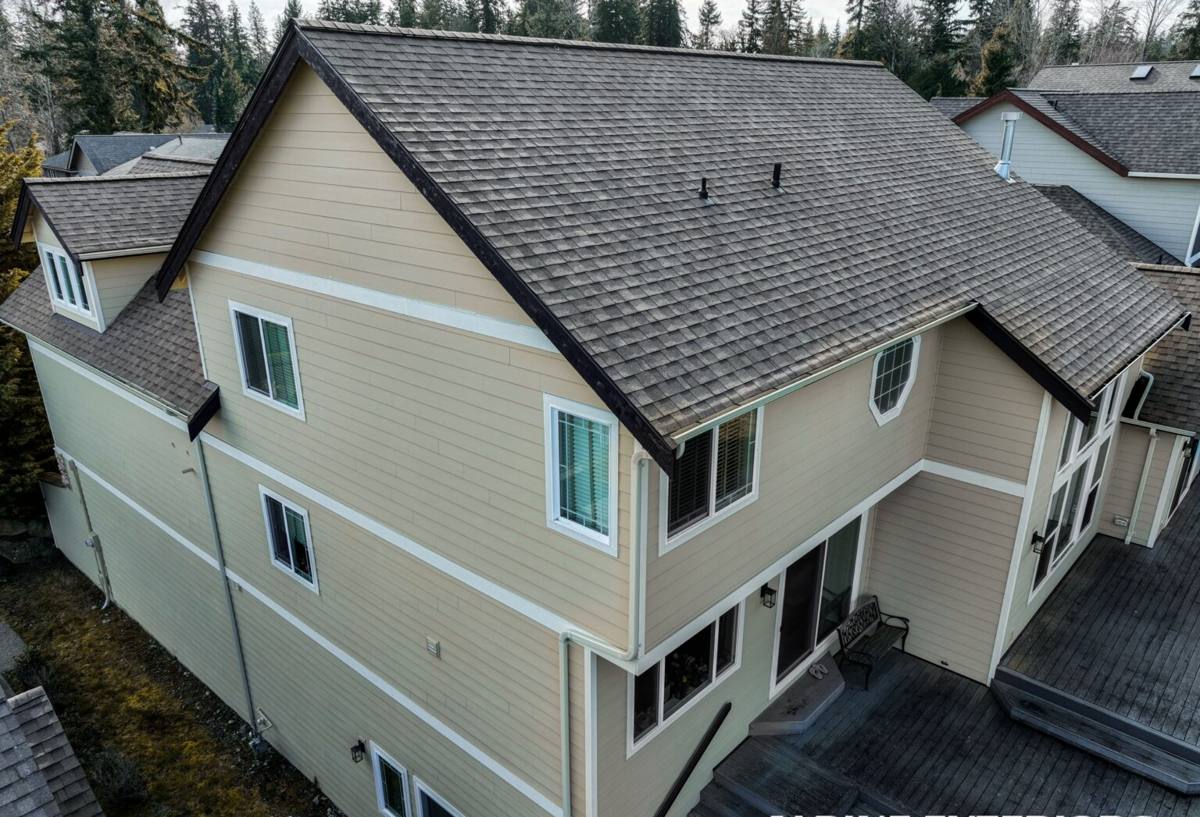
What Correct Fiber Cement Installation Actually Involves
Fiber cement siding is only as good as the installation behind it. The material itself is dimensionally stable and non-combustible, but a bad install can still fail in this climate — usually not because the siding itself gave out, but because water got behind it and had nowhere to go.
The Details That Matter in a Marine Climate
- A properly lapped weather-resistant barrier (WRB) behind the siding, with all seams taped and shingled so water sheds downward and outward
- Correct clearance from grade, roof lines, decks, and patios — the manufacturer's own installation instructions specify minimum gaps, and skipping them is one of the most common shortcuts we see on older Columbia homes
- Flashing at every window, door, and penetration, installed so it drains onto the WRB rather than behind it
- Factory-primed cut edges resealed with the correct primer before installation — an exposed cut edge is a straight path for moisture into the panel
- Corrosion-resistant, hot-dip galvanized or stainless fasteners driven to the correct depth — not overdriven, not underdriven
- Caulking only where the install guide calls for it, with a quality sealant rated for exterior movement
None of this is exotic. It's just detail work that takes longer to do right, and it's exactly the detail work that gets skipped when a crew is trying to move fast on a bid that was priced too low.
Fastener and Flashing Choices Near the Water
Salt air accelerates galvanic corrosion, especially where dissimilar metals touch or where a fastener's coating gets scratched during installation. On Columbia homes we pay particular attention to matching flashing metal to fastener type and to keeping any exposed metal fully coated. A rust streak bleeding down a wall a few years after installation is almost always a fastener or flashing mismatch, not a siding defect — and it's avoidable with the right hardware from day one.
Why We Only Install James Hardie Fiber Cement
We don't install vinyl, LP SmartSide, primed wood, cedar, or other fiber cement brands. That's a standard we hold across every job, not just Columbia, and it comes down to what actually holds up under decades of Pacific Northwest weather.
James Hardie's HZ product lines are engineered for climate zones — HZ5 is formulated for the wetter, harsher exposure common in western Washington, which matters directly here given the salt air and rain load Columbia sees. The ColorPlus factory finish is baked on under controlled conditions with a warranty backing the finish itself, which means far less repainting than field-applied paint on wood or job-site-primed products. Fiber cement is also non-combustible, which matters for insurance considerations and for peace of mind even in a generally wet region.
None of that means other products are junk — vinyl is inexpensive, engineered wood has its fans, and cedar has real curb appeal. But we've made a professional call that the moisture behavior, maintenance burden, and long-term warranty structure of those alternatives don't hold up as well against this specific climate, and we'd rather stand behind one product installed correctly than offer several installed to a lower standard.
Our Process for a Columbia Siding Project
The steps are the same whether it's a full re-side or a targeted section replacement, but the sequencing matters:
- On-site assessment. We look at the existing siding, sheathing condition, trim, flashing, and any moss or moisture staining pattern to understand what's actually happening behind the wall, not just what's visible.
- Tear-off and sheathing check. Old siding comes off in sections so we can inspect sheathing as we go. Soft or water-damaged sheathing gets flagged and repaired before anything new goes up — covering rotten sheathing with new siding just delays the same problem.
- WRB and flashing installation. This is the layer that actually keeps water out long-term, and it's the layer nobody sees once the job is done — which is exactly why it has to be right the first time.
- Siding installation. Panels or planks go on to manufacturer clearances and fastening specs, with cut edges primed and joints treated per the published installation details.
- Trim, caulking, and touch-up. Final detail work, plus a walkthrough so you know what was done and what to watch for over the coming years.
What Drives the Cost of a Project Like This
| Factor | Why It Matters | Typical Impact |
|---|---|---|
| Tear-off of existing siding | Removal, disposal, and dealing with what's found underneath | Adds labor time before any new material goes on |
| Sheathing or framing repair | Moss and driving rain can hide rot behind old siding for years | Varies widely — only known once old siding is off |
| Home size and wall complexity | More corners, dormers, and trim details mean more cutting and detail work | Straightforward walls install faster than cut-up facades |
| ColorPlus vs. field-applied finish | Factory finish carries its own warranty and needs no immediate painting | Slightly higher material cost, lower long-term maintenance |
| Accessibility | Multi-story sections, tight side yards, or limited staging area | Can add equipment or labor time |
We don't quote a job over the phone for this reason — the honest number depends on what we find once we're actually looking at your walls, not just the square footage.
Why Local Experience in Columbia Specifically Matters
A crew that has already worked in Columbia knows how homes here tend to be built, which sides of a house typically take the worst weather exposure, and where moss buildup tends to be worst based on tree cover and sun exposure. That's not guesswork — it's pattern recognition from having been on enough roofs and walls in the same few square miles to know what to expect before the tear-off even starts.
There's also a practical side: being local means a faster response if something needs a second look after the job is done, easier scheduling around Whatcom County's wetter months, and a crew that isn't learning the neighborhood's quirks on your dime.
What to Expect After Installation
Correctly installed fiber cement siding is genuinely low-maintenance, but low-maintenance doesn't mean no attention needed. Here's what a homeowner should keep an eye on:
- Rinse off accumulated moss or algae on shaded, north-facing walls once or twice a year — a garden hose and soft brush is usually enough
- Check caulking at trim joints and window surrounds every couple of years and have any cracked or shrunken caulk redone
- Watch for any staining below flashing points, which can signal a flashing issue worth a quick look
- Keep gutters clear so overflow isn't running down the siding face during heavy rain events
- Trim back vegetation that keeps a wall shaded and damp longer than the rest of the house
None of this is heavy upkeep — it's the kind of periodic attention that keeps a well-installed system performing for its full service life instead of catching a small problem too late.
Signs Your Current Siding Is Already Behind
If your Columbia home still has its original siding, a few signs suggest it's worth a closer look sooner rather than later: soft spots when you press on the siding near the bottom of walls, paint that keeps failing in the same spots no matter how often it's redone, visible gaps or warping at butt joints, or moss that keeps returning to the same section within weeks of cleaning. Any of these can mean moisture has already gotten past the surface, and waiting usually means more sheathing repair once the siding does come off.
If you're weighing your options for a Columbia home, we're happy to take a look and walk you through what we're actually seeing — no pressure, no obligation. Request a free estimate below and we'll schedule a time to assess your siding in person.