 Bellingham Roofing
 Building a Deck for Columbia's Particular Climate
Columbia sits close enough to Bellingham Bay that salt-laden air is a real factor in how a deck ages, not just a talking point. Add Whatcom County's driving rain and the long stretch of months where surfaces barely dry out between storms, and you have a climate that is genuinely hard on outdoor structures. A deck built here does not fail the same way a deck fails in a dry inland climate. It fails at fasteners that corrode, at framing that never gets a chance to dry, and at surfaces that stay damp long enough for moss and algae to take hold.
Composite decking was designed to solve some of these problems, but only when it is installed with those specific failure points in mind. A composite board dropped onto a framing system that was built for a drier region will still have problems — they will just show up underneath the boards instead of on top of them, which makes them harder to catch early.
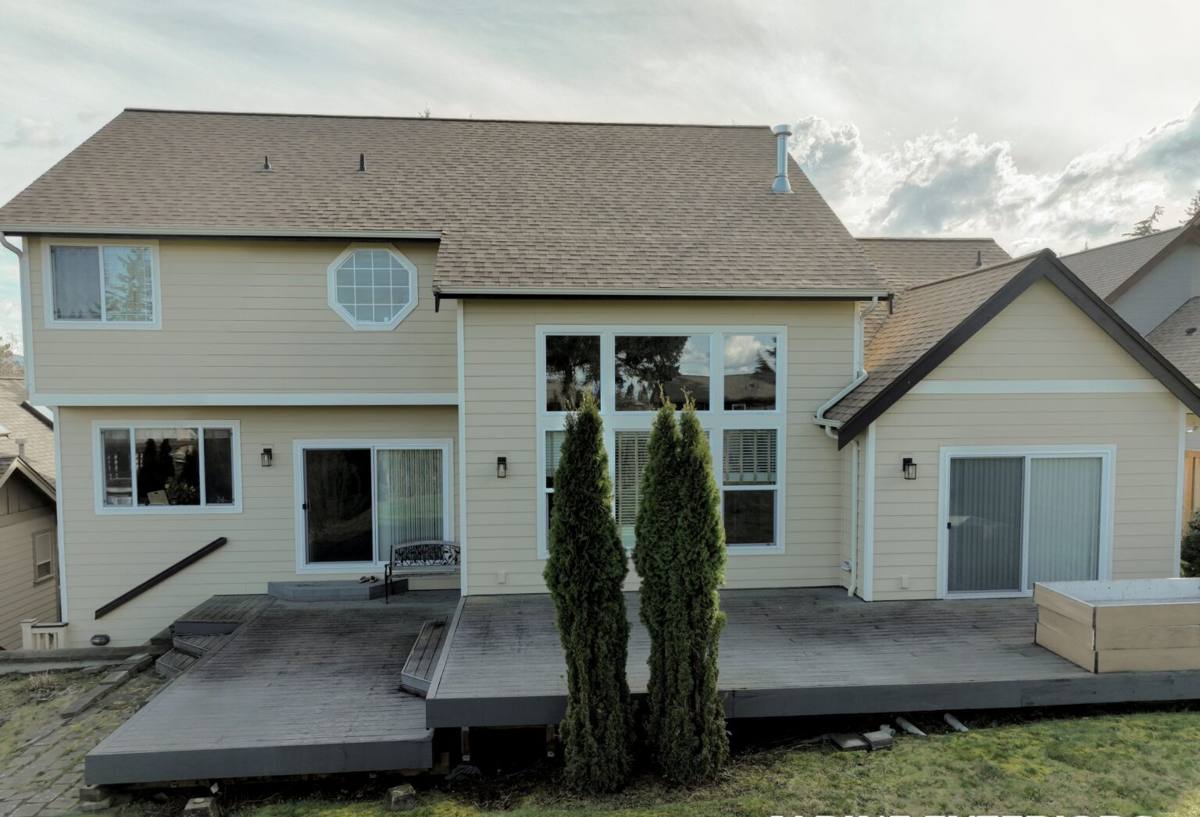
What a Correct Composite Deck Installation Actually Involves
Composite decking is a forgiving material on the surface — it will not splinter, crack, or need refinishing the way wood does. But the installation details underneath the boards matter more with composite than with wood, because composite decking does not "breathe" or dry out the way wood does. Trapped moisture stays trapped.
Ledger Board and Flashing
Where the deck attaches to the house is the single most common source of hidden rot on any Bellingham-area deck, composite or wood. Flashing has to be installed correctly at the ledger board so that water running off the house sheds away from the structure instead of wicking into it. In a climate with as much driving rain as ours, a poorly flashed ledger board is not a maybe-someday problem — it is a matter of a few wet seasons before damage shows up.
Joist Framing and Protection
Composite boards sit on a wood or wood-composite substructure, and that substructure is still vulnerable to rot even if the decking on top of it never will be. We wrap or tape the tops of joists to keep water from soaking into end grain and fastener holes, and we frame with enough spacing and airflow underneath the deck that the structure actually gets a chance to dry between rain events — which, in Whatcom County, can be few and far between for months at a time.
Fasteners and Hardware
Proximity to salt water changes what hardware is appropriate. Standard galvanized fasteners can corrode faster near the bay than they would further inland, leading to rust streaks on the decking surface and, eventually, weakened connections. We use stainless steel or coated fasteners rated for coastal exposure on decks in this area as a standard practice, not an upsell.
Composite Board Options and How They Handle Our Weather
Not all composite decking is built the same way, and the differences matter more here than in a milder climate. The main distinction is whether a board is capped — meaning it has a plastic shell wrapped around a wood-plastic composite core — or uncapped, where the composite material is exposed on all sides.
| Board Type | Moisture Behavior | Moss/Algae Resistance | Best Fit |
|---|---|---|---|
| Uncapped composite | Can absorb moisture at the surface over time | Lower — more porous surface holds spores | Drier, covered areas only |
| Capped composite (cap on top only) | Good on the walking surface, exposed underside and edges | Better on top, weaker at cut ends | Most open decks with good drainage |
| Fully capped composite (cap all sides) | Best moisture resistance overall | Best — smooth, sealed surface resists spore growth | Uncovered decks, high-exposure sites near the bay |
For a deck in Columbia that is going to sit exposed to weather off the bay, we generally steer homeowners toward fully capped boards. It costs more up front, but the maintenance burden and long-term moisture performance are different enough that it is usually the more honest recommendation, not just the higher-margin one.
Moss, Mildew, and Algae: What Actually Stops It
Bellingham's moss season is long, and a deck that stays shaded and damp for weeks at a stretch will grow something on its surface eventually — that is true of composite, wood, or nearly any exterior decking material. What changes the outcome is a combination of board choice, airflow, and layout.
- Grooved boards (used for hidden fastener systems) can trap organic debris in the groove — solid-edge boards shed debris more easily on shaded, low-airflow sites
- Gaps between boards need to be sized for drainage, not just appearance — too tight and water sits on the surface longer
- Substructure airflow matters as much as surface drainage — a deck built low to the ground with poor underside ventilation will grow moss on top faster, even with a premium board
- Overhanging trees and shaded north-facing sites need wider board gaps and, sometimes, a different board finish than a sun-exposed deck on the same property
We factor these things into the layout and material choice at the design stage rather than leaving it to the homeowner to manage with a pressure washer every spring.
Our Process for a Columbia Deck Project
The process is straightforward, but each step exists for a reason specific to building decks in this area.
- Site visit and assessment — we look at sun exposure, drainage, proximity to the bay, existing structure condition, and any signs of prior moisture damage before we talk products.
- Design and material selection — board type, fastener system, and railing choices are matched to the site conditions we just found, not a one-size-fits-all package.
- Permitting — deck projects in Whatcom County and within Bellingham city limits often require a permit depending on size, height, and attachment to the home; we handle that process rather than leaving it to the homeowner to sort out.
- Framing and flashing — this is the stage that determines how the deck performs in ten years, and it happens before a single composite board goes down.
- Decking installation — boards, hidden or exposed fasteners, and edge details are installed to the manufacturer's spec, which matters for warranty coverage.
- Final walkthrough — we go over what the specific board finish needs going forward, so there are no surprises about maintenance later.
What Maintenance Actually Looks Like
One of the real advantages of composite decking is that maintenance is lighter than wood — no staining, no sealing, no sanding. But "low maintenance" does not mean "no maintenance," especially in a climate that grows moss on driveways and roofs, let alone decks.
- Sweep debris off the deck regularly, especially in fall when leaves and needles collect in board gaps
- Rinse or lightly wash the surface once or twice a year to clear early moss and algae growth before it takes hold
- Check fastener heads periodically for corrosion, especially on decks closer to the bay
- Keep gutters and downspouts near the deck clear so runoff is not adding extra water directly onto the surface
- Trim back overhanging vegetation that keeps sections of the deck shaded and damp longer than the rest
Cost Factors for a Composite Deck in This Area
Every deck is different, but the same handful of factors drive most of the cost difference between projects in this area.
| Factor | Why It Affects Cost Here |
|---|---|
| Board tier (uncapped vs. fully capped) | Fully capped boards cost more but hold up better against salt air and moss |
| Substructure condition | Existing framing with moisture damage needs repair or replacement before decking goes on |
| Fastener and hardware spec | Coastal-rated stainless hardware costs more than standard galvanized |
| Site exposure and shade | Shaded, low-airflow sites may need wider board spacing or added drainage detailing |
| Permitting requirements | Height, attachment, and size can trigger permit and inspection requirements |
We give a broad range during the initial conversation and a firm number once we have actually assessed the site — not before.
Why a Local Crew Matters for This Specific Job
Composite decking installation is not exotic work, but doing it correctly in a climate like Bellingham's takes judgment calls that come from having built decks in this exact kind of weather repeatedly — how much board gap a shaded site actually needs, which hardware holds up near the bay, how framing has to be handled to survive a wet season before decking even goes on. A crew that works this area regularly has already seen what goes wrong when those details are skipped, and builds accordingly from the start rather than learning it on your project.
If you are considering composite decking for a home in the Columbia area, we are happy to take a look at your site, walk through board and layout options suited to your specific exposure, and put together a straightforward estimate. There is no pressure and no obligation — just a clear look at what your deck actually needs. Use the form below to get started.