 Bellingham Roofing
 Why Blaine Roofs Wear Out Differently Than Roofs Inland
Blaine sits right on the water at the northern edge of Whatcom County, and that location shapes how a roof ages here. Salt-laden air off the Strait of Georgia and Boundary Bay works on exposed metal fasteners, flashing, and shingle granules in a way that homes even a few miles inland don't experience to the same degree. Add the driving rain that comes in sideways during winter storms, and you've got wind-driven moisture finding its way under shingle tabs and around penetrations that would stay dry on a calmer roof. Then there's the moss season, which in this part of Washington isn't really a season at all — it's most of the year, thanks to shade, humidity, and mild temperatures that never dry a north-facing slope out for long.
None of that means a Blaine roof is doomed to fail early. It means the materials, fastening, ventilation, and detailing have to account for salt exposure, wind-driven rain, and constant moisture pressure from day one. A roof replacement done without that in mind may look fine at installation and still underperform within a few years.
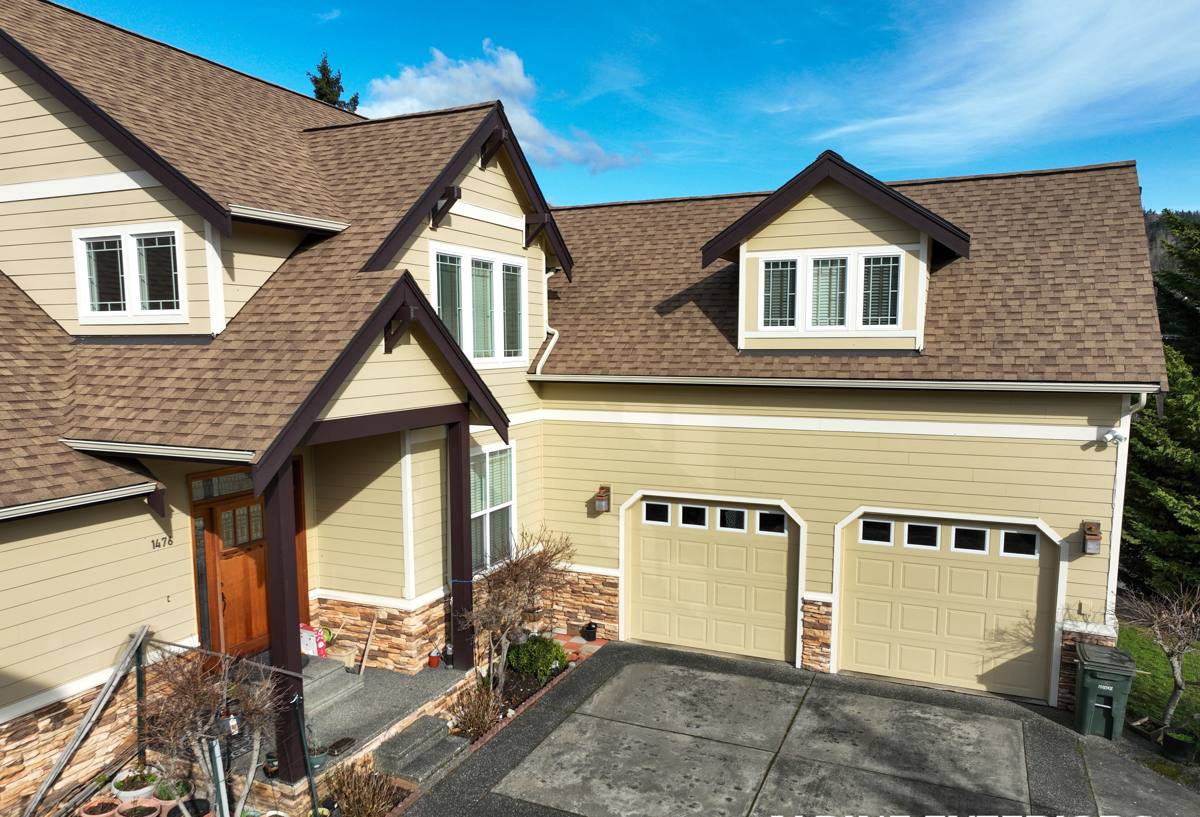
Signs Your Blaine Home Has Reached Replacement, Not Repair
Most homeowners call us because something specific caught their eye — a stain on a ceiling, a shingle in the yard after a windstorm, moss creeping up from the eaves. The honest answer isn't always "replace it." Plenty of roofs just need targeted repair. Replacement becomes the right call when the damage is spread across the roof rather than isolated to one spot, or when the roof is old enough that repairing one area just shifts the failure point to the next weak spot.
- Granule loss heavy enough that you can see bare, shiny patches on multiple slopes, not just one
- Shingles that are cupping, curling, or cracking across the field of the roof rather than in one localized area
- Soft or spongy decking felt underfoot during an inspection, which tells us moisture has gotten past the shingles and underlayment
- Persistent moss growth that keeps returning within a year or two of cleaning, especially on shaded north and west slopes
- Flashing around chimneys, vents, and valleys that's rusted, lifted, or was never properly stepped and counter-flashed to begin with
- A roof already at or past the 20-25 year mark for asphalt shingle, especially one that's taken the brunt of salt air the whole time
If your roof shows one or two of these in a small area, repair is usually the honest recommendation. If it's several of these spread across the roof, replacement is the more cost-effective path — patching a roof that's failing broadly just means paying for the same work again in a year or two.
What a Correct Roof Replacement Actually Involves
Full Tear-Off, Not Overlay
We tear the old roofing down to bare decking rather than layering new shingles over old ones. An overlay hides problems instead of fixing them, and on a home dealing with wind-driven rain and salt exposure, you need to see the decking itself to know it's sound.
Decking Inspection and Repair
Once the old roofing is off, we check every sheet of decking for soft spots, delamination, or rot — common where moss has held moisture against the roof for years, or where old flashing let water track in slowly over time. Any compromised decking gets replaced before anything new goes down. This step gets skipped on cheap replacements, and it's the single biggest reason a roof that looks fine in year one fails in year five.
Underlayment Built for Wind-Driven Rain
A synthetic underlayment or self-adhered membrane goes down as the roof's real waterproofing layer, with extra attention — often ice-and-water shield style membrane — at eaves, valleys, and any place wind can drive rain up under the shingle tabs rather than straight down.
Flashing Done Properly the First Time
Chimneys, skylights, sidewalls, and valleys get step flashing and counter-flashing installed correctly, not caulked as a shortcut. Caulk fails; properly lapped metal doesn't. This is one of the most common corners cut on lower-bid replacements, and it's usually where the first leak shows up.
Ventilation That Matches the Home
Intake at the eaves and exhaust at the ridge need to balance so the attic can actually dry out between rain events. We'll cover this in more detail below, since it matters more here than in drier climates.
Material Options for a Home This Close to the Water
There's no single "best" roofing material for Blaine — the right choice depends on your budget, your roof's slope and exposure, and how long you plan to stay in the home. Here's how the common options actually compare for a coastal Whatcom County property.
| Material | Typical Lifespan Here | Salt Air / Moisture Behavior | Trade-offs |
|---|---|---|---|
| Architectural asphalt shingle | 20-30 years | Good with proper ventilation; algae-resistant granules help slow moss and staining | Best value; still needs decent airflow to hit its full lifespan |
| 3-tab asphalt shingle | 15-20 years | Thinner profile wears faster under wind-driven rain and salt exposure | Lowest upfront cost, shortest service life on an exposed coastal roof |
| Standing seam metal | 40-50+ years | Excellent shedding of moss and rain when fasteners and coatings are marine-rated | Higher upfront cost; fastener and coating quality matter more here than inland |
| Composite/synthetic shake or slate | 30-50 years | Resists moisture absorption better than wood shake; holds up well to salt air | Mid-to-high cost; appearance-driven choice for homes wanting a shake look without the maintenance |
We don't install cedar shake on homes this close to the water as a matter of professional standard — untreated wood shake holds moisture against itself in a climate that rarely lets a roof fully dry out, and that shortens its life regardless of how well it's installed. If the look matters to you, the composite shake products in the table above get you the appearance without that moisture liability.
3-Tab vs. Architectural: Why We Steer Most Blaine Homes Toward Architectural
3-tab shingles are a single layer laminated to the decking, which means less mass to resist wind uplift and less surface for algae-resistant granules to do their job over time. Architectural (dimensional) shingles are laminated in two layers, giving them more wind resistance and a thicker wear surface — both of which matter more on a roof taking regular wind-driven rain off the water than on a sheltered inland roof. The cost difference is usually modest; the lifespan difference on an exposed roof is not.
Our Replacement Process, Start to Finish
- On-site inspection and honest assessment. We walk the roof, check the attic if accessible, and tell you plainly whether you need a replacement or just a repair.
- Written estimate with material options. You'll see the cost difference between shingle grades and any alternative materials side by side, no pressure to upsell.
- Scheduling around Blaine's weather windows. We plan tear-off days around dry stretches where possible and keep the roof dried in with protective covering if weather turns mid-project.
- Full tear-off and decking inspection. Old roofing comes off completely; any soft or damaged decking gets flagged and replaced before we move forward.
- Underlayment, flashing, and ventilation installed to spec. This is where the roof's actual weather resistance is built — not in the shingle you see on top.
- Shingle or material installation. Installed to manufacturer spec for nail placement and pattern, which is what keeps warranties valid and shingles from lifting in wind.
- Cleanup and magnetic sweep for stray nails. Job site and yard cleared before we call it done.
- Final walkthrough with you. We go over the finished roof together before we consider the job complete.
Ventilation and Moisture Control Matter More Here Than Most Places
A roof replacement that ignores attic ventilation is setting the new roof up to fail early, and that's especially true in a climate where the air rarely gets a chance to dry things out. Without balanced intake and exhaust, moist attic air condenses against the underside of the decking, which accelerates rot from the inside — the exact opposite direction most homeowners are watching for. It also raises shingle temperatures in summer and traps moisture in winter, both of which shorten shingle life.
On a moss-prone, rain-heavy roof, we also pay close attention to how water sheds off shaded north and west slopes, since those are the areas where moss gets a foothold and holds moisture against the shingles longest. Proper ventilation combined with the right underlayment at those slopes is a bigger factor in long-term moss resistance than any granule treatment applied after the fact.
What Drives the Cost of a Blaine Roof Replacement
Every roof is priced on its own specifics, but the factors below are what actually move the number up or down. We'll walk through these with you directly rather than handing you a one-line quote.
| Factor | Why It Matters |
|---|---|
| Roof size and number of slopes | More square footage and complex slope layouts mean more material and labor |
| Material choice | Architectural shingle, metal, and composite each carry different material and labor costs, as shown above |
| Decking condition | Rotted or delaminated sheathing found during tear-off needs replacement before new roofing goes down |
| Roof pitch and access | Steep roofs and limited access (tight lots, overhead lines) add labor time and safety equipment needs |
| Number of penetrations | Chimneys, skylights, and multiple vents each need proper flashing, which adds time |
| Existing ventilation | Adding or upgrading intake/exhaust vents where the current setup is inadequate |
| Tear-off layers | A roof with a prior overlay means more material to remove before we can start fresh |
A Practical Checklist Before You Commit to a Replacement
- Get a written scope, not just a price — it should list tear-off, decking policy, underlayment type, flashing approach, and ventilation plan
- Ask how decking repairs are priced if damage is found — this should be a per-sheet rate agreed upfront, not a surprise change order
- Confirm the crew is licensed and insured to work in Washington, and ask to see current coverage
- Ask what warranty covers workmanship versus what the manufacturer covers on materials — these are two separate things
- Find out how weather delays are handled mid-project, since Blaine's rain doesn't always cooperate with a schedule
- Ask whether the crew doing the work is the same crew that sold you the job, or a subcontracted team you haven't met
Why a Crew That Already Works Blaine Matters
Roofing crews that mostly work drier, more sheltered parts of Whatcom County can do fine work, but they're not making daily calls about how to detail a valley against wind-driven rain off the water, or which slopes on a given lot need extra ventilation because they never see direct sun. Working Blaine regularly means we've already seen how salt air treats exposed fasteners over a few winters, which underlayment choices hold up and which don't, and where moss actually comes back versus where a good ventilation fix stops it for good. That's not something you can fully substitute with a generic install checklist — it comes from doing this specific kind of roof, in this specific place, repeatedly.
If you're weighing repair versus replacement, or just want a straight answer on what your roof actually needs, we're happy to take a look. There's no cost and no pressure for an estimate — use the form below to get one scheduled.