 Bellingham Roofing
 Birchwood's Siding Problem Isn't Cosmetic — It's Moisture
Birchwood sits inland from Bellingham Bay but still gets the same weather pattern that defines siding performance across Whatcom County: long stretches of low-intensity rain, wind-driven storms off the water, and a marine layer that keeps humidity high even on days it isn't actively raining. Add tree cover common to Birchwood's older residential streets, and you get shaded, slow-drying wall sections that stay damp far longer than siding on an open, sun-exposed lot. That combination — moisture load plus slow drying — is the single biggest factor in how long any siding product actually lasts here, regardless of what the manufacturer's brochure claims.
Most siding failures we get called out to inspect in this area aren't dramatic. They're slow: swelling at butt joints, soft spots near the bottom courses, moss and algae staining that keeps coming back no matter how often it's cleaned, paint that won't hold past a few years. None of that is bad luck. It's what happens when a siding material's real-world moisture tolerance doesn't match Bellingham's climate.
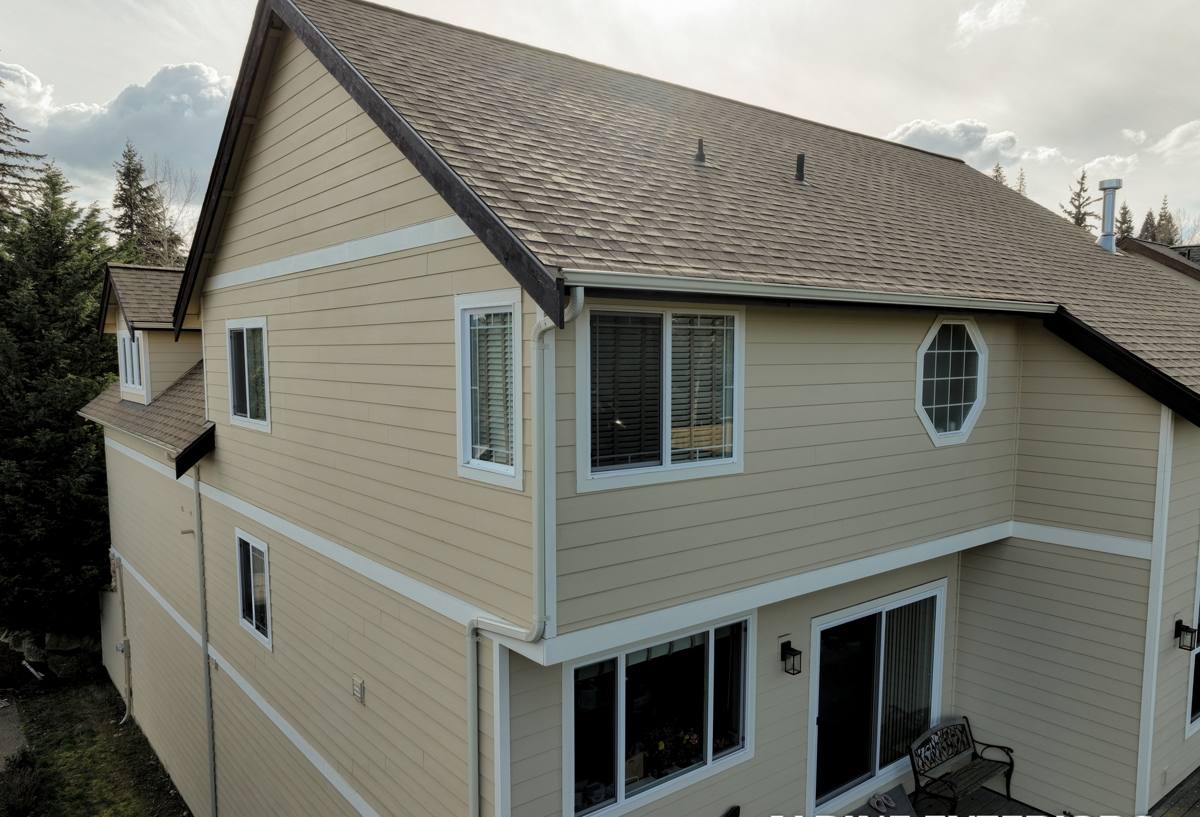
What Salt Air, Driving Rain, and Moss Season Actually Do
Salt air
Bellingham's proximity to the Salish Sea means airborne salt is a real factor, even a few miles inland. Salt accelerates corrosion on fasteners, flashing, and any exposed metal trim, and it draws moisture — surfaces exposed to salt-laden air stay damp longer than the same surface would inland. Siding and fastening hardware that aren't rated for coastal exposure corrode faster than their warranty timelines assume.
Driving rain
Wind-driven rain doesn't just wet a wall's surface — it forces water sideways and upward into laps, seams, and butt joints that were designed for water running straight down. Siding systems with weak joint design or inadequate house-wrap integration let that water track behind the cladding, where it does the real damage: rot in sheathing, mold in wall cavities, and siding that fails from the back before it ever looks bad from the front.
Moss and algae season
Whatcom County's wet season runs long — often eight months or more of conditions favorable to moss, algae, and mildew growth on north-facing and shaded walls. Organic growth isn't just unsightly; it holds moisture against the siding surface, which speeds up whatever degradation process the underlying material is prone to. A siding product that resists moisture intrusion handles this stress cosmetically at worst. A product that absorbs or swells with moisture takes real, compounding damage every wet season it goes untreated.
Why We Only Install James Hardie Fiber Cement
We made a decision as a company to install one siding system — James Hardie fiber cement — and not offer vinyl, LP SmartSide, Cemplank, Allura, primed spruce, or cedar as alternatives. That's not a marketing position; it's a maintenance and moisture-performance conclusion we reached after years of servicing homes in this exact climate.
- Vinyl doesn't absorb water, but it warps and becomes brittle with UV and temperature swings, and its seams and J-channels give wind-driven rain an easy path behind the cladding — a real liability with Bellingham's storm patterns.
- Wood-based composite (LP SmartSide) and primed spruce are engineered or milled wood products. Wood-based siding is inherently more vulnerable to moisture absorption and rot at cut edges and joints, which is exactly where our climate concentrates its damage.
- Cedar is a beautiful, honest material, but it requires disciplined refinishing on a schedule most homeowners can't keep up with in a climate this wet, and it's a combustible material in a region where wildfire smoke seasons are becoming a more regular concern.
- Other fiber cement brands (Cemplank, Allura) are legitimate fiber cement products, but we standardized on one manufacturer so we can guarantee installation to a single specification, train crews on one system, and back every job with one consistent warranty structure — rather than juggling install details across several product lines.
James Hardie fiber cement is non-combustible, engineered specifically for different regional moisture and temperature profiles, and backed by a factory-applied finish and a long transferable warranty when installed to Hardie's specification. For Birchwood's climate, it's the product that holds up the way homeowners actually expect siding to.
The James Hardie Lines That Make Sense for Birchwood
Hardie builds regional formulations under its "HZ" system, engineered for either wetter, more temperature-stable climates (HZ5) or freeze-thaw regions. Western Washington, including Bellingham and Whatcom County, falls into the moisture-focused engineering profile — the boards, the ColorPlus factory finish, and the resin formulation are built around resisting sustained dampness and freeze-thaw cycling rather than extreme heat.
| Product | What it's for | Why it fits Birchwood |
|---|---|---|
| HardiePlank lap siding | Primary wall cladding | Standard horizontal siding profile; the workhorse for most Birchwood homes |
| HardiePanel vertical siding | Accent walls, gables, modern facades | Clean vertical lines for contemporary updates or accent sections |
| HardieTrim boards | Corners, window and door casing, fascia | Non-combustible trim that won't rot at the joints the way wood trim does |
| ColorPlus factory finish | Baked-on color, all products | Resists fading and holds color far longer than field-applied paint, especially under this region's UV and moisture cycle |
What a Correct Installation Actually Involves
Fiber cement performs exactly as well as its installation. A quality board installed with shortcuts will fail in the same places, for the same reasons, as a cheap product — because the failure points aren't in the board itself, they're in the details around it.
- Weather-resistive barrier and flashing first. Every penetration, window, and door gets properly flashed and integrated with the house wrap before a single board goes up — this is what actually stops driving rain from reaching the sheathing.
- Correct clearances. Hardie specifies minimum gaps at grade, roof lines, decks, and horizontal surfaces so water has somewhere to go instead of wicking up into the board.
- Proper fastening. Corrosion-resistant, coastal-rated fasteners driven at the manufacturer-specified pattern and depth — under- or over-driven nails are one of the most common causes of early siding failure we find on re-inspections.
- Joint and seam treatment. Butt joints get flashed or caulked per spec, not just butted and painted over.
- Factory-cut edges wherever possible. Field cuts expose raw fiber cement edges that need sealing; minimizing them and sealing what remains protects long-term moisture resistance.
None of this is optional detailing — it's the difference between a job that meets its warranty terms and one that quietly fails behind the wall in five years.
Our Process, Start to Finish
1. On-site assessment
We walk the home, check for existing moisture damage, evaluate the current siding and sheathing condition, and note anything — shaded walls, existing moss, poor drainage — that needs to be addressed before new siding goes up, not covered by it.
2. Written estimate and product plan
You get a clear scope: which Hardie products, trim details, color, and a realistic cost range, with no pressure to decide on the spot.
3. Prep and any repair work
Damaged sheathing gets repaired, not sided over. This is the step that determines how the finished job actually performs.
4. Installation to spec
House wrap, flashing, clearances, and fastening done to Hardie's published installation guidelines — the same standard that keeps the warranty valid.
5. Final walk-through
We review the completed work with you before calling the job done, and go over basic care so you know what to expect from the new siding.
What Drives the Cost of a Birchwood Siding Job
| Factor | Why it matters |
|---|---|
| Home size and wall complexity | More corners, gables, and dormers mean more trim work and cut boards |
| Existing wall condition | Rotten sheathing or hidden moisture damage found during tear-off adds repair scope |
| Product mix | Lap siding vs. panel accents vs. trim-heavy designs price differently |
| Access and site conditions | Tree cover, tight lot lines, and multi-story sections affect labor time |
| Color and finish | ColorPlus factory finish vs. field painting changes both cost and long-term maintenance |
We don't quote a number without seeing the house — anyone who does is guessing, and guesses on siding jobs tend to grow once the crew opens up the walls.
Keeping Hardie Siding Looking Right Through Bellingham's Wet Season
- Rinse shaded, moss-prone sides of the house once or twice a year with a garden hose — avoid pressure washers, which can force water behind joints
- Keep gutters clear so overflow doesn't run down the wall face during heavy rain
- Trim back vegetation and tree limbs that keep wall sections shaded and slow to dry
- Check caulking at trim joints and penetrations every couple of years and re-caulk as needed
- Watch for any soft spots, staining, or paint failure at the bottom courses and near grade — catch small issues before they spread
Why a Crew That Already Works Birchwood Matters
Siding installed to the same generic spec everywhere doesn't hold up the same everywhere. A crew that already works Birchwood and the wider Bellingham area knows which walls in this neighborhood stay shaded and damp longest, how local storm patterns drive rain against specific wall orientations, and where salt air exposure changes fastener and flashing choices. That local knowledge shows up in details a homeowner never sees until they matter — the flashing at a north-facing window, the clearance at a shaded foundation line, the fastener spec that accounts for coastal air. It's the difference between siding that just meets code and siding that's actually built for this specific climate.
If you're weighing a siding replacement or repair in Birchwood, we're happy to take a look and walk you through what your home actually needs — no pressure, no obligation. Request a free estimate below and we'll schedule a time to assess your home in person.