 Bellingham Roofing
 Why Birch Bay's Coastal Climate Is Tougher on Roofs Than Inland Bellingham
Birch Bay sits right on the water in Whatcom County, and that shoreline exposure changes what a roof has to deal with compared to a home a few miles inland in Bellingham. Wind coming off the Salish Sea drives rain sideways into fascia, soffits, and roof-to-wall transitions instead of just falling straight down. Salt-laden air corrodes exposed metal faster than it would elsewhere, and the persistent damp keeps roof surfaces wet longer between storms, which is exactly the condition moss needs to take hold. None of this means a roof here fails faster by default — it means a roof here needs to be built and maintained with those specific stresses in mind. A roofing system that's fine in a dry, sheltered part of the county can underperform on a bay-front home simply because it wasn't detailed for wind-driven moisture and salt exposure.
We work on homes throughout Whatcom County, and the difference in wear patterns between an inland roof and a Birch Bay roof is real and visible once you know what to look for. That's the backdrop for every replacement recommendation we make out here — it's not a generic Bellingham roof job, it's a coastal one.
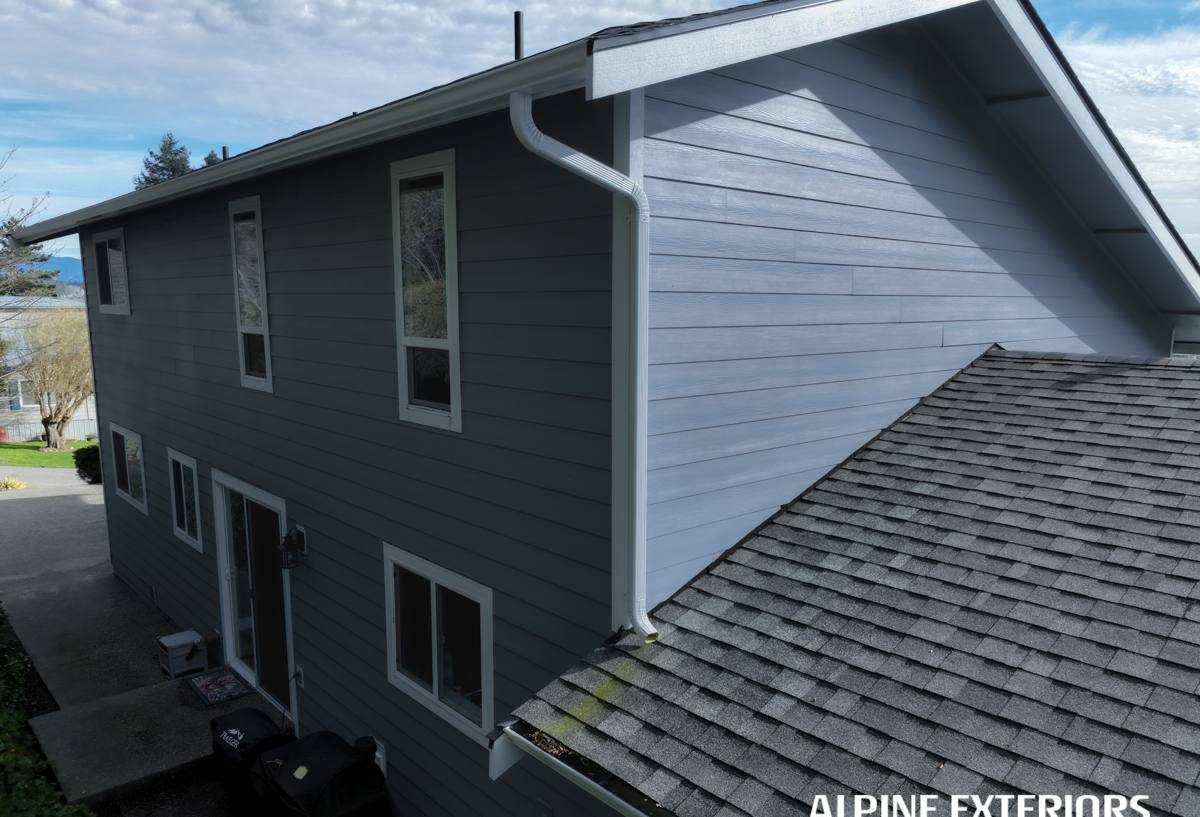
Signs a Birch Bay Roof Needs Replacement, Not Just Another Repair
Repairs make sense when the damage is isolated and the rest of the roof still has useful life left. Replacement is the honest answer when the roofing material itself is worn out system-wide, even if only part of it is actively leaking today. Here's what typically tips a Birch Bay roof from "repair" to "replace":
- Granule loss heavy enough that you can see bare, shiny patches on multiple slopes, not just one storm-damaged spot
- Shingles that are curling, cupping, or cracking across the roof rather than in one localized area
- Soft or spongy decking found during inspection, which tells us moisture has been getting past the roofing surface for a while
- Persistent moss coverage that keeps returning within a season or two of cleaning, a sign the roof is staying damp longer than it should
- Rusted, pitted, or failing flashing around chimneys, valleys, and skylights — often the first thing salt air damages
- A roof already at or past the manufacturer's expected service life, especially one that's taken the full brunt of bay-front wind and rain for that entire time
- Repeated repair calls to the same handful of trouble spots — at some point patching costs more than doing the job right
If your roof shows one or two of these in isolation, a repair is probably the right call and we'll say so. If several of these are true at once, replacement is usually the more honest long-term answer, and we'll walk you through why before recommending it.
What a Correct Roof Replacement Involves Out Here
Full Tear-Off and Deck Inspection
We don't recommend layering a new roof over an old one on Birch Bay homes. A tear-off is the only way to actually see the decking underneath, and after years of driving rain, that's where problems hide — soft spots, old water staining, delaminating plywood. Any damaged decking gets replaced before a single new shingle goes down. Skipping this step just buries a problem under a new surface and shortens the life of the whole job.
Underlayment Built for Wind-Driven Rain
A synthetic underlayment goes down as the primary water barrier, but the detail that matters most in Birch Bay is where we add self-adhering ice-and-water shield: eaves, valleys, around penetrations, and anywhere wind-driven rain is most likely to work its way sideways under the roofing surface. That extra layer of protection at the vulnerable points is what separates a roof built for this location from one built to a generic spec.
Flashing and Fasteners That Can Handle Salt Air
Flashing around chimneys, skylights, and valleys is where coastal roofs fail first if it's done wrong, because it's exposed metal in a salt-air environment. We detail flashing so water is always shed downhill and lapped correctly, and we use fasteners and hardware rated to resist corrosion rather than standard-grade materials that will rust prematurely this close to the water. It costs a little more up front and saves a lot of grief later.
Choosing a Roofing Material That Holds Up Near the Water
There's no single "best" roofing material for every home — the right choice depends on your budget, your roof's exposure, and how much long-term maintenance you want to take on. Here's an honest comparison of the options homeowners in Birch Bay usually weigh:
| Material | Coastal Durability | Maintenance | Typical Trade-Offs |
|---|---|---|---|
| Architectural (laminate) asphalt shingle | Good, especially algae-resistant lines | Periodic moss/debris removal | Best value; wide color range; solid mid-range lifespan |
| Standing seam metal | Very good when properly coated and fastened | Low; sheds moss and debris well | Higher upfront cost; needs a crew experienced with coastal metal detailing |
| 3-tab asphalt shingle | Fair; more exposed to wind lift | More frequent moss/algae attention | Lower cost, but shorter service life in this exposure |
| Wood shake | Poor in persistent damp | High; prone to moss and rot near the coast | We generally steer homeowners away from it out here for this reason |
For most Birch Bay homes, a high-quality architectural shingle rated for algae resistance and higher wind speeds hits the right balance of cost, appearance, and durability. Standing seam metal is a strong option for homeowners who want the lowest long-term maintenance and are comfortable with the higher initial investment. We'll be straightforward with you about which fits your home and budget rather than steering you toward whatever's easiest to install.
Ventilation: The Difference Between a Roof That Lasts and One That Doesn't
Proper attic ventilation is one of the most overlooked parts of a roof replacement, and it matters more in a damp coastal climate than almost anywhere else. Without balanced intake and exhaust airflow, moisture gets trapped under the roof deck, which accelerates decking rot from the underside and creates ideal conditions for mold — problems that have nothing to do with the shingles themselves but will shorten their life anyway. We calculate ventilation needs based on your attic's square footage and existing intake at the soffits, then correct any imbalance as part of the replacement, not as an afterthought.
Moss, Algae, and Whatcom County's Long Wet Season
Whatcom County's wet season runs long, and shaded or north-facing roof sections near Birch Bay's tree cover rarely get a chance to fully dry out between rains. That's what drives moss and algae growth, and it's a maintenance issue as much as a materials issue. A new roof replacement is the right time to install zinc or copper control strips near the ridge, which release trace metal ions that discourage regrowth every time it rains. We'll also talk with you honestly about a realistic cleaning schedule for your specific roof — some Birch Bay homes need attention every year or two, others go longer, depending on tree cover and sun exposure. No roofing material is fully moss-proof in this climate; the goal is to slow it down and keep it from becoming a moisture problem.
Our Roof Replacement Process for Birch Bay Homeowners
- On-site inspection — we walk the roof and attic, check decking condition, ventilation, and flashing, and take photos to show you exactly what we find
- Written estimate — a clear scope of work and price, with material options explained so you understand what you're paying for and why
- Scheduling around the weather — we plan tear-off days with realistic weather windows in mind, since an open roof deck and a coastal rain system don't mix
- Tear-off and deck repair — full removal of the old roofing, replacement of any damaged decking, and a clean surface to build on
- Underlayment, flashing, and ventilation correction — the details that determine how the roof performs, not just how it looks
- New roofing installation — installed to manufacturer specs and to the wind and moisture conditions specific to your property
- Final walkthrough — we go over the finished job with you, answer questions, and make sure the site is cleaned up before we leave
What Roof Replacement Costs Depend On
We don't publish flat prices because every roof is different, but these are the main factors that move the number up or down:
| Factor | Why It Matters |
|---|---|
| Roof size and number of slopes | More square footage and more valleys/hips mean more material and labor |
| Decking condition | Rotted or soft plywood found during tear-off adds material and time to replace |
| Material chosen | Architectural shingle, metal, and other options carry different material and labor costs |
| Roof pitch and access | Steeper or harder-to-access roofs take longer and require more safety setup |
| Ventilation and flashing corrections | Fixing an undersized or poorly detailed system adds some cost but prevents problems later |
| Number of penetrations | Chimneys, skylights, and vents each need proper flashing, which adds labor |
The only way to get an accurate number is a real inspection of your specific roof — anything else is a guess.
Why Hiring a Crew That Already Works in Birch Bay Matters
A roofing crew that mostly works dry, sheltered, inland jobs doesn't always think about wind-driven rain at the eaves or salt-corroded fasteners at the flashing — because they haven't had to. Working regularly along the Whatcom County coastline means we've seen how roofs actually fail out here, not just how they're supposed to perform on paper. That shapes real decisions on your job: where we add extra underlayment, what fastener grade we use, how we detail flashing, and how we set up ventilation for a damp climate instead of a dry one. It's the difference between a roof that's technically installed correctly and one that's built for the specific conditions it has to survive.
Before You Hire: A Practical Checklist
- Ask whether the crew tears off down to the deck or plans to layer over the existing roof
- Confirm they use corrosion-resistant fasteners and flashing, given the salt-air exposure here
- Ask how they handle ventilation correction, not just shingle installation
- Get the material warranty and workmanship warranty in writing, and understand what each actually covers
- Ask for proof of current licensing and insurance before any work begins
- Ask how they plan around weather for tear-off day — a vague answer is a red flag on this coast
If your Birch Bay roof is showing its age or you just want an honest opinion on whether repair or replacement makes sense, we're happy to take a look. Fill out the form below for a free, no-pressure estimate — we'll tell you what we actually see, not just what's easiest to sell.