 Bellingham Roofing
 Why Puget-Area Roofs Wear Differently Than Roofs Inland
If you own a home in the Puget area near Bellingham, your roof is doing a harder job than a roof twenty or thirty miles inland. Whatcom County sits right up against the water, and that proximity changes how a roof ages. Salt-laden air corrodes exposed metal faster than dry inland air does. Fasteners, flashing, and gutter hardware that would last decades elsewhere can start showing rust and pitting years ahead of schedule here. Add in driving rain that comes sideways off the water during winter storms, and you've got wind-driven moisture finding its way into laps, seams, and fastener penetrations that would stay dry in a straight-down rain.
Then there's the moss. Bellingham's long, mild, wet stretches from fall through spring give moss and algae months to establish themselves on a roof, especially on north-facing slopes and anywhere shaded by trees. Moss isn't just cosmetic — its root structure lifts shingle edges, holds moisture against the roof deck, and accelerates granule loss. A roof that would need attention every ten years in a drier climate often needs it every five to seven here if it isn't maintained.
None of this means Puget-area homes need exotic materials or constant repair. It means repairs have to be done with this specific combination of salt exposure, wind-driven rain, and moss pressure in mind — not with a generic approach copied from a drier region.
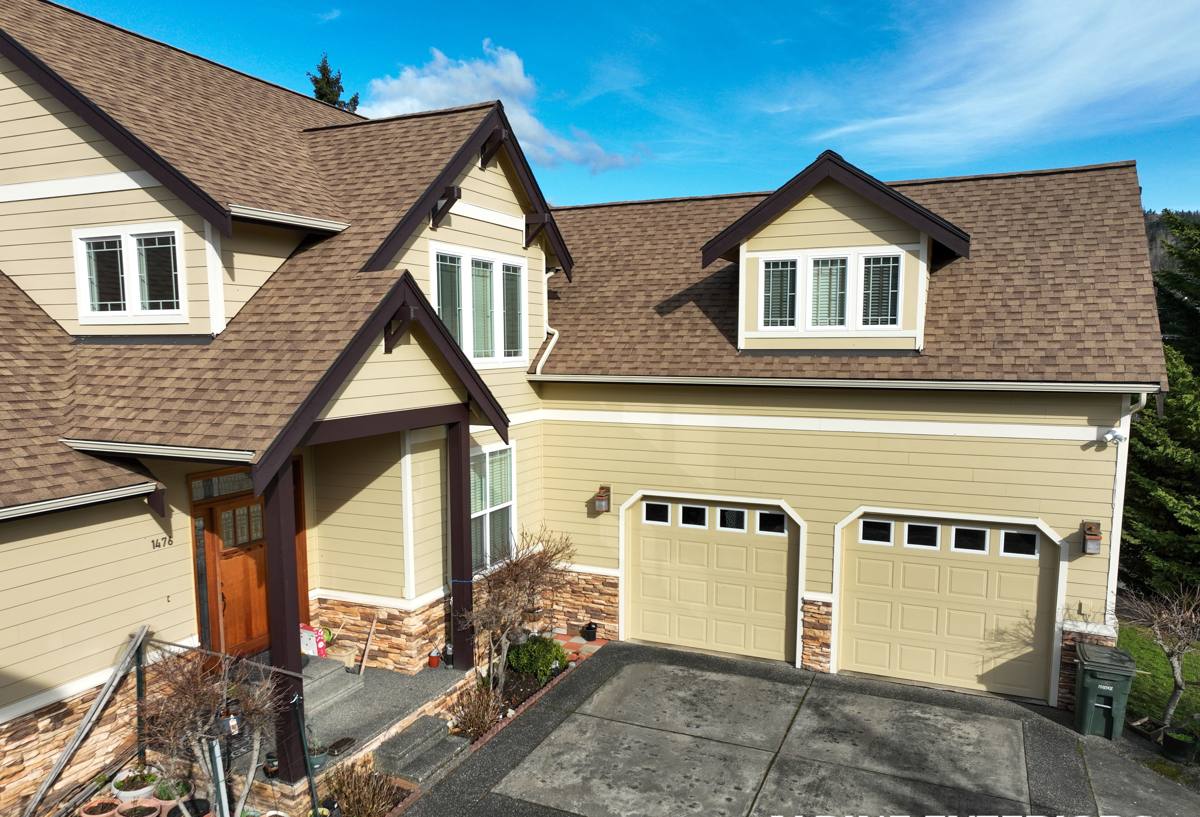
Signs a Puget Roof Needs Repair, Not a Full Replacement
Most roofs don't fail all at once. They develop specific, localized problems that are fixable if caught early. Here's what we look for and what it usually means:
- Granule buildup in gutters — normal in small amounts as a roof ages, but heavy buildup after a storm can mean accelerated wear from moss or wind abrasion.
- Dark streaking or green-black patches — algae or moss taking hold, usually starting on the shaded or north-facing sections.
- Rust staining below metal flashing or fasteners — a sign that salt-air corrosion has started eating into the metal itself, not just the surface finish.
- Curling or lifted shingle edges — often caused by moss growing under the tab or by repeated wind-driven rain getting under the edge.
- Damp spots on interior ceilings after a windy rainstorm — points to a flashing or seam failure, not necessarily a worn-out roof field.
- Visible daylight or gaps around chimneys, vents, or skylights — flashing has moved, corroded, or was never sealed correctly to begin with.
If the damage is limited to a few of these areas and the roof deck underneath is still sound, repair is almost always the right call — it's less disruptive and less expensive than replacement, and a well-done repair on a roof with useful life left can buy another decade of service.
When Repair Isn't Enough
We'll tell you honestly if a roof is past the point where patching makes sense — widespread granule loss across most slopes, soft or spongy decking in multiple areas, or repeated leaks in different spots each season are signs the roof system itself is failing, not just a section of it. We'd rather give you that assessment upfront than sell you a repair that won't hold.
What a Correct Roof Repair Actually Involves
A repair that's done right isn't just "cover the hole." It involves diagnosing the actual entry point for water, which is often several feet away from where the stain shows up inside the house, because water travels along the underlayment or decking before it drips through.
Diagnosis First
We start by tracing the leak or damage to its actual source — checking flashing points, valleys, penetrations, and any area where moss or debris has been holding moisture. On a home this close to the water, we also check fastener heads and exposed metal for corrosion, since that's a failure point that's easy to miss from the ground.
Removing and Assessing
Damaged shingles, flashing, or underlayment get pulled back so we can see the decking underneath. If the decking is soft or delaminating from prolonged moisture exposure, that gets addressed before anything new goes back on — patching over a wet or rotten deck just guarantees a repeat visit.
Rebuilding the Water Path
Roofing works as a system of overlapping layers designed to shed water downhill, not as a single waterproof sheet. Every repair has to respect that layering — new underlayment, flashing, and shingles have to integrate with the existing material in the correct order, especially around valleys and wall intersections where wind-driven rain from off the water puts the most pressure on the seams.
Sealing and Finishing
Fasteners and flashing edges get sealed with materials chosen for this climate — ones that stay flexible through temperature swings and resist breaking down under constant damp exposure. Corroded metal gets replaced rather than resealed, since sealing over rust just delays the same failure.
Common Puget-Area Repairs We Handle
| Repair Type | Typical Local Cause | What the Fix Involves |
|---|---|---|
| Flashing repair/replacement | Salt-air corrosion, wind-driven rain intrusion | Remove corroded metal, replace with properly lapped flashing, reseal |
| Moss and algae removal | Long wet season, shaded north-facing slopes | Careful low-pressure removal, treatment, and checking for lifted shingles underneath |
| Shingle replacement (localized) | Wind uplift, moss root damage, granule loss | Remove damaged shingles, inspect deck, install matched replacements |
| Valley repair | Concentrated water flow during heavy storms | Rebuild valley underlayment and metal to handle higher water volume |
| Vent and penetration resealing | Aging boots and sealant breaking down in constant damp | Replace pipe boots and reseal with climate-appropriate sealant |
| Gutter and fastener corrosion repair | Salt exposure on exposed metal | Replace corroded hardware, verify proper drainage away from the roof edge |
Our Process, From Call to Completion
We keep the process straightforward because most homeowners just want a clear answer and a fair timeline, not a sales pitch.
- Inspection. We walk the roof (or use a ladder and camera where a walk-on inspection isn't safe or appropriate) and check the areas most likely to be affected by moss, salt exposure, and wind-driven rain, not just the spot where you noticed a problem.
- Honest assessment. We explain what we found, what's causing it, and whether repair or replacement makes sense — in plain terms, not scare tactics.
- Written estimate. You get a clear scope of work and price before anything starts.
- The repair. Work is scheduled around Bellingham's weather windows — we don't rush a repair into a job during active driving rain, since that compromises the seal.
- Final check. We confirm the repair is watertight and walk you through what to watch for going forward.
Materials and Methods for Coastal Whatcom County Homes
We select materials with the local climate in mind rather than defaulting to whatever's cheapest or most common inland. That means corrosion-resistant flashing and fasteners rather than standard-grade metal that pits quickly this close to salt air, and underlayment and sealants rated to stay flexible and adhere well in persistent damp and cooler temperatures rather than products that perform best in hot, dry conditions.
We also pay close attention to how a repair handles moss going forward. A patch that ignores the conditions that caused the original moss growth — poor airflow, overhanging shade, debris buildup — just sets up the same failure again in a few years. Where it's practical, we'll flag simple changes, like trimming back overhanging branches or improving debris clearing at valleys and gutters, that reduce how much moss pressure the roof faces afterward.
Repair vs. Replacement: What Actually Drives the Decision
| Factor | Favors Repair | Favors Replacement |
|---|---|---|
| Age of roof | Under 15-18 years | Nearing or past expected lifespan for the material |
| Extent of damage | Localized (one slope, one flashing area) | Widespread across most or all slopes |
| Deck condition | Solid, no soft spots found | Soft, delaminated, or damaged decking in multiple areas |
| Leak history | First occurrence or isolated cause | Recurring leaks in different locations each season |
| Moss/algae damage | Surface-level, caught early | Root damage has already lifted shingles broadly |
We walk through these factors with you directly rather than defaulting to the more expensive option. A lot of roofs we're called out to in the Puget area genuinely just need targeted repair, not a full tear-off.
Ongoing Care That Extends a Repair's Life
A good repair holds up longer when it's paired with basic seasonal upkeep, especially given how long the wet season runs here. A simple maintenance checklist for Puget-area homeowners:
- Clear gutters and valleys of debris before the fall rains start, so water has a clear path off the roof.
- Trim back tree limbs that shade roof sections and keep them from drying out between rains.
- Have moss treated or removed before it spreads, rather than after it's visibly widespread.
- Check attic ventilation — poor airflow keeps the underside of the deck damp and speeds up rot from the inside.
- Have flashing and exposed metal checked periodically for early corrosion, especially after the first few years.
- Walk the property after major windstorms and look for lifted or missing shingles rather than waiting for an interior leak to show up.
Why a Crew That Already Works in Puget Matters
Roof repair isn't one-size-fits-all, and a crew that mostly works drier, inland areas can miss things that are routine knowledge for a crew that works this stretch of Whatcom County regularly. Knowing which slopes in this area tend to hold moss longest, how far wind-driven rain typically pushes water under a flashing edge in a coastal storm, and which fastener and flashing grades actually hold up against salt air isn't guesswork — it's pattern recognition built from doing this work here, on homes with the same exposure yours has.
That local familiarity also means a faster, more accurate diagnosis. We're not guessing at what "normal wear" looks like for this climate — we know it, because we see it on roof after roof in this area. That translates into repairs that address the actual cause instead of just the visible symptom, and fewer callbacks down the road.
If you're noticing moss, a stain on a ceiling, or just want a second set of eyes on a roof that's due for a look, we're happy to come take an honest look and walk you through what we find. Reach out for a free, no-pressure estimate — there's a form below to get started.