 Bellingham Roofing
 Composite Decking in Puget: Built for What This Corner of Bellingham Actually Deals With
Puget sits close enough to the water that homes here take a different kind of weathering than decks a few miles inland. Salt-laden air works into fasteners and hardware, driving rain off the Sound finds every seam and gap a deck wasn't built to handle, and the long stretch of gray, wet months from fall through spring gives moss and algae months to gain a foothold on any surface that doesn't shed water well. A deck built to a generic spec sheet, without accounting for those three things together, tends to show its age fast in this neighborhood. Composite decking, installed correctly for this specific environment, is one of the more sensible ways to get a deck that still looks and performs well after a decade of Whatcom County winters.
This page is about that one job, in this one area: what Puget's climate demands from a deck, what a correctly built composite deck actually involves below the surface, and why a crew that already works this neighborhood tends to get better long-term results than one working from a checklist.
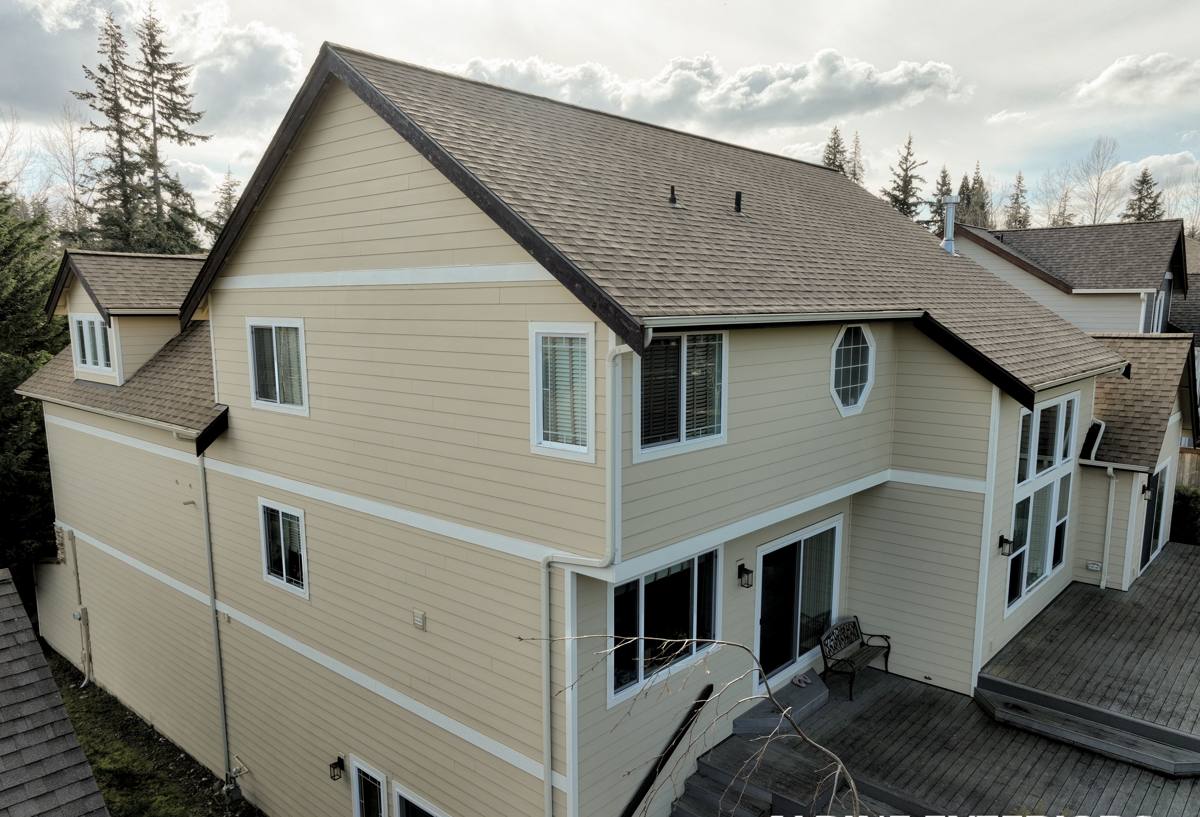
What Bellingham's Climate Does to a Deck Over Time
Salt Air and Corrosion
Even set back from the immediate waterfront, homes in and around Puget get enough salt-carried moisture in the air to accelerate corrosion on fasteners, brackets, and railing hardware. Standard zinc-coated screws and connectors that hold up fine in a dry inland climate can start showing rust streaks and weakening within a few seasons here. This matters more than people expect, because the hardware — not the decking boards — is usually what fails first on a poorly specified deck.
Driving Rain and Moisture Intrusion
Storms coming off the Sound don't just fall straight down; wind-driven rain gets pushed sideways into ledger connections, under railing posts, and into any gap where a board meets a house wall or post. Over time, that repeated wetting is what rots substructures and loosens ledger boards, even when the decking surface itself is a water-resistant composite. The composite boards can outlast the frame underneath them if that frame wasn't built and flashed correctly.
The Long Moss Season
Western Washington's wet season stretches long, and a deck surface that stays damp and shaded for weeks at a time gives moss, algae, and lichen plenty of time to establish. Once moss takes hold in a deck's grain or grooves, it holds moisture against the board and turns a walking surface slippery and, eventually, unsightly. Deck orientation, board spacing, and drainage underneath all affect how much of a moss problem a given deck ends up with — and those are choices made at installation, not after the fact.
Composite vs. Wood vs. PVC: What Actually Holds Up Here
Every decking material has real trade-offs. None of them is a bad product — the question is which trade-offs match Puget's specific combination of salt air, rain, and moss exposure.
| Material | How it handles salt air & moisture | Moss & algae resistance | Maintenance burden |
|---|---|---|---|
| Pressure-treated wood | Absorbs moisture readily; fasteners and connectors corrode faster near salt air | Grain holds moisture, feeds moss growth without regular cleaning | Annual sealing/staining recommended; highest ongoing labor |
| Uncapped composite | Better than wood, but the exposed core can still absorb some surface moisture over time | Better than wood but still needs periodic cleaning in shaded, damp spots | Low, but not zero — occasional washing |
| Capped composite | A polymer shell resists moisture intrusion into the board core, which matters most near the water | Smoother, less porous surface sheds moss and algae more easily with routine washing | Lowest of the three — mostly seasonal cleaning |
For most Puget homeowners, a capped composite board is the practical middle ground: it doesn't need annual sealing like wood, and its shell is built to resist the kind of surface moisture that drives moss growth in this climate. It isn't maintenance-free — nothing exposed to Bellingham weather truly is — but it asks a lot less of you over a 15- to 25-year span than a wood deck does.
What a Correct Composite Deck Installation Involves
The Substructure Comes First
Composite decking is only as good as the frame underneath it. In this climate, that means pressure-treated or naturally rot-resistant framing lumber, joists spaced tighter than the bare minimum where board spans and local snow/live-load expectations call for it, and every ledger connection properly flashed so wind-driven rain can't work its way behind the house's siding or sheathing.
Fastening and Hardware
Given how salt air treats standard hardware here, we spec stainless or coated fasteners and connectors rated for coastal-adjacent exposure rather than the cheapest code-minimum option. Hidden fastener clip systems, where the board profile allows for them, also reduce the number of exposed screw heads that can become corrosion or water-entry points over time.
Drainage and Airflow Underneath
A deck that traps standing water or stagnant, damp air underneath it is a deck that grows mold and rot faster, and it's also more prone to surface moss because the boards never fully dry out between rains. Proper joist spacing, ground clearance, and in some cases a drainage membrane between joists all help the whole structure dry out between storms instead of staying saturated through the wet months.
Railings and Guard Systems
Any deck surface more than about 30 inches above grade needs a code-compliant guard rail, generally 36 inches high with baluster spacing that won't pass a 4-inch sphere. In a salt-air environment, railing hardware deserves the same corrosion-resistant treatment as the deck fasteners — a railing post that loosens because its anchor bolts rusted is a safety issue, not just a cosmetic one.
Our Process, Start to Finish
- On-site assessment: we look at sun and shade exposure, drainage slope, existing substructure condition (for replacement projects), and how close the site sits to prevailing wind and rain direction.
- Design and board selection: board profile, color, and railing style chosen for both your preferences and how that combination will actually perform on this lot.
- Permitting: most attached decks in Bellingham and unincorporated Whatcom County require a building permit; we handle that paperwork rather than leaving it to you.
- Substructure build or repair: framing, ledger flashing, and footings built or corrected to hold up under repeated wet-dry cycling.
- Composite board installation: proper gapping for drainage and thermal movement, corrosion-resistant fastening throughout.
- Railings, stairs, and finish details: installed to code and checked for tightness and corrosion resistance.
- Final walkthrough: we go over basic care with you before we consider the job done.
Choosing Board Profile and Color for This Light and This Moisture
Darker composite boards absorb more heat and tend to dry faster after rain, which can help in shaded, damp corners of a lot that stay wet longer. Lighter boards run cooler underfoot in direct summer sun but may show water spotting or algae staining more visibly if a section of deck doesn't get much airflow. Grooved-edge boards paired with hidden fasteners give a cleaner surface with fewer places for moss to grab hold, while square-edge, face-screwed boards are simpler to replace individually if one board is ever damaged. None of these is objectively "best" — the right call depends on how much sun your specific deck location gets and how you plan to use the space.
Maintenance Realities in a Marine Climate
Composite decking cuts down on maintenance significantly compared to wood, but "low-maintenance" isn't "no-maintenance," especially this close to the water. A realistic seasonal routine looks like:
- Sweep debris and standing leaves off the surface regularly through fall, when they trap moisture against the boards
- Wash the deck surface with a soft-bristle brush and mild soap and water once or twice a year to prevent moss and algae from establishing
- Rinse salt residue off railings and hardware periodically if the deck faces prevailing wind off the water
- Check railing post connections and stair fasteners annually for looseness or early corrosion
- Keep gutters and downspouts nearby clear so runoff isn't discharging directly onto or under the deck
- Avoid pressure-washing at close range or high pressure, which can damage the board's cap layer over time
Cost Factors on a Puget Composite Deck
Every project is different, but the same handful of factors drive most of the cost variation we see on composite decks in this area:
| Factor | How it affects cost |
|---|---|
| Substructure condition | New framing or repairing rot-damaged joists/ledgers adds cost beyond a straightforward resurfacing |
| Deck size and shape | Larger footprints and complex layouts (multiple levels, angles, cutouts) increase both material and labor |
| Board tier | Uncapped composite generally costs less upfront than capped composite; capped composite typically costs more but needs less upkeep |
| Railing style | Composite or metal railing systems cost more than basic wood rail but usually hold up better to salt air |
| Site access | Difficult access for equipment or materials, common on some sloped Bellingham lots, can add labor time |
| Permitting and inspection | Required for most attached decks; adds a modest fixed cost and some lead time |
We'll walk through which of these apply to your specific deck during the estimate rather than quoting a number blind — a deck sitting on a failing substructure is a different project than a straightforward rebuild on solid framing.
Why a Crew That Already Works Puget Matters
A contractor who works this specific area regularly has already seen how salt exposure, prevailing wind direction, and moss buildup play out on decks a few years after installation — not just at handoff. That shows up in small decisions: which hardware grade actually holds up here, how much board gap to leave for drainage given our rainfall, which corners of a lot need extra attention to airflow. It also means familiarity with Whatcom County and City of Bellingham permitting requirements, so the paperwork side of the job doesn't stall the build. A deck built to a generic national spec sheet can still fail early in a climate it wasn't really designed for; a deck built by people who've watched decks age in this exact environment tends to hold up the way it's supposed to.
If you're weighing a new composite deck or a rebuild for your Puget property, we're happy to walk the site with you and put together a straightforward, no-pressure estimate — just fill out the form below to get started.