 Bellingham Roofing
 Why Decks in Happy Valley Take a Beating
Happy Valley sits close enough to Bellingham Bay that salt-laden air reaches the hillside, and it gets the same long, wet Pacific Northwest winters as the rest of Whatcom County. That combination is rough on outdoor wood and hardware in ways that homeowners from drier climates rarely anticipate. Salt air accelerates corrosion on fasteners, brackets, and railing hardware. Driving rain off the Sound finds every gap in flashing and decking, and it doesn't dry out quickly once it's in. And the moss season here runs long — often eight months or more — coating deck boards, stairs, and shaded rail caps with a slick green film that holds moisture against the wood long after the rain has stopped.
None of that means a deck is doomed. It means a deck in this neighborhood needs repair work that actually accounts for the climate, not a generic patch job. We've worked on enough decks in this part of Bellingham to know where the damage typically starts and what actually holds up here.
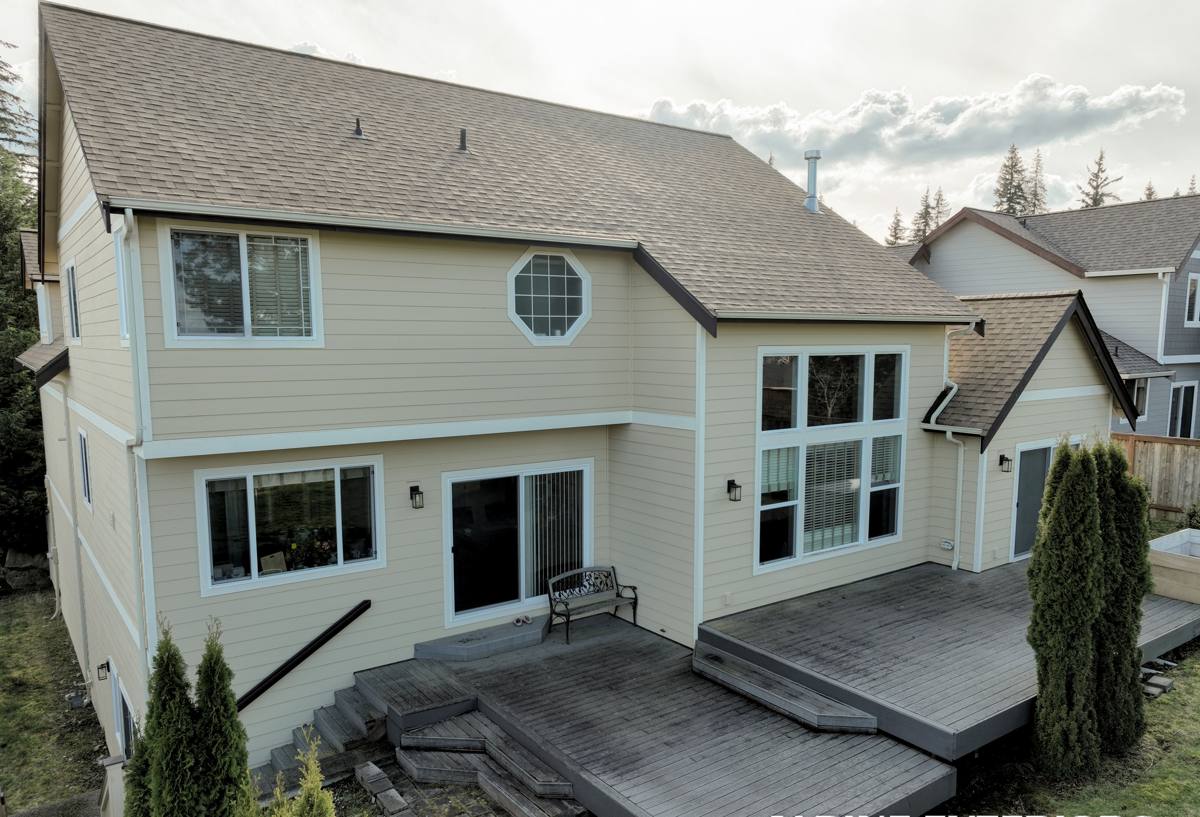
Signs Your Deck Needs Repair, Not Just a Cleaning
A lot of deck problems look cosmetic at first — a dark stain, a soft spot, a rail that wiggles a little — and get put off for another season. Here's what actually signals a repair is due:
- Boards that feel spongy or flex more than their neighbors underfoot
- Railings or posts that move when you lean on them
- Dark staining or a musty smell near the ledger board where the deck meets the house
- Rust streaks running down from screws, joist hangers, or bolts
- Persistent moss or algae in the same spots every year, even after cleaning
- Gaps that have widened between boards, or boards that have started to cup or crown
- Stair stringers or treads that feel less solid than they used to
Any one of these on its own might be minor. Several together, especially near the house connection or on stairs, usually means moisture has been working on the structure for a while.
What a Correct Deck Repair Actually Involves
Structure First
Before anything cosmetic happens, we check the framing: joists, beams, posts, and — most importantly — the ledger board where the deck attaches to the house. This connection carries a large share of the deck's load, and it's also the spot most exposed to trapped moisture if the flashing behind it has failed. A repair that skips this step and just replaces surface boards over a compromised frame is a repair that fails again within a couple of seasons.
Decking and Railings
Once the structure is sound, we address the decking boards and railings themselves — replacing individual boards where rot or splitting has set in, resetting or replacing loose rail posts, and making sure guard rail height and baluster spacing meet current building code, which is often out of date on older decks even if the rest of the structure is fine.
Fasteners and Flashing
This is where a lot of deck repairs cut corners, and it's exactly the part that matters most in a salt-air, high-rain climate. We use fasteners rated for exterior and coastal exposure, not general-purpose hardware that starts rusting within a year or two. Flashing at the ledger and any other point where the deck meets siding or roofing gets checked and corrected, because that single detail is responsible for a large share of the hidden rot we find.
Repair or Replace? What Actually Drives the Decision
Homeowners often assume any visible damage means a full replacement. In our experience, most decks can be repaired if the damage is caught before it spreads into the main structural members. Here's how we weigh it:
| Factor | Favors Repair | Favors Replacement |
|---|---|---|
| Ledger board condition | Solid, dry, properly flashed | Rotted, poorly flashed, or code-non-compliant attachment |
| Framing (joists, beams, posts) | Sound with isolated soft spots | Widespread rot or undersized for current code |
| Decking boards | Scattered bad boards among mostly good ones | Most boards cupped, splitting, or rotted through |
| Age of structure | Under 15-20 years, built to a reasonable standard | Older deck built to outdated code or with undersized footings |
| Railings and stairs | Loose but structurally intact | Undersized, unsafe spacing, or failing connections |
We'll always tell you honestly which side of that table your deck falls on. There's no advantage to us in talking a homeowner into a full rebuild when a targeted repair will hold up fine — and no advantage in patching something that's going to need redoing in two years.
Material Choices for a Wet, Salt-Air Climate
Pressure-Treated Lumber
Still the most common choice for framing and often for decking itself. It handles moisture well when properly sealed and maintained, but it does require upkeep — periodic cleaning, sealing, and attention to end cuts where the treatment doesn't always penetrate fully. In a climate with this much rain, skipping that maintenance is the single biggest reason pressure-treated decks fail early.
Cedar
A traditional choice in this region for good reason — it has natural resistance to rot and insects and weathers to an attractive silver-gray if left unsealed. It's a softer wood, though, so it dents and wears faster underfoot, and it still benefits from a protective finish if you want to keep its color.
Composite Decking
Composite boards cut down on the sanding, staining, and sealing that wood requires, which appeals to a lot of homeowners who don't want that maintenance cycle. The trade-off is a higher upfront material cost and the fact that composite still needs to be installed with proper ventilation and drainage underneath — trapped moisture under a composite deck causes its own problems, just hidden ones instead of visible ones. We're honest about that trade-off rather than pitching composite as maintenance-free, because it isn't.
For repairs specifically, we'll generally recommend matching your existing material unless there's a good reason to switch, since mixing materials on a single structure can create uneven wear and different maintenance schedules for different parts of the same deck.
Our Deck Repair Process in Happy Valley
- On-site inspection of the full structure — framing, ledger, decking, railings, and stairs — not just the spot you called about
- Honest assessment of what's actually failing versus what's cosmetic, with photos and a plain-language explanation
- A written estimate that separates structural repair, decking/rail work, and any code-compliance items so you know what you're paying for and why
- Repair work, starting with structure and moisture protection before anything cosmetic
- Final walk-through so you can see and understand what was done, and what to watch for going forward
We don't upsell repairs you don't need, and we don't downplay ones you do. If a full rebuild really is the better long-term value, we'll say so and explain why — but that's not where most of these projects end up.
Why Hiring a Crew That Already Works This Neighborhood Matters
Deck problems in Happy Valley tend to follow patterns tied to lot orientation, tree cover, and how close a home sits to the water-facing side of the hill. A crew that regularly works this part of Bellingham has already seen which framing details hold up to salt air and which don't, which shaded corners collect moss no matter what, and which older homes were built to standards that don't match current code. That local pattern recognition shortens the inspection process and helps avoid repairs that look fine on paper but don't actually hold up to another Whatcom County winter.
It also means we're not guessing at permit requirements or inspection expectations for deck work in the City of Bellingham — we handle that as a normal part of the job rather than something the homeowner has to sort out separately.
Seasonal Deck Maintenance Checklist
Between repairs, a little seasonal attention goes a long way toward avoiding the next one. A few habits worth keeping:
- Clear leaves and debris from between boards before the fall rains settle in
- Treat moss and algae early in the season rather than letting it build up all winter
- Check fasteners and rail connections for rust or looseness once a year
- Reseal or refinish wood decking on the schedule appropriate to your specific product — don't wait until it's visibly gray and dry
- Keep gutters and downspouts clear so runoff isn't dumping extra water directly onto the deck surface
- Look under the deck occasionally, not just on top — hidden moisture damage usually shows up there first
Ready for a Straight Answer on Your Deck?
If your Happy Valley deck has a soft spot, a wobbly rail, or just feels like it's past due for a real look, we'll come out, inspect it honestly, and tell you what it actually needs — repair or otherwise. Use the form below to request a free, no-pressure estimate.