 Bellingham Roofing
 Why Birch Bay Homes Wear Out Windows Faster Than Most
Birch Bay sits right on the water, which is exactly what makes it a beautiful place to live and a hard place to keep windows performing well. Homes here take a steady diet of salt-laden air, wind-driven rain coming straight off the water, and a moss and mildew season that runs longer than it does even a few miles inland in Bellingham. None of that is dramatic on its own — it's the accumulation over years that gets a homeowner. Salt air corrodes hardware and metal components faster than it would in a dry inland climate. Wind-driven rain doesn't just fall on a window, it gets pushed sideways and upward into gaps that a standard install in a calmer part of Whatcom County might never have to deal with. And moss and algae, which thrive in the shade and moisture of our long wet season, work their way into any seam, sill, or flashing detail that wasn't sealed correctly the first time.
None of this means Birch Bay homes need exotic products. It means the window itself, the way it's flashed, and the materials used around it all need to be chosen with this specific exposure in mind — not just picked off a standard order sheet built for a drier climate.
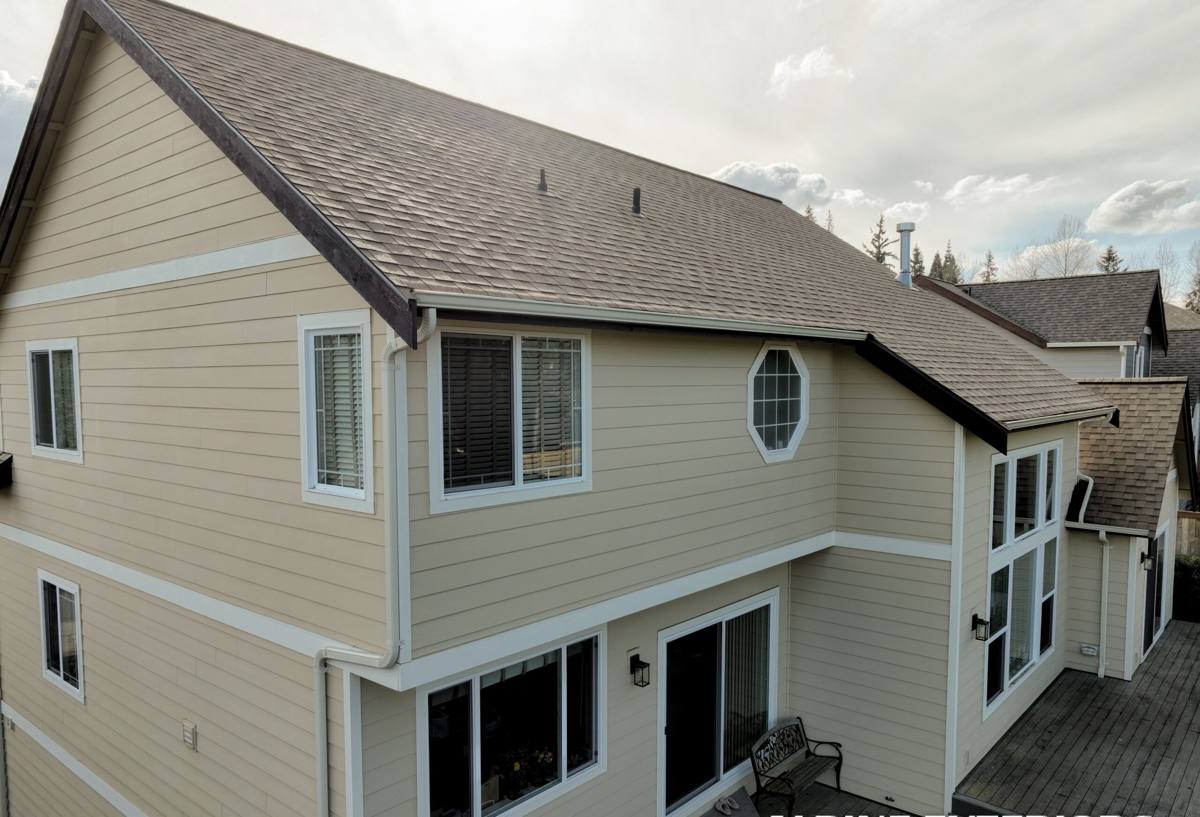
What "Custom" Actually Means Here
"Custom windows" gets used loosely in this trade, so it's worth being specific. For Birch Bay, custom usually means one or more of the following:
- Non-standard rough openings — common in older cabins and beach homes that were built or added onto over decades without a strict framing standard.
- Matching sightlines and grid patterns across a home where windows were replaced piecemeal over the years, leaving a mismatched look.
- Larger view openings facing the water, which change the structural and wind-load requirements compared to a standard bedroom window.
- Shapes or configurations — bays, casements next to fixed picture units, transoms — that off-the-shelf stock sizing doesn't cover.
Custom doesn't have to mean expensive or exotic. It means the window is built or ordered to fit the actual opening and actual exposure of your home, rather than forcing your home to fit a standard product.
Older Birch Bay Homes and Additions
A lot of the housing stock in and around Birch Bay includes original beach cottages that have been added onto, re-sided, or converted to year-round living over the decades. That history means openings are frequently out of square, sills have settled, and previous window installs may have been done to whatever standard was common at the time. A correct custom install starts with an honest look at the opening itself — not just measuring for a box that will slide in.
Choosing the Right Frame Material for a Salt-Air, Wet-Winter Site
Frame material matters more here than in a lot of inland Whatcom County neighborhoods, because the combination of salt air and constant moisture is harder on some materials than others. There's no single "best" material for every home — it depends on your budget, your home's exposure to wind and water, and how much maintenance you're willing to keep up with.
| Frame Material | How It Handles Salt Air & Rain | Maintenance | Where It Fits Best |
|---|---|---|---|
| Vinyl | Good corrosion resistance since there's no bare metal to pit; performs well if fusion-welded corners are sealed properly | Low — occasional rinse to keep salt film off | Most homes on a budget-conscious full replacement |
| Fiberglass | Excellent — dimensionally stable, doesn't expand/contract as much with temperature swings, holds paint and seals well over time | Low to moderate | Homes with direct water exposure or larger view openings |
| Wood-clad | Attractive interior wood look but the cladding seams need to be watertight; more sensitive to installation quality in this climate | Higher — cladding and interior finish need periodic attention | Homeowners prioritizing interior appearance who are comfortable with upkeep |
| Aluminum | Prone to corrosion and pitting in direct salt air unless it's a marine-grade or properly coated product | Moderate to high | We generally steer homeowners away from standard aluminum this close to the water |
We don't push one brand or material on every job. What we do insist on is being straight with you about how a given material actually behaves once it's facing Birch Bay's exposure year after year, not just how it looks in a showroom.
Glass and Weatherproofing Choices That Actually Matter
Double-Pane vs. Triple-Pane
Triple-pane glass gets marketed heavily, but for most Birch Bay homes the bigger win is a quality double-pane unit with the right low-E coating and gas fill, correctly installed. Triple-pane adds real value on north- or water-facing walls that take the brunt of wind and cold, but it also adds weight, cost, and in older framing can be more than the opening was built to carry without added support. We'll walk through where the upgrade is worth it on your specific home rather than defaulting to it everywhere.
Condensation and Moisture Behavior
In a climate this wet, how a window handles moisture matters as much as how it handles cold. A correctly sealed insulated glass unit with proper spacer and gas-fill integrity resists interior condensation and won't fog between the panes prematurely. This is one area where installation quality and product quality both have to be right — a good window installed with a poor seal will still develop moisture problems.
Installation Details That Prevent Leaks — Where Most Failures Actually Start
Most window problems we get called out to fix in coastal Whatcom County didn't start with a bad window. They started with a flashing or sealing detail that wasn't right for this exposure. A correct install in a wind-driven-rain environment like Birch Bay includes:
- Proper flashing sequencing so water is directed out and down, never trapped behind the window or siding.
- Sill pan flashing under every opening, not just a bead of sealant, so any water that does get past the exterior has somewhere to drain.
- Housewrap and flashing tape integration that matches how your home's existing weather barrier is layered — details vary based on siding type.
- Sealants and backer rod chosen for UV and salt exposure, not generic interior-grade caulk that breaks down faster in this climate.
- Weep holes and drainage paths kept clear so moss, debris, and windblown grit don't dam up water against the frame.
This is also where moss becomes a real issue and not just a cosmetic one. Moss holds moisture against a surface longer than bare wood or vinyl would dry on its own, and if it's allowed to establish itself in a sill or flashing gap, it accelerates whatever water intrusion problem was already starting. Correct flashing and drainage details are the actual defense against that — not a caulk gun applied more heavily.
Our Process, Start to Finish
- On-site walkthrough: We look at each opening individually — framing condition, current flashing, exposure to wind and water — before recommending anything.
- Honest recommendation: You get options across materials and glass packages with the real trade-offs explained, not a single upsell path.
- Written estimate: Clear scope, materials, and timeline, no surprise change orders for work that was visible at the walkthrough.
- Removal and opening prep: Old windows come out carefully, and we check framing and sheathing condition before anything new goes in — this is often where hidden moisture damage from a prior poor install turns up.
- Flashing and installation: Sill pans, flashing, and sealing done to the sequence that fits your home's siding and exposure, not a one-size install.
- Final check and cleanup: Operation, seal, and finish checked on every window before we consider the job done, site cleaned up before we leave.
What Drives Cost
We don't quote prices without seeing the openings, but these are the factors that actually move the number up or down on a Birch Bay custom window job:
| Cost Factor | Why It Matters |
|---|---|
| Opening condition | Rot, settling, or out-of-square framing found during removal adds repair work before the new window goes in |
| Frame material | Vinyl is generally the most budget-friendly; fiberglass and wood-clad cost more up front |
| Glass package | Triple-pane and specialty coatings add cost over a standard double-pane low-E unit |
| Size and shape | Large view windows, bays, and custom shapes cost more than standard-sized units |
| Number of openings | Whole-house replacements typically bring a better per-window cost than one-off replacements |
| Siding and trim work | Homes needing trim rebuild or siding tie-in around the new window add labor beyond the window itself |
Broadly, homeowners in this area should expect custom window work to run from a modest per-window cost for a straightforward vinyl replacement up into a considerably higher range for large fiberglass or wood-clad units in tricky openings. The only way to get a real number is a walkthrough of your actual windows.
Keeping Windows Performing Through Birch Bay's Wet, Mossy Winters
Even a well-installed window needs some upkeep in this climate to keep performing the way it should. A short seasonal checklist goes a long way:
- Rinse salt film off frames and glass periodically, especially on sides facing the water.
- Check weep holes and drainage paths each fall and clear out debris, moss, or dirt buildup before the wet season sets in.
- Inspect exterior caulking and sealant lines yearly for cracking or gaps, and re-seal before they become leak paths.
- Keep gutters and downspouts clear so water isn't sheeting down across window heads during heavy rain.
- Trim back vegetation or anything holding shade and moisture directly against window trim, which is what lets moss take hold in the first place.
- Operate and lubricate hardware on operable windows a couple of times a year so salt air doesn't seize mechanisms unnoticed.
Why It Matters That We Already Work in Birch Bay
A crew that mainly installs windows in drier, more sheltered parts of Whatcom County can still do fine work — but they're often solving for a different set of conditions by default. Working regularly along the Birch Bay shoreline and the surrounding coastal stretch of the county means we've already seen how flashing details, sealant choices, and frame materials actually hold up here over time, not just on paper. That shows up in small decisions during an install — how a sill pan is lapped, which sealant gets used where, how drainage is kept clear — that don't show up on a spec sheet but make the difference between a window that's still tight in five years and one that's already showing moisture staining.
Being a Bellingham-based crew also means we're not driving in from out of the area for a callback if something needs attention after the install. That local presence is part of standing behind the work, not just selling it.
If you're weighing a window replacement or addition on a Birch Bay home, we're glad to come take a look and give you a straightforward, no-pressure estimate — just fill out the form below to get started.