 Bellingham Roofing
 Composite Decking in Sudden Valley: Built for the Conditions Up Here
Sudden Valley sits in a pocket of Whatcom County where the deck on your house works harder than decks in drier parts of the state. Between the lake-effect moisture, the shade from mature evergreens, and the long stretch of fall-through-spring rain, a deck here spends most of the year damp. Add the salt-tinged air that drifts in off the Puget Sound region and you've got a combination that's rough on fasteners, rough on wood fiber, and relentless on anything that traps moisture against a surface. Composite decking, installed correctly, handles that combination far better than natural wood — but "installed correctly" is doing a lot of work in that sentence, and it's the part that separates a deck that looks good for fifteen years from one that starts showing problems in three.
This page is about composite decking specifically for Sudden Valley homes — what the climate demands, what a proper installation actually involves, and why a crew that already works this neighborhood catches things an out-of-town installer might miss.
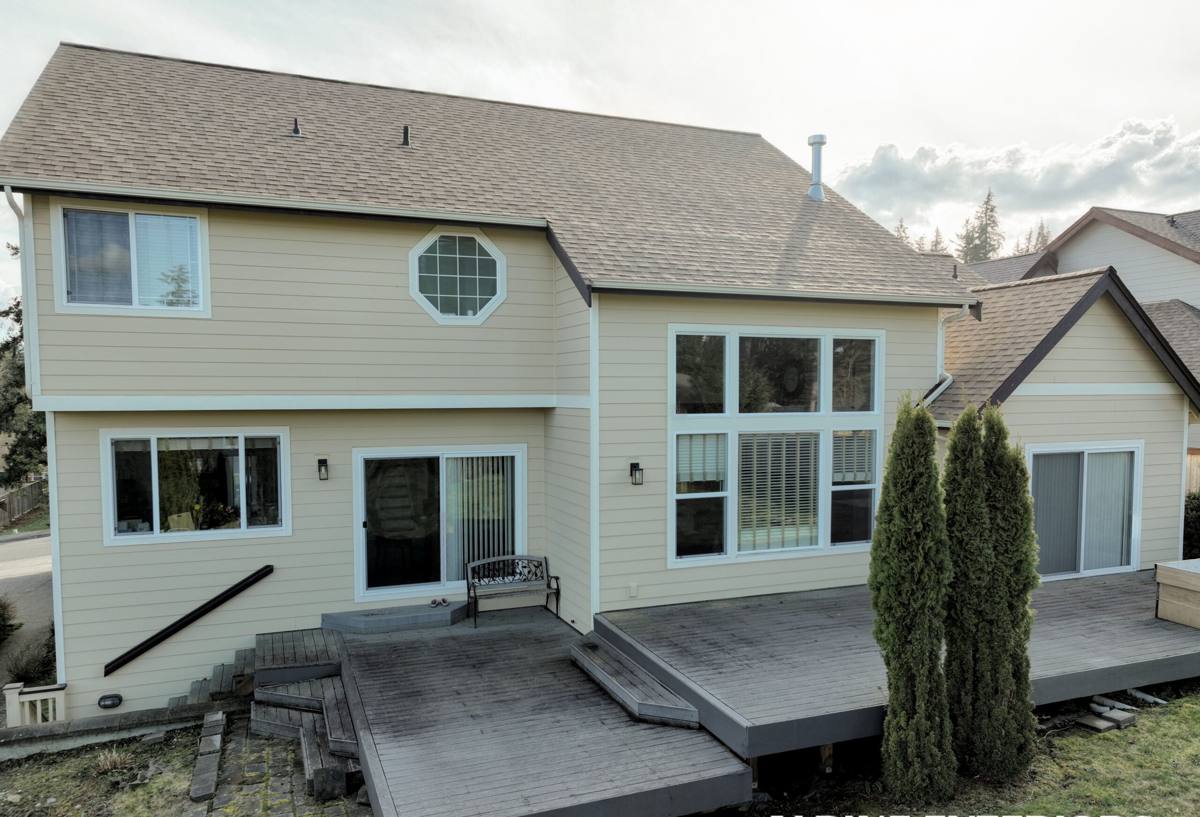
Why Composite Makes Sense for This Neighborhood
Natural wood decking isn't a bad product — it's just a high-maintenance one in a climate like this. Untreated or under-maintained wood in Whatcom County's wet season takes on moisture, and once moss and algae get a foothold on a shaded deck surface, you're looking at annual pressure washing, periodic sealing, and eventually board replacement as rot sets in around fastener points. Composite decking sidesteps most of that. It doesn't need annual staining, it resists moss growth far better than bare wood, and it doesn't split, splinter, or cup the way lumber does when it cycles between soaked and dry through a Bellingham winter.
That doesn't mean composite is maintenance-free — no exterior product truly is in this climate — but the maintenance shifts from "structural upkeep" to "occasional cleaning," which is a meaningfully different commitment for a homeowner.
What Sudden Valley's Microclimate Actually Does to a Deck
- Extended shade from tree cover keeps deck surfaces damp longer after rain, which is exactly the condition moss and algae need to establish.
- Lake proximity and regional salt air accelerate corrosion on exposed fasteners, hidden clips, and any metal hardware that isn't rated for coastal exposure.
- Long wet season means a deck substructure spends more months of the year absorbing moisture than drying out, which makes framing material and ventilation choices matter more here than in drier inland areas.
- Freeze-thaw cycling, while milder than higher elevations, still happens enough in a Whatcom County winter to stress any joint or fastener that wasn't set with expansion room.
What a Correct Composite Deck Installation Involves
A composite deck is only as good as what's underneath it. We've seen composite boards installed over framing that was already compromised, or over ledger connections that weren't properly flashed — and no amount of premium decking material fixes that. Here's what we treat as non-negotiable on every Sudden Valley composite project.
Substructure and Framing
Composite boards are heavier than wood, and manufacturers specify joist spacing tighter than what's traditional for a cedar or fir deck — typically 16 inches on center, sometimes closer for angled or picture-frame layouts. In a damp climate like this, we favor pressure-treated framing rated for ground contact even when the joists themselves won't touch soil, because the humidity here keeps framing lumber at a higher moisture content year-round than it would sit at in a drier region.
Ledger Flashing and Water Management
Where a deck attaches to the house, the ledger board connection is the single most common failure point we find on older decks in this area — not because the decking failed, but because water got behind flashing that was undersized, missing, or installed before the current code-driven flashing standards. Given how much rain Whatcom County sees over a typical year, we treat ledger flashing, proper counterflashing, and a drainage gap behind the ledger as mandatory, not optional upgrades.
Fastener and Hardware Selection
This is where salt air exposure really matters. Standard galvanized fasteners can start showing corrosion within a few years near the lake or anywhere with regular salt-laden wind. We use stainless steel or coated fasteners rated for coastal/marine exposure on hidden fastener systems, joist hangers, and structural connectors — the upcharge is small relative to the cost of a deck failure down the line.
Ventilation Underneath
Composite decking sheds water well on the surface, but the space underneath a deck still needs airflow to keep framing dry. Low-clearance decks, or decks built tight against a foundation wall, need extra attention to skirting design and ventilation gaps so trapped moisture doesn't sit against the joists all winter.
Choosing the Right Composite Product
Not all composite decking is built the same, and the differences matter more in a wet, shaded climate than they would somewhere dry. The main distinction is between capped and uncapped composite.
| Feature | Capped Composite | Uncapped Composite |
|---|---|---|
| Moisture resistance | Polymer shell resists water absorption and staining | More exposed wood fiber, higher absorption over time |
| Moss/algae resistance | Smoother, less porous surface is harder for growth to grip | More porous surface, more prone to moss in shaded areas |
| Fading/staining over time | Better UV and stain resistance under the cap layer | More prone to graying and staining without regular cleaning |
| Upfront cost | Higher material cost | Lower material cost |
| Long-term maintenance | Occasional rinse/wash | More frequent cleaning to prevent buildup |
For a shaded, damp lot in Sudden Valley, we generally steer homeowners toward fully capped composite, especially on north-facing or tree-covered decks. It costs more up front, but the reduced moss and moisture issues pay that back in avoided maintenance over the life of the deck. On sunnier, more exposed lots, uncapped or partially capped products can be a reasonable value trade-off — it depends on the specific site.
Board Profile and Grip
Given how often this deck surface will be damp, slip resistance is worth thinking about beyond just color and finish. Textured or grooved-edge boards designed for hidden fastener systems tend to hold traction better underfoot than smooth-faced boards once they're wet, which matters on a deck that rarely gets a long dry stretch in the winter months.
Our Process for a Sudden Valley Composite Deck
- On-site assessment — we look at existing framing (if replacing an old deck), sun/shade exposure, drainage patterns, and how the deck ties into the house.
- Ledger and structural evaluation — check the existing ledger connection or plan the new one, confirm flashing approach, and identify any framing that needs upgrading to meet current span and fastening standards.
- Material selection walkthrough — we go over capped vs. uncapped options, color and board profile choices, and hardware upgrades relevant to this site's exposure.
- Permitting — most deck work in Whatcom County requires a permit depending on height and scope; we handle that process rather than leaving it to the homeowner.
- Framing and flashing installation — the structural work that determines how the deck performs over the next 20+ years, done before a single composite board goes down.
- Decking installation — hidden fastener systems where the product allows, proper board spacing for expansion, and attention to picture-framing or border details if specified.
- Final walkthrough — we go over the finished deck, drainage, and basic care with the homeowner before calling the job done.
Maintenance: What Composite Actually Needs Here
Composite decking is lower-maintenance than wood, but "low" isn't "none," especially in a climate that stays damp as long as this one does.
- Rinse or sweep debris off the surface regularly — trapped leaves and needles hold moisture against the board even on capped composite.
- Wash the deck surface once or twice a year with a soft-bristle brush and a mild cleaner rated for composite — pressure washing on too high a setting can damage the cap layer on some products.
- Check and clear gaps between boards periodically, since debris buildup in the gaps can trap moisture and encourage moss even on resistant products.
- Inspect fasteners and hardware every year or two, especially on decks closer to the lake, since salt exposure is the main driver of hardware wear here.
- Keep an eye on the skirting and under-deck ventilation — blocked airflow underneath is one of the more common causes of hidden framing problems we find on older decks.
Why Hiring a Crew That Already Works Sudden Valley Matters
A lot of what determines whether a composite deck holds up here isn't the decking material itself — it's decisions made before the first board goes down: how the ledger is flashed, what fasteners get used, how the framing is spaced and ventilated, and whether the crew accounted for how much shade and moisture this specific lot actually gets. A crew that hasn't worked much in this part of Whatcom County can miss those details, because they're used to building for a drier or less shaded climate.
We're a Bellingham-based crew, and Sudden Valley's conditions — the tree cover, the lake-driven humidity, the salt air — are part of what we plan around on every project here, not something we're learning on your job. That local familiarity shows up in the small decisions: which hardware grade we default to, how tight we run joist spacing on a shaded deck, and where we add extra drainage detail that a generic spec sheet wouldn't call out.
What to Expect on Cost
Composite decking costs more upfront than pressure-treated wood, largely offset over time by lower maintenance and longer service life. Actual project cost depends on deck size, framing condition (new build vs. tear-off and rebuild), product tier (uncapped vs. fully capped composite), and site-specific factors like elevation changes, railing requirements, and access for the crew and materials. Rather than quote a number that won't reflect your actual lot, we'd rather walk the site and give you a real figure.
Quick Reference: Factors That Move the Price
- Whether we're building new or removing and replacing an existing deck
- Total square footage and deck shape (angles, cutouts, and multiple levels add labor)
- Capped vs. uncapped composite product tier
- Railing material and style
- Framing condition and any structural repairs needed underneath
- Site access and how far materials need to be carried
If you're planning a new deck or replacing an aging one in Sudden Valley, we're happy to come take a look and give you a straightforward, no-pressure estimate based on your actual lot and conditions — not a generic quote. There's a form below to get that started.