 Bellingham Roofing
 Why Ferndale Decks Wear Differently Than Decks Inland
Ferndale sits close enough to the water and open farmland that decks here take a different kind of beating than a deck built twenty miles inland. Salt-laden air off the Strait and bay moves through on prevailing winds and settles into wood fibers, metal fasteners, and any gap where moisture can sit. Add Whatcom County's long stretch of driving rain from fall through spring, plus the shaded, damp conditions that let moss and algae take hold on north-facing and tree-covered decks, and you get a structure that's under near-constant moisture pressure for eight or nine months of the year.
None of that is unusual for this part of Washington. But it does mean a deck built the way you'd build one in a dry inland climate — standard lumber, minimal ventilation, generic fasteners — tends to show problems here faster: soft spots, graying and splintering, moss colonizing the board surface, and rust bleed at every screw head. Composite decking, installed correctly for these conditions, is one of the more effective ways to get ahead of that cycle instead of fighting it every spring.
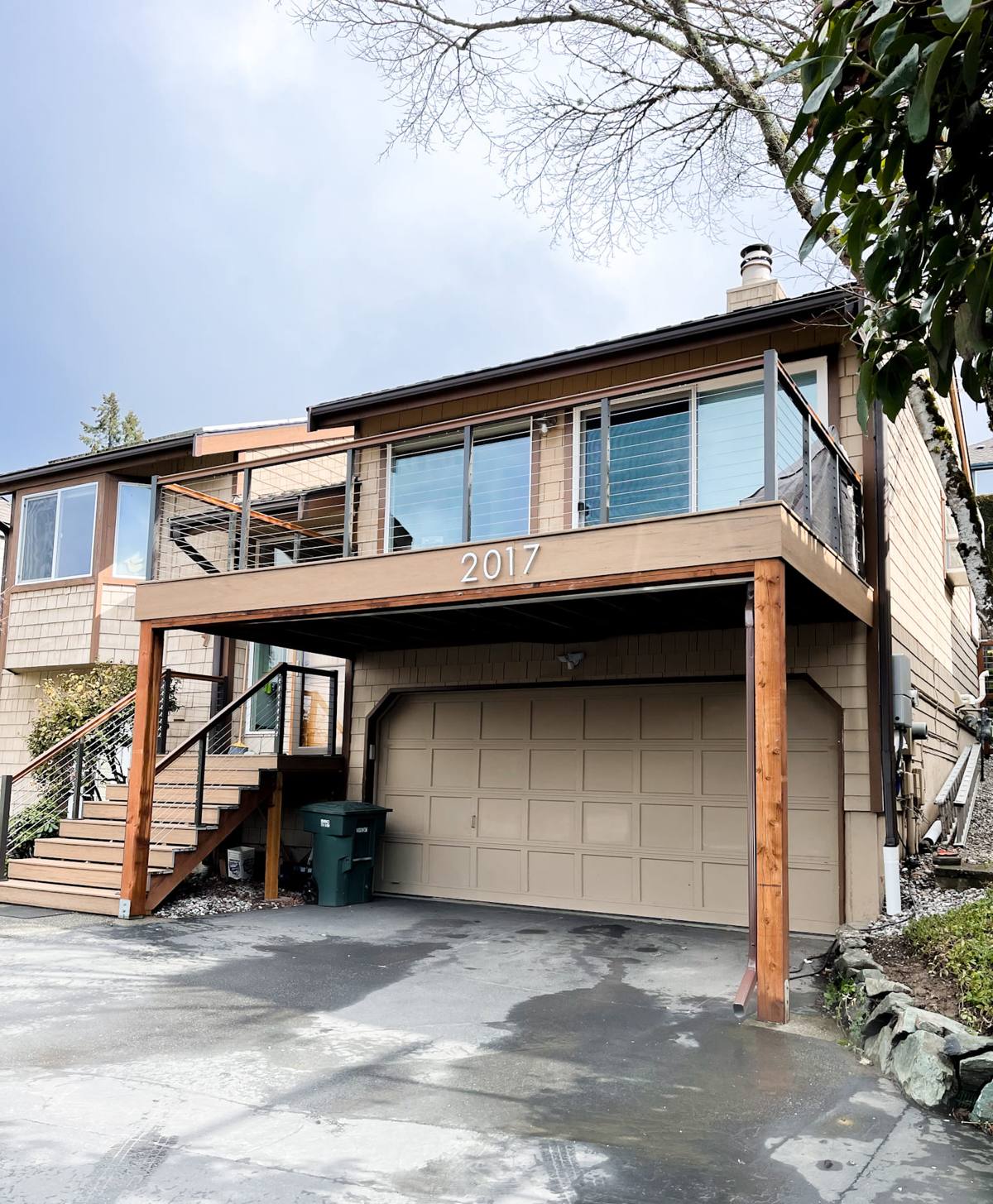
What Composite Decking Actually Solves — And What It Doesn't
Composite boards (a blend of wood fiber and plastic, capped or uncapped) resist rot and don't provide the same food source for moss and algae that raw wood does. That's a real, meaningful difference for a Ferndale property near trees, low airflow, or a shaded north side of the house. It doesn't require annual staining or sealing, and it won't cup, crack, or splinter the way untreated or under-maintained wood eventually will.
What composite doesn't solve on its own is moisture management underneath and around the deck. A composite deck built on a poorly ventilated substructure, with flashing details skipped or fasteners that aren't rated for coastal exposure, will still fail — just in different places than a wood deck would. The board surface might look fine for years while the frame underneath is quietly rotting or the ledger connection is corroding. This is the part of the job that separates a deck that lasts fifteen-plus years from one that needs structural repair in five, and it's mostly invisible once the project is finished.
The Substructure Is Where Ferndale Decks Actually Fail
Framing and Drainage
Composite board itself sheds water, but the joists, beams, and ledger board underneath it are almost always still standard framing lumber. In a climate with this much sustained rain, that framing needs real airflow underneath the deck surface and a drainage path that doesn't trap water against the ledger or posts. We build in ventilation gaps and slope drainage away from the house rather than assuming the composite surface will handle moisture management by itself — it won't.
Ledger Flashing
The ledger board — where the deck attaches to the house — is the single most common point of hidden failure on any deck in this region, composite or wood. Driving rain pushes water sideways and up under poorly flashed ledgers, and once that starts, it rots the rim joist and sheathing behind it long before anyone notices from the deck surface. Correct flashing here, with proper overlap and a drainage gap, isn't optional in a climate like this — it's the difference between a deck that lasts and a hidden repair bill in eight years.
Fasteners and Hardware
Salt air accelerates corrosion on standard fasteners and structural hardware faster than most homeowners expect. We use fasteners and connectors rated for coastal or high-moisture exposure on every deck we build here, not just the ones closest to the water. Cutting corners on hardware is one of the most common shortcuts we see in decks that fail early — it's a small cost difference during the build and a large one to fix later.
Choosing the Right Composite Board for This Climate
Not all composite decking is built the same, and the differences matter more in a wet, moss-prone climate than they do somewhere dry. Fully capped composite (a plastic shell wrapped around the wood-fiber core) resists moisture absorption and staining far better than uncapped composite, which can still take on water at the core over time if the cap or edge protection is compromised. In a Whatcom County winter, that difference shows up as swelling, discoloration, or mold at board edges within a few seasons on lower-grade product.
Color and texture matter too, though for a different reason: darker boards absorb more heat in the rare stretches of direct summer sun, and lighter, textured surfaces tend to show algae growth less obviously in shaded, damp spots. We'll walk through the board options that hold up well here and explain the honest trade-offs of each rather than pushing whatever has the best margin — that's a decision worth making with the maintenance reality of this climate in mind, not just the showroom sample.
Composite vs. Wood vs. PVC: An Honest Comparison
| Factor | Wood (cedar/pressure-treated) | Capped Composite | PVC (cellular) |
|---|---|---|---|
| Upfront cost | Lowest | Mid-range | Highest |
| Moss/algae resistance | Poor without regular treatment | Good | Very good |
| Maintenance | Annual staining/sealing | Occasional wash-down | Occasional wash-down |
| Moisture behavior | Absorbs, swells, splits over time | Sheds water, minor core absorption if damaged | Fully water-resistant core |
| Typical lifespan here | 10-20 years with upkeep | 20-30 years | 25-30+ years |
| Warranty structure | Manufacturer varies, wood itself unwarranted | Manufacturer-backed, often prorated | Manufacturer-backed, typically stronger |
Wood is still a reasonable choice for homeowners who want a specific natural look and are willing to keep up with sealing and cleaning on a set schedule. Composite is the right fit for most Ferndale properties because it cuts the maintenance burden substantially without the full cost jump to PVC. PVC makes sense on decks with heavy shade, standing moisture risk, or ground-level proximity where moisture exposure is at its worst.
How We Approach a Composite Decking Project in Ferndale
- On-site assessment — we look at sun/shade exposure, drainage slope, ledger condition, and existing moss or moisture damage before recommending anything.
- Substructure plan — framing layout, ventilation, and drainage path are designed for the specific site, not a generic template.
- Material selection — we go through board options and hardware with the homeowner, including cost and maintenance trade-offs, before ordering.
- Flashing and framing build — ledger flashing, joist protection tape, and coastal-rated hardware go in before a single composite board is laid.
- Board installation — hidden or face-fastened per the product spec, with attention to expansion gaps so boards perform correctly through wet and dry cycles.
- Final walkthrough — drainage, railing security, and stair details checked before we call it done.
Maintaining a Composite Deck Through a Whatcom County Winter
Composite cuts the maintenance workload significantly compared to wood, but "low-maintenance" doesn't mean "no maintenance" in a climate this wet. A little seasonal attention keeps moss from ever getting a foothold and keeps drainage working the way it was built to.
- Sweep leaves and debris off the surface regularly in fall — trapped organic matter is what gives moss and algae something to grow on, even on composite.
- Hose down or lightly scrub the deck once or twice a year, more often in shaded areas, to keep surface residue from building into a moss base.
- Check that gaps between boards and at the perimeter stay clear so water keeps draining through rather than pooling.
- Inspect railing posts and stair connections annually — hardware is the first thing coastal air affects, even when the board surface still looks new.
- Confirm gutters and downspouts near the deck are directing water away, not onto or under the deck framing.
Why Hiring a Crew That Already Works in Ferndale Matters
A deck built the same way it would be built in Spokane or Phoenix is going to struggle here. Crews that work Ferndale and the surrounding Whatcom County area regularly already know which fastener grades hold up against salt air, how much ventilation a substructure actually needs given how long boards stay damp after a typical fall rain, and where moss tends to establish first on a given site orientation. That local pattern recognition is the difference between a deck that's designed for this specific climate and one that's just assembled to spec on paper.
It also means fewer surprises during the build. Local crews know what inspectors in the area expect for ledger attachment and railing details, and they've already seen how different composite products actually perform after a few Whatcom County winters — not just how they're marketed.
Getting Started
If you're weighing composite decking for a Ferndale property, we're glad to come take a look, walk through the site conditions, and give you a straightforward estimate — no pressure, no upsell on materials you don't need. Use the form below to request a free estimate and we'll get back to you to schedule a time.