 Bellingham Roofing
 Why Birchwood Homes Take a Different Kind of Beating
Birchwood sits close enough to the water and the weather patterns rolling off Bellingham Bay that homes here deal with a specific combination of stresses most siding products were never engineered for: salty, moisture-laden air, long stretches of driving rain, and a moss and algae season that can run most of the year in Whatcom County's shaded, damp microclimates. None of these factors on their own is unusual for Western Washington. Together, over years, they're what separates a siding job that still looks sharp at year fifteen from one that's chalking, swelling, or growing green film by year five.
Salt-laden air corrodes exposed fasteners and accelerates the breakdown of coatings that aren't formulated to resist it. Driving rain — the kind that comes in sideways off a Puget Sound storm system rather than falling straight down — finds every gap in flashing, every under-caulked seam, every place where siding was nailed tight to trim instead of left to breathe. And moss doesn't just grow on roofs. On siding, especially in the shaded north and east faces common on Birchwood's tree-lined lots, organic growth holds moisture against the surface and speeds up whatever damage the rain and salt air have already started.
This is the environment we're installing into, and it's why we only put James Hardie fiber cement on these homes. Hardie's HZ5 formulation is engineered specifically for the freeze-thaw and moisture-cycling conditions of this region, and it doesn't rot, delaminate, or feed the kind of organic growth that softer or wood-based siding products are prone to here.
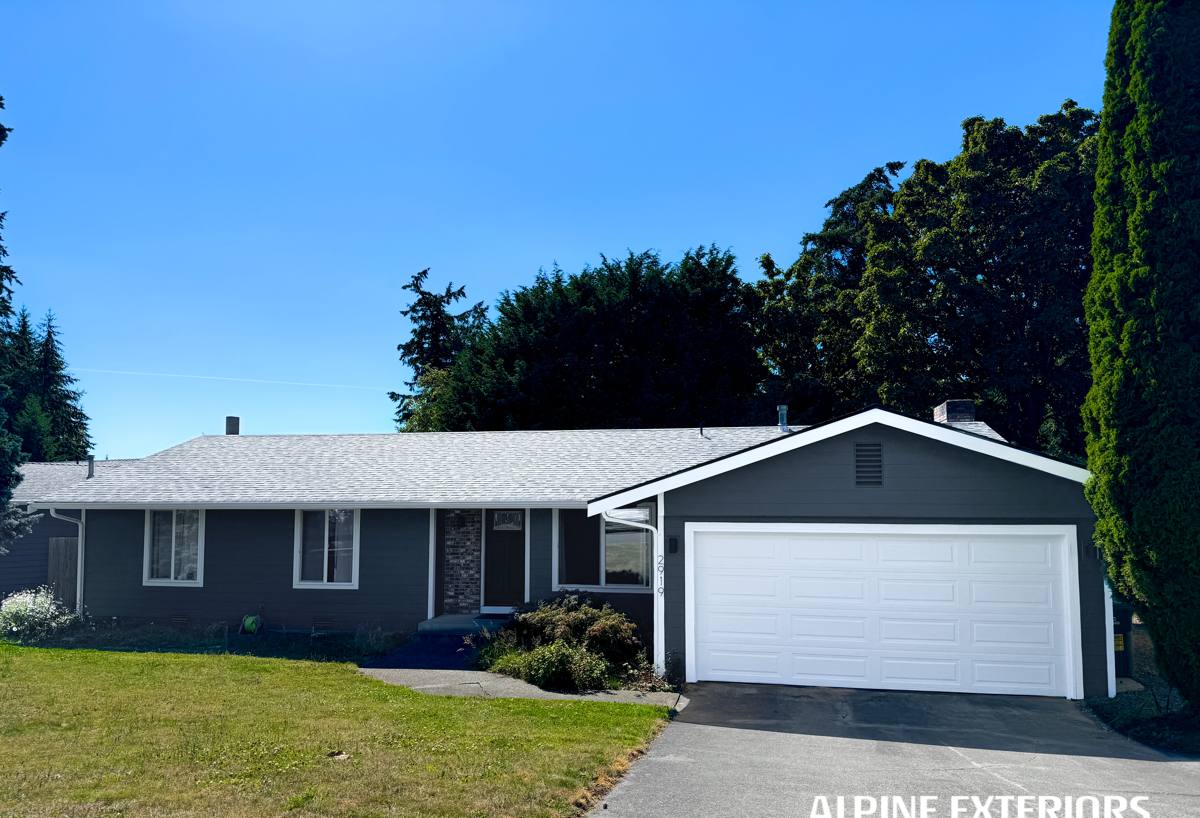
What "Correct" Actually Means on a Birchwood Job
James Hardie siding performs the way it's rated to perform only when it's installed exactly to the manufacturer's specifications. That's not a marketing point — it's the difference between a 30-year warranty that holds and one that gets voided the first time there's a moisture claim. On a Birchwood home, a handful of details matter more than they would somewhere drier and more sheltered.
Moisture Management Comes First
Before a single piece of siding goes up, the wall needs a correctly lapped weather-resistive barrier, properly flashed windows and doors, and rainscreen or drainage gap detailing where the wall assembly calls for it. In a climate that sees this much driving rain, water is going to reach the back of the siding at some point — the whole system has to be built so that water sheds down and out instead of getting trapped against the sheathing.
Clearance and Fastening
Hardie's specs call for a minimum clearance between the bottom of the siding and grade, roof lines, decks, and patios — typically 6 inches from grade and 2 inches from roofing. On older Birchwood lots where landscaping, decking, or grading has crept up over the years, we often find siding on the existing home that was installed tight to soil or hardscape. That's a moisture trap, full stop, and it's one of the most common causes of premature siding failure we see on re-sides in this area. Fasteners matter too — corrosion-resistant nails or screws, driven correctly (not overdriven, not underdriven), spaced to Hardie's pattern, are non-negotiable in a salt-air environment.
Caulking and Joint Treatment
Every butt joint, every trim intersection, every penetration needs the right sealant, applied correctly, or it becomes the entry point that undoes everything else done correctly on the wall. This is detail work that shows up as a callback five years later if it's rushed.
Which Hardie Product Line Fits Your Home
James Hardie makes several siding profiles, and the right one for a Birchwood home usually comes down to the house's architecture, HOA or neighborhood aesthetic, and how much shade and moisture exposure a given elevation gets.
| Product Line | Best Fit For | Local Consideration |
|---|---|---|
| HardiePlank Lap Siding | Traditional and craftsman-style homes | Most common choice in this area; wide range of exposures and textures |
| HardieShingle | Accent gables, Craftsman and cottage details | Popular for street-facing accents on Birchwood-style homes |
| HardiePanel | Modern and board-and-batten styles | Works well with metal roofing and contemporary trim packages |
| HardieTrim | Corner boards, window and door trim | Pairs with any of the above; keeps trim from being the weak point |
Every one of these comes in Hardie's ColorPlus factory finish, which is baked on and backed by its own finish warranty — a real advantage in a climate that's hard on field-applied paint. Instead of repainting siding every several years to keep salt air and UV from breaking down the finish, ColorPlus color holds without that maintenance cycle.
Our Process, Start to Finish
The process doesn't change dramatically from one Bellingham neighborhood to the next, but there are steps we pay particular attention to on Birchwood homes because of the local exposure.
- On-site assessment of the existing wall assembly, current siding condition, and any moisture damage already present behind it
- Product and profile selection based on the home's style and exposure
- Written estimate with a clear scope — what's being removed, what's being repaired, what's being installed
- Removal of old siding and inspection of sheathing for rot or water damage before anything new goes up
- Correct weather barrier, flashing, and drainage detailing
- Hardie installation to manufacturer spec, including fastener type, clearance, and joint treatment
- Final walkthrough and warranty documentation
Why a Crew That Already Works Birchwood Matters
Siding installation isn't identical everywhere, even within the same city. A crew that's worked houses in Birchwood already knows what these lots tend to look like — where drainage patterns cause standing moisture, which elevations take the worst of the wind-driven rain, where mature tree cover keeps a wall shaded and damp for most of the year. That familiarity shows up in small decisions on the job: where to add extra flashing attention, which fastener spacing to tighten up, where a rainscreen gap earns its keep.
It also means fewer surprises during the estimate. A contractor who's pulled old siding off enough homes in this specific area has a realistic sense of what's likely hiding underneath — moss buildup, soft sheathing near grade, undersized flashing at old window installs — and can price and plan for that instead of discovering it mid-project.
Mistakes We See on Re-Sides in This Area
- Siding installed with less than the required clearance from grade, decks, or roof lines
- Missing or improperly lapped weather-resistive barrier behind the old siding
- Caulk used as a substitute for correct flashing instead of a supplement to it
- Fasteners that have visibly corroded or bled rust streaks down the face of the siding
- Trim and siding installed tight against each other with no gap for water to escape
- Moss and algae growth left untreated for years, holding moisture against the wall surface
Most of these aren't visible from the curb until they've already caused damage. It's one more reason a proper tear-off and inspection matters more than a quick cosmetic re-side.
Living With Hardie Siding in a Salt Air, High-Moss Climate
Fiber cement doesn't eliminate maintenance entirely, but it removes the failure modes that wood-based and vinyl products struggle with here. It won't rot, warp, or delaminate from moisture the way engineered wood siding can, and it doesn't get brittle or crack the way vinyl does when temperatures swing. What it does need is the same basic upkeep any exterior surface benefits from in this climate:
- Rinse the siding occasionally to keep salt residue and organic buildup from accumulating, especially on shaded north- and east-facing walls
- Keep gutters clear so overflow isn't running down the wall face during heavy rain events
- Trim back vegetation and tree cover that's keeping a wall section damp and shaded longer than the rest of the house
- Recaulk joints and trim intersections as part of normal exterior upkeep — every several years, not decades
- Address moss or algae growth early with a gentle wash rather than letting it establish
None of this is heavy maintenance. It's the kind of routine care that, paired with a correctly installed product, is what actually gets a Birchwood home the full service life James Hardie siding is built to deliver.
What This Costs
Every home is different, and pricing depends on square footage, current siding condition, how much repair work is needed underneath, trim complexity, and product line selection. In general terms, a full Hardie re-side costs more up front than vinyl or engineered wood, and less over the life of the siding once you account for repainting cycles, repair costs, and premature replacement that those products more commonly need in this climate. We give straightforward written estimates that break down material and labor so there's no guessing where the cost is going.
If you're weighing a siding replacement or repair for a Birchwood home, we're glad to take a look and walk you through what we'd actually recommend — no pressure, no upsell to a product we don't stand behind. Reach out for a free estimate using the form below.