 Bellingham Roofing
 Roof Replacement Built for Edgemoor's Waterfront Climate
Edgemoor sits close enough to Bellingham Bay that its homes take a different kind of weather beating than houses further inland in Whatcom County. Salt-laden air off the water accelerates corrosion on fasteners, flashing, and metal roofing components. Driving rain off Puget Sound finds every weak seam and undersized flashing detail. And the tree cover that makes Edgemoor's lots so desirable also means a long moss season that can quietly shorten a roof's life if it's never addressed. A roof replacement here isn't just about swapping old shingles for new ones — it's about specifying and installing a system that's actually suited to this stretch of coastline.
We work Edgemoor regularly, which matters more than it might sound like. A crew that already knows how salt air treats exposed metal, how the tree canopy on certain streets shades roofs long enough to hold moisture, and how prevailing wind-driven rain hits these homes doesn't have to guess. That local pattern recognition shows up in better material choices and cleaner installation details, not just faster scheduling.
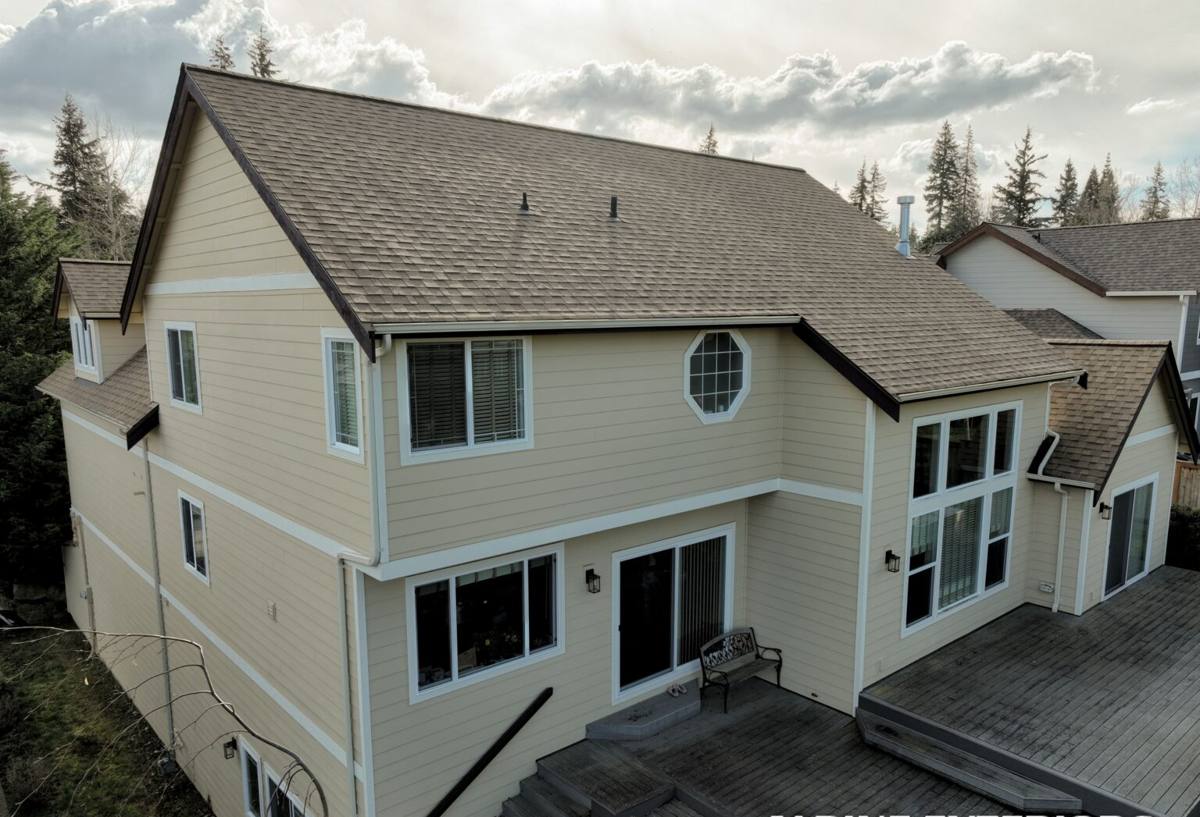
Signs an Edgemoor Roof Is Due for Replacement
Roofs rarely fail all at once. In this climate, the warning signs tend to show up gradually, and homeowners often live with them longer than they should because nothing is leaking yet.
- Granule loss showing up in gutters or at downspout discharge points
- Shingles that are cupping, curling at the edges, or losing their flat profile
- Moss or algae streaking that keeps coming back within a season or two of cleaning
- Soft or spongy spots underfoot when walking the roof deck (a sign of trapped moisture)
- Rusting or deteriorating flashing around chimneys, vents, and valleys
- Daylight visible through the attic roof deck, or damp insulation below it
- A roof that's approaching or past the manufacturer's expected service life for its material
If you're seeing two or more of these, it's worth having someone look at the whole system rather than patching the symptom you happened to notice.
Why Repairs Stop Making Sense
Repairs make sense when the underlying roof system is sound and the problem is localized — a cracked boot, a lifted shingle, a damaged flashing detail. Once moss has been established for multiple seasons, or granule loss is widespread rather than isolated, the roofing material itself has usually degraded past the point where patching buys much time. In a climate this wet, a roof that's failing broadly rather than at one spot is usually telling you it's time to replace rather than keep chasing individual leaks.
What a Correct Roof Replacement Involves Here
A roof replacement done right in this part of Whatcom County is more than removing old material and nailing down new shingles. The details underneath the surface layer are what actually determine how the roof performs through wet Pacific Northwest winters.
Tear-Off and Deck Inspection
We remove the existing roofing down to the deck rather than layering over it. That's the only way to actually see what's underneath — soft spots, rot, or deck damage from long-term moisture intrusion don't show up until the old material is off. Any compromised sheathing gets replaced before anything new goes down; new shingles over a bad deck just hides the problem.
Underlayment and Ice/Water Barrier
Given how much rain this area sees, underlayment isn't a formality — it's the roof's real waterproofing layer, with the shingles acting as the first line of defense on top of it. We use synthetic underlayment for coverage and durability, and we install self-adhering ice-and-water membrane at vulnerable spots: eaves, valleys, and around every roof penetration, where wind-driven rain is most likely to find a way in.
Flashing Done Properly
Most roof leaks that show up years later trace back to flashing, not the field shingles. Chimneys, skylights, sidewalls, and valleys all need flashing that's properly integrated with the underlayment and the siding or wall covering above it — not just caulked over the top. In salt air, we also pay attention to flashing material choice, since some metals corrode faster than others this close to the water.
Ventilation
A roof deck that can't breathe traps moisture from inside the house, which accelerates rot from below even if the roofing surface above is in good shape. We check that intake and exhaust ventilation are balanced and adequate for the attic space — this is a step that's easy to skip and hard to notice is missing until problems show up years later.
Material Options for Edgemoor Homes
There's no single "best" roofing material for every home — it depends on the roof's pitch, the home's style, budget, and how much maintenance the homeowner wants to take on. Here's how the common options stack up for this specific climate.
| Material | Moss/Moisture Resistance | Maintenance | Typical Lifespan |
|---|---|---|---|
| Architectural asphalt shingle | Good with proper ventilation and periodic cleaning | Low to moderate | 25–30 years |
| Standing seam metal | Excellent — sheds moisture and resists moss growth | Low | 40–50+ years |
| Synthetic/composite shake | Good, more consistent than wood in this climate | Low to moderate | 30–40 years |
| Cedar shake | Requires diligent upkeep in a wet, shaded climate | High | 20–30 years with upkeep |
We don't push cedar shake in heavily shaded, moisture-prone settings like parts of Edgemoor as a first recommendation — not because it's a bad product, but because it demands a level of ongoing maintenance (cleaning, treating, monitoring) that a lot of homeowners don't want to sign up for long-term. If a homeowner wants that look and is prepared for the upkeep, we'll install it correctly. Our default recommendation is whatever material fits the budget and roofline while keeping long-term maintenance realistic for how the home actually sits on its lot.
Cost Factors for an Edgemoor Roof Replacement
Roof replacement pricing depends on real, specific factors rather than a flat per-square rate, and we'd rather walk a homeowner through what drives cost than quote a number that doesn't hold up once we're on the roof.
- Roof size and complexity — square footage, plus the number of valleys, dormers, and penetrations
- Pitch and accessibility — steeper roofs and limited access (common on sloped or wooded Edgemoor lots) affect labor
- Tear-off scope — how many existing layers need to come off, and deck condition underneath
- Material choice — asphalt, metal, and composite options carry different material and installation costs
- Flashing and ventilation work — how much needs to be replaced or upgraded, not just reused
- Deck repair — any rotted or damaged sheathing found during tear-off
We give a firm, itemized quote after an on-roof inspection — not a guess from the street or a satellite photo. That's the only way to price this accurately, and it protects the homeowner from surprise add-ons mid-project.
Our Process, Start to Finish
- On-site inspection — we walk the roof, check the attic, and assess deck, flashing, and ventilation condition
- Written estimate — a clear scope of work and pricing, with material options explained honestly
- Scheduling — timed around weather windows, since a roof tear-off needs a reasonably dry stretch to do right
- Tear-off and deck repair — old material removed, deck inspected, any damaged sheathing replaced
- Underlayment, flashing, and ventilation — the details that determine long-term performance
- New roofing installation — installed to manufacturer specification for full warranty coverage
- Final walkthrough and cleanup — site cleared, debris removed, and the finished roof reviewed with the homeowner
Why a Local Crew Matters in Edgemoor
Roofing crews that only pass through the Bellingham area occasionally don't build the same working knowledge of how this specific microclimate treats a roof. A crew that regularly works Edgemoor and the surrounding Whatcom County neighborhoods has already seen how salt air affects fastener and flashing choices, how shaded lots hold moisture longer after a storm, and how local permitting and inspection processes actually work — none of which shows up on a spec sheet.
There's also a practical accountability angle: a local, established crew is going to be reachable next year and the year after if a warranty question comes up. That matters more on a roof than on almost any other part of a home, since roofing problems are often invisible until they've already caused damage.
Maintaining an Edgemoor Roof After Replacement
A new roof still needs a small amount of ongoing attention in this climate to hit its full expected lifespan.
- Keep gutters and downspouts clear so water isn't backing up under the roof edge
- Have moss growth addressed early, before it works under shingle edges
- Trim back overhanging branches that keep sections of the roof shaded and damp
- Schedule a periodic visual inspection, especially after major windstorms off the bay
- Address any flashing or sealant issues promptly rather than waiting for a visible leak
None of this is complicated, but skipping it is how a well-installed roof loses years off its expected life in a climate this wet.
If your Edgemoor roof is showing its age or you're just not sure how much life it has left, we're happy to take a look. We'll give you a straight assessment and a free, no-pressure estimate — use the form below to get started.